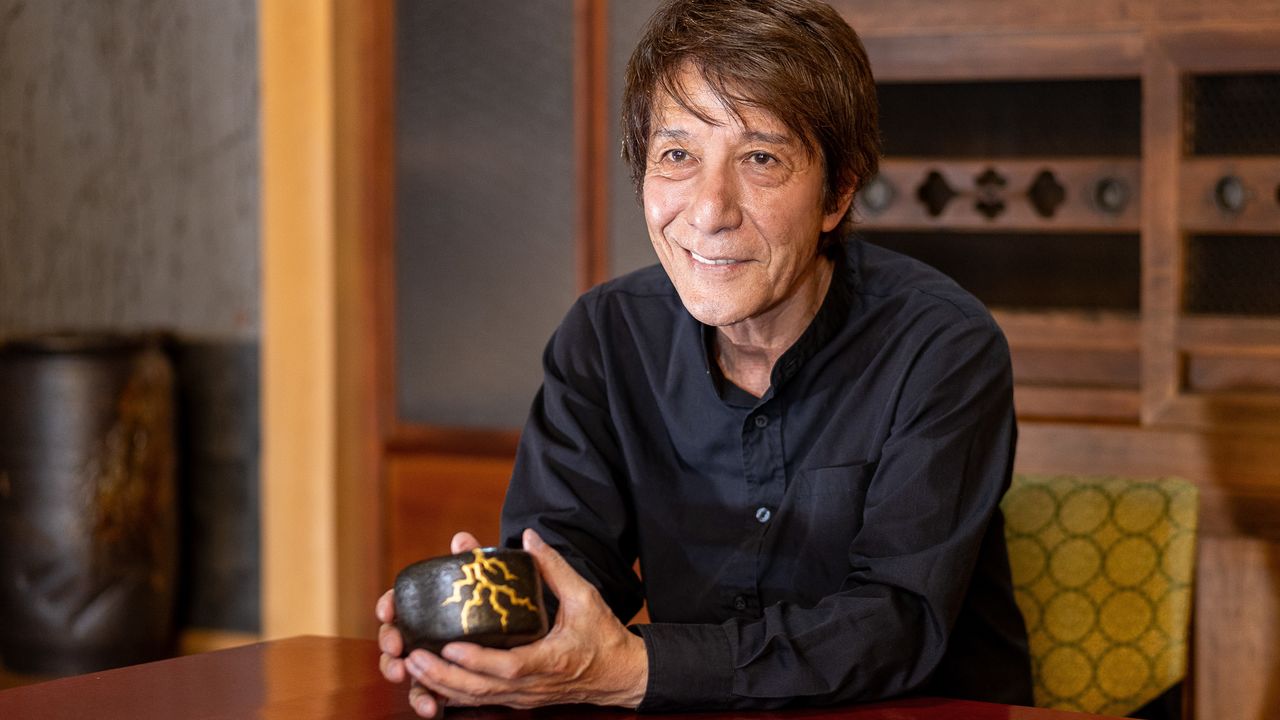
Japanese lacquer restoration artist Suezaki Hiroki, born in Osaka in 1957, apprenticed in lacquer arts after high school and became an independent restoration specialist in 1985, working on cultural properties at shrines, temples, and museums across Japan. In 2014 he opened a workshop in Kyoto and began offering kintsugi classes the following year, aiming to make traditional handwork visible and relevant to daily life.
Kintsugi repairs broken ceramics with lacquer adhesive and decorates the seams with gold, silver, or platinum, treating cracks as part of an object's story rather than flaws to hide. Suezaki's approach includes experimental designs, such as gold lines resembling chandelier ornaments on a 250-year-old porcelain vessel and a reshaped wineglass rim turned into a droplet motif.
During the COVID-19 pandemic the BBC featured Suezaki as a leading kintsugi master, and in March 2024 the term "kintsugi" was added to the Oxford English Dictionary, reflecting its international reach. Suezaki founded the nonprofit Role in 2021 to support artisan culture, arguing that mass production alone cannot sustain the value of one-of-a-kind handmade items and that skills must be used daily to survive.
A turning point came in 2022 when Suezaki lectured in Vatican City during events marking 80 years of Japan-Holy See diplomatic relations. He demonstrated kintsugi and presented Bakōro, a collaborative incense burner shaped like a horse created with ceramic artist Mori Reiji using the nearly lost tōtai shikki technique of lacquer, makie, and mother-of-pearl on a ceramic core. The Vatican Museums acquired the piece in 2023.
Since then Suezaki has lectured at institutions in Rome, Faenza, Venice, Lugano, London, and Oxford, and in 2024 began teaching a special lacquer restoration course at a school in Venice to train overseas conservators. In Japan he has taught classical kintsugi classes in Tokyo and Kyoto since 2015, with around 250 students to date, and hosted nearly 600 foreign workshop participants in 2025.
Suezaki says he now wishes to devote more time to creation and restoration itself while his hands and eyes remain sharp, alongside his outreach work. He continues to restore pieces such as a statue of the 17th-century merchant-poet Uda Kinnori held by Myōkōji temple in Kyoto.
The article notes that kintsugi's philosophy — that breaks begin a new, richer chapter — underpins Suezaki's effort to ensure artisan culture endures for future generations.
Kintsugi and the Art of Embracing Imperfection: Suezaki Hiroki’s Vision for Artisan Renewal
This is an independent summary. The complete reporting, supporting context and any primary documents remain with Nippon.com.