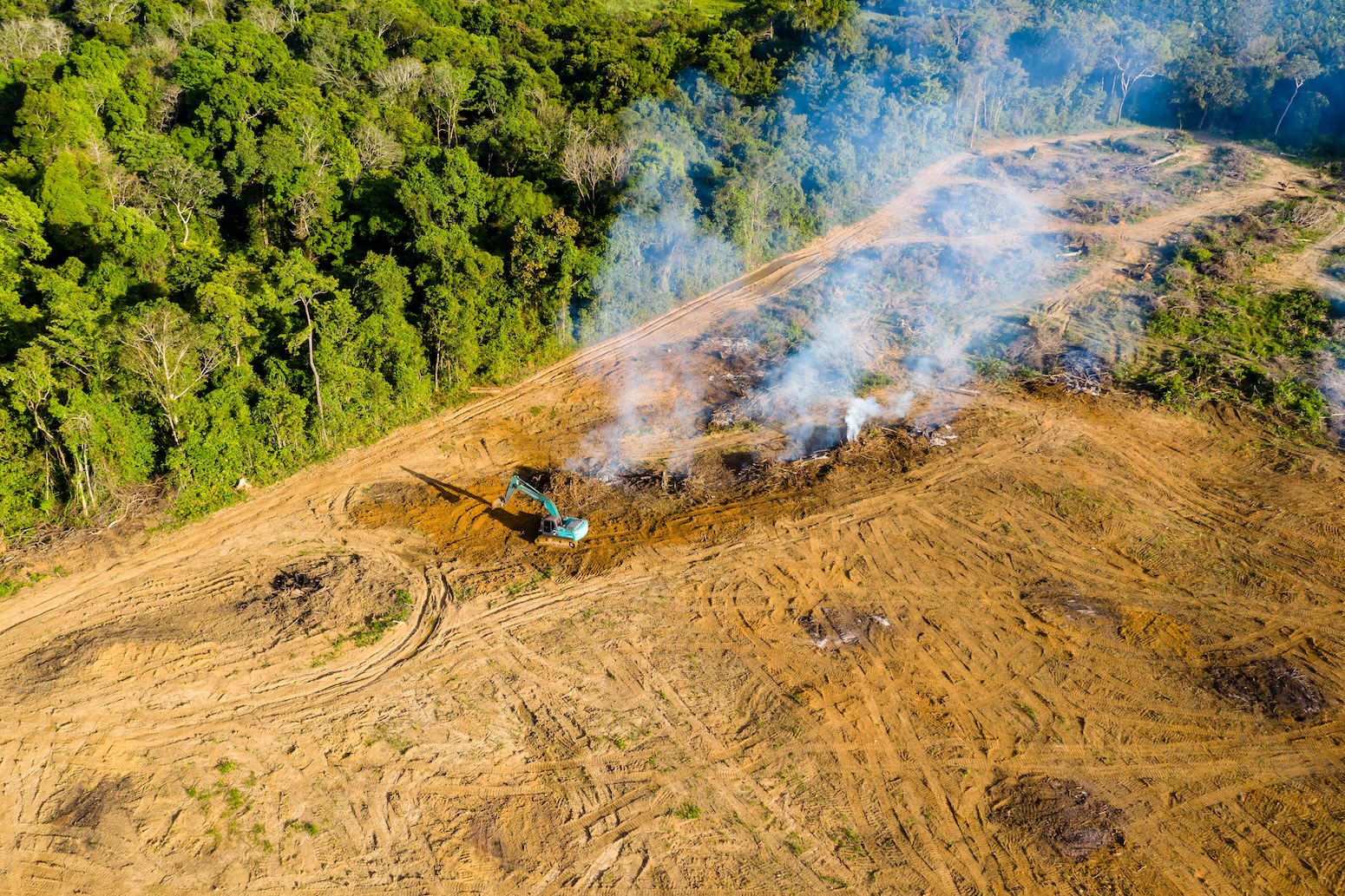
Emissions from land-use change — including deforestation, peatland drainage and forest degradation — have fallen by about one-third since the early 2000s, according to the latest Global Carbon Budget report published in Earth System Science Data. The report finds a "statistically significant decrease" in net land-use emissions since the late 1990s, with a "steep drop" after 2015. Average annual emissions for 2015–24 were 5 billion tonnes of CO2 (GtCO2), 23% lower than the 1995–2004 average and 19% lower than 2005–14. Preliminary data for 2025 show a further decline to 4.1 GtCO2, while fossil-fuel and cement emissions reached a new high of 38.1 GtCO2.
The decline is attributed mainly to reduced permanent deforestation — the complete clearing of forest for agriculture, mining or urban expansion — and to increasing carbon removals from forest regrowth. Over 2015–24, reforestation and afforestation offset two-thirds of deforestation emissions: deforestation emitted an average 6.96 GtCO2 per year, while forest growth removed 4.76 GtCO2. Just under half of those removals came from deliberate afforestation and reforestation; the rest came from forest recovery after shifting cultivation.
Brazil, the Democratic Republic of the Congo (DRC) and Indonesia together accounted for 57% of global land-use emissions in 2015–24. The long-term global decline has been driven primarily by falling deforestation in Brazil, where a 2004 action plan, a 2006 soy moratorium and expanded protected areas reversed a 1990s peak. Brazil's deforestation rate in the legal Amazon has trended downward despite political fluctuations.
Indonesia has accelerated the global decline over the past decade by rewetting more peatland area since 2017 than Europe has in its entire history, and by experiencing fewer uncontrolled fire spikes linked to land-use drainage. In contrast, DRC emissions have remained high, driven by population growth and expanding smallholder farming rather than export-oriented agriculture, making international trade regulations less effective there.
China, the European Union and the United States lead carbon removals from reforestation and afforestation, collectively sequestering 1.1 GtCO2 per year over 2015–24. China's large-scale programs since the 1990s have rehabilitated tens of millions of hectares, turning its land sector from a carbon source into a sink. Significant removals also occur in Brazil, Russia and Indonesia, but in those countries deforestation emissions still dominate the net balance.
The Global Carbon Budget estimates an uncertainty range of 2.6 GtCO2 per year for the 2015–24 average — more than half the central estimate — because land-use emissions are derived from three models (BLUE, OSCAR and LUCE) that differ in how they represent processes such as peat fire, shifting cultivation and wood harvest. Researchers caution that the recent drop in 2025 partly reflects the end of El Niño conditions, which dry tropical peatlands and exacerbate fires, and that future trends depend on whether current land policies persist.
Why land-use emissions have fallen by a third this century – in six charts
This is an independent summary. The complete reporting, supporting context and any primary documents remain with Carbon Brief.