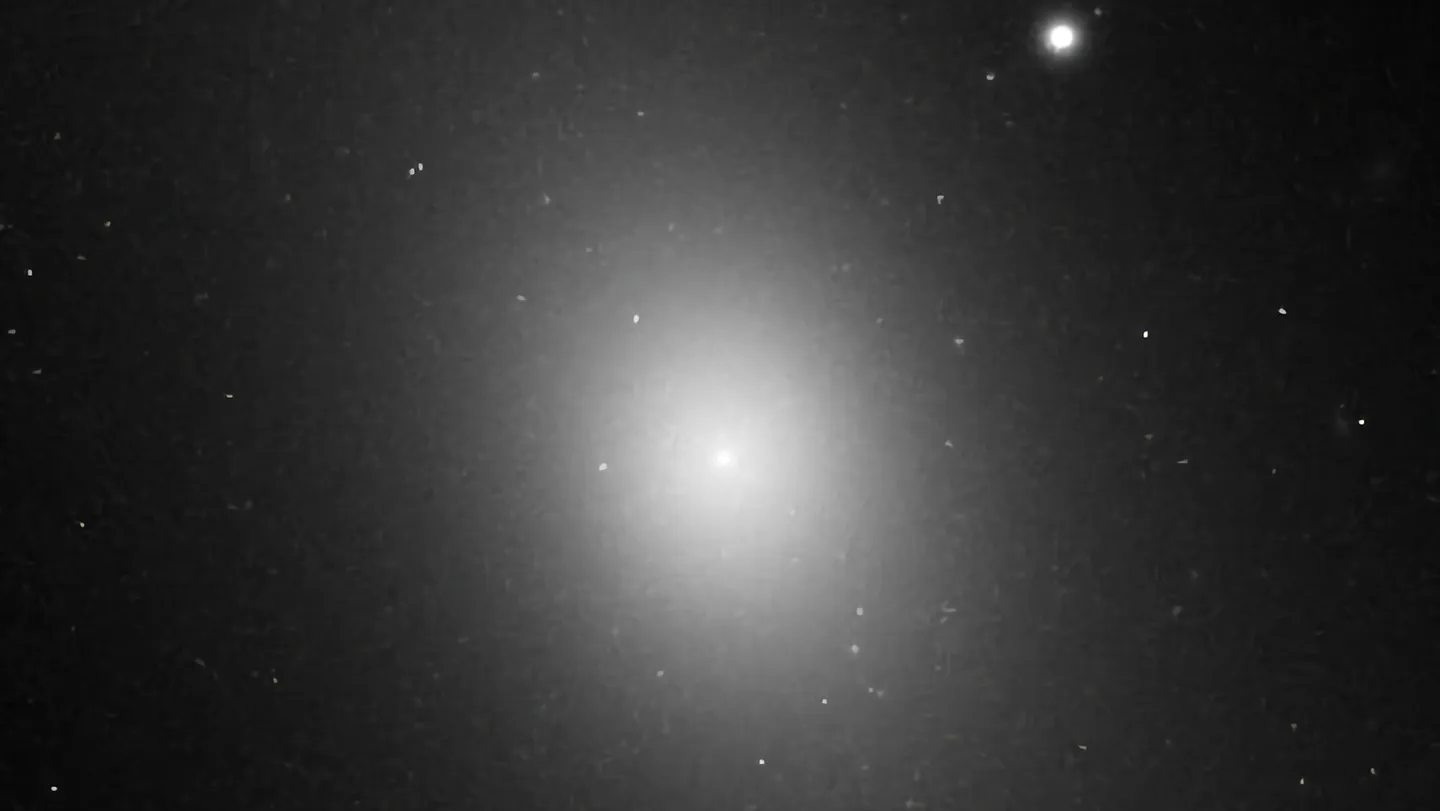
Astronomers have confirmed that the elliptical galaxy IC 1101 is the largest known galaxy, with a diameter of approximately 520 kiloparsecs, or nearly 1.7 million light-years. The finding comes from a study submitted to arXiv.org on July 16 that analyzed the deepest images ever taken of the galaxy. Those images were captured in 2022 by the Isaac Newton Telescope at the Roque de los Muchachos Observatory on La Palma in the Canary Islands.
The ultra-deep exposures allowed researchers to identify the galaxy's faint outer edge for the first time, distinguishing it from the diffuse material of the surrounding Abell 2029 galaxy cluster. The galaxy contains roughly 3.4 trillion solar masses of stellar material. Previous studies had indicated IC 1101 was massive but could not precisely determine where the galaxy ended and the cluster environment began.
Located over a billion light-years away, IC 1101 sits at the heart of the Abell 2029 cluster and is classified as a brightest cluster galaxy. These systems are known to grow through repeated mergers with smaller neighboring galaxies, a process known as galactic cannibalism. The new images reveal taillike features extending from IC 1101's edges, which researchers interpret as evidence of ongoing mergers.
Astrophysicist Carlos Marrero de la Rosa of the Instituto de Astrofísica de Canarias in Tenerife, Spain, said the galaxy is still accreting material and has not finished growing. He described IC 1101 as an example of what happens when galactic evolution through repeated merging reaches extreme levels over time, calling it "a kind of galaxy of the future."
The study, led by Marrero de la Rosa and colleagues, is titled "How large can galaxies be? Ultra-deep imaging of IC 1101, the most extended known galaxy" and appears on arXiv.org with the identifier 2607.15340.
The largest known galaxy is wider than 17 Milky Ways
This is an independent summary. The complete reporting, supporting context and any primary documents remain with Science News.