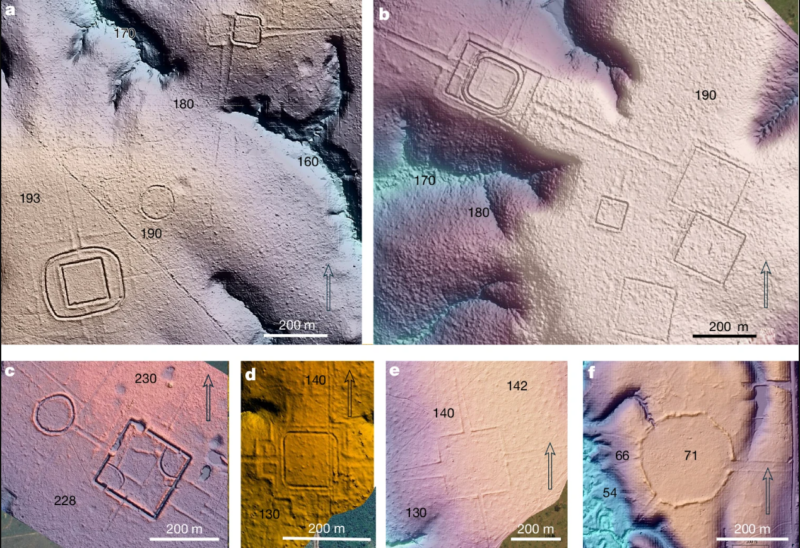
Airborne laser scanning, known as lidar, has identified hundreds of geometric earthworks hidden beneath the Amazon rainforest canopy. The survey covered areas in Brazil, Bolivia, Colombia and Peru, revealing a network of roads, plazas, fortified villages and agricultural terraces.
The structures date from roughly 1,500 to 500 years ago, predating European contact. Their scale and distribution indicate a level of social organization and landscape modification far greater than previously documented in the region.
Researchers combined the lidar data with archaeological ground-truthing and demographic modeling to estimate the population that could have been sustained by the observed infrastructure. The upper bound of their model suggests the civilization may have supported around three million people at its peak.
Earlier assumptions held that the Amazon was sparsely populated by small, nomadic groups before 1492. The new findings challenge that view, showing instead a densely settled, engineered landscape with sophisticated water management and food production systems.
The earthworks include geometric enclosures, causeways and raised fields that required coordinated labor and planning. Their presence across multiple modern national borders points to a shared cultural tradition or interconnected societies spanning a vast area.
Deforestation and agricultural expansion have already damaged or destroyed some of the newly identified sites. Researchers emphasize that lidar allows rapid, non-invasive documentation before further loss occurs.
The study was conducted by an international team of archaeologists, geographers and remote-sensing specialists. Their results have been submitted for peer-reviewed publication, and the underlying data will be made available for further analysis.
While the population estimate carries uncertainty due to limited excavation data, the physical extent of the earthworks provides concrete evidence of large, settled communities. Future fieldwork aims to refine the chronology and understand the social and environmental dynamics of these ancient Amazonian societies.
Ancient Amazon civilization might have been home to millions
This is an independent summary. The complete reporting, supporting context and any primary documents remain with EarthSky.