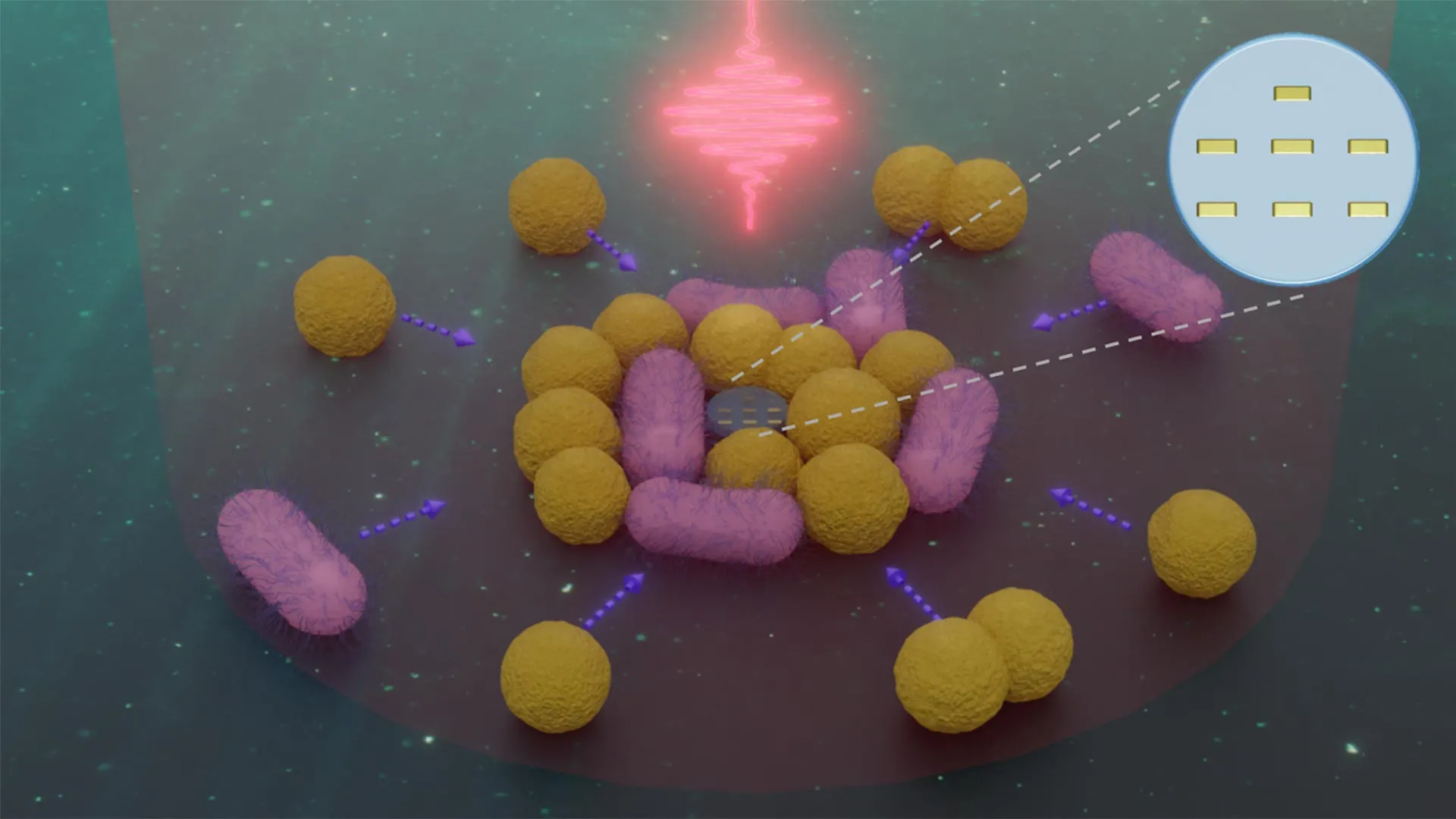
Scientists at Julius-Maximilians-Universität Würzburg have developed nanorobots smaller than one micrometer that can navigate liquid environments, capture bacteria, and release them at designated spots. The devices are roughly 50 times smaller than the diameter of a human hair, allowing them to operate at the scale of individual microbes.
Propulsion comes from photon recoil: each nanorobot carries up to four plasmonic nanoantennas that absorb light of a specific color and helicity, then re-emit it in a preferred direction. The resulting recoil forces, though minute, produce substantial acceleration because of the robots' extremely low mass.
Steering is achieved by rotating the polarization of the illuminating light. Nanoscale antenna wires built into each robot naturally align with the polarization direction, so changing that polarization reorients the device while photon recoil continues to push it forward. The system enables rapid 90-degree turns and organized scanning of a sample area.
In laboratory demonstrations, the nanorobots selectively captured substantial numbers of bacteria, transported them, and deposited them at chosen locations. The robots remained maneuverable while carrying larger bacterial clusters, although their speed decreased under the added load.
Lead experimental scientist Jin Qin described the devices as light-driven nanorobots that can track down and collect bacteria, functioning like microscopic cleaning tools. Professor Bert Hecht noted that the work shows how light can be used not only to observe but also to actively shape the microscopic world.
The research was published in Nature Communications on August 18, 2026. The authors caution that the experiments were conducted under controlled laboratory conditions and that further work is needed to assess performance in more complex environments.
Tiny robots powered by light can hunt down and collect bacteria
This is an independent summary. The complete reporting, supporting context and any primary documents remain with ScienceDaily.