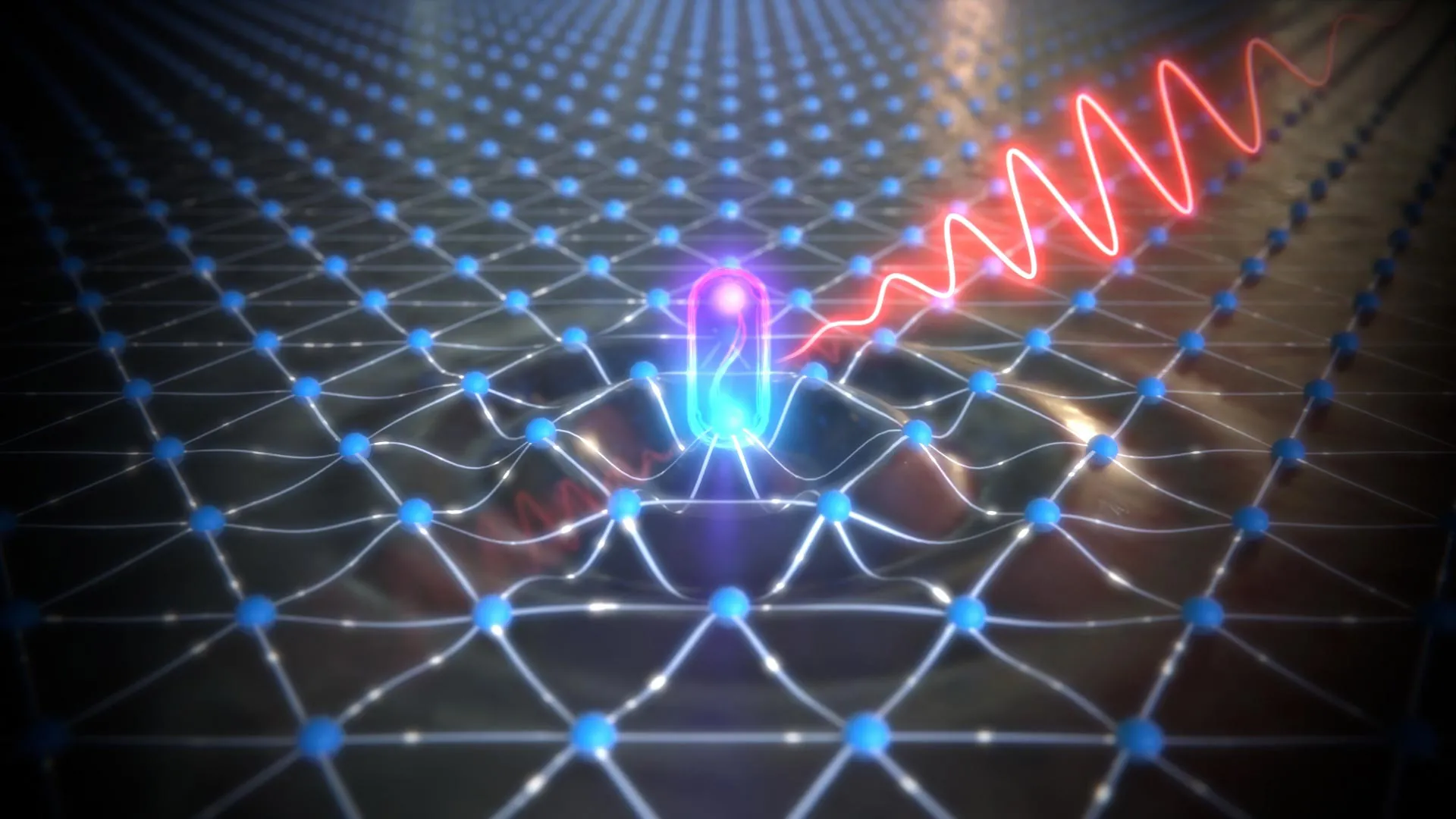
Researchers at the University of Basel and the Technical University of Munich have developed a way to watch the internal dynamics of a Wigner crystal, a quantum state in which electrons arrange themselves into a repeating lattice through their own mutual repulsion. The team cooled an atomically thin layer of tungsten diselenide to a few degrees above absolute zero and illuminated it with light. By analyzing the reflected light, they detected optical signatures that had not been seen before.
Those signals arise from hybrid quasiparticles the authors call Wigner crystal polarons. They form when optically generated excitons — bound pairs of electrons and holes — couple to the collective motion of the ordered electrons. The polarons act as sensitive probes that reveal both the crystal's structure and the way its electrons move in concert.
First author Lujun Wang said the measurements show that light can do more than confirm the crystal's existence; it can expose how the state behaves internally. Professor Tomasz Smoleński, who led the experimental group, described the technique as a powerful new tool for studying collective excitations in electronic crystals that are otherwise extremely difficult to access.
The strength of the electron–electron interactions shapes the observed optical features, linking the signals directly to the underlying many-body physics. A theoretical team led by Professor Michael Knap at the Technical University of Munich developed a model that explains how the Wigner crystal polarons form through the coupling of excitons with the crystal's collective modes.
Doctoral researcher Fabian Pichler noted that the signals carry information about the quantum dynamics of the electrons, not just their static arrangement. This connection allows experimental observations to be tied directly to the many-body interactions that drive the system's behavior.
The work demonstrates that atomically thin semiconductors can serve as a platform for probing the hidden motion inside ordered quantum states. Making these dynamics experimentally accessible may help researchers build a deeper understanding of strongly correlated matter, where macroscopic properties emerge from the interplay of many interacting particles.
The study was published in Nature Physics.
A strange crystal made of electrons just revealed its hidden motion
This is an independent summary. The complete reporting, supporting context and any primary documents remain with ScienceDaily.