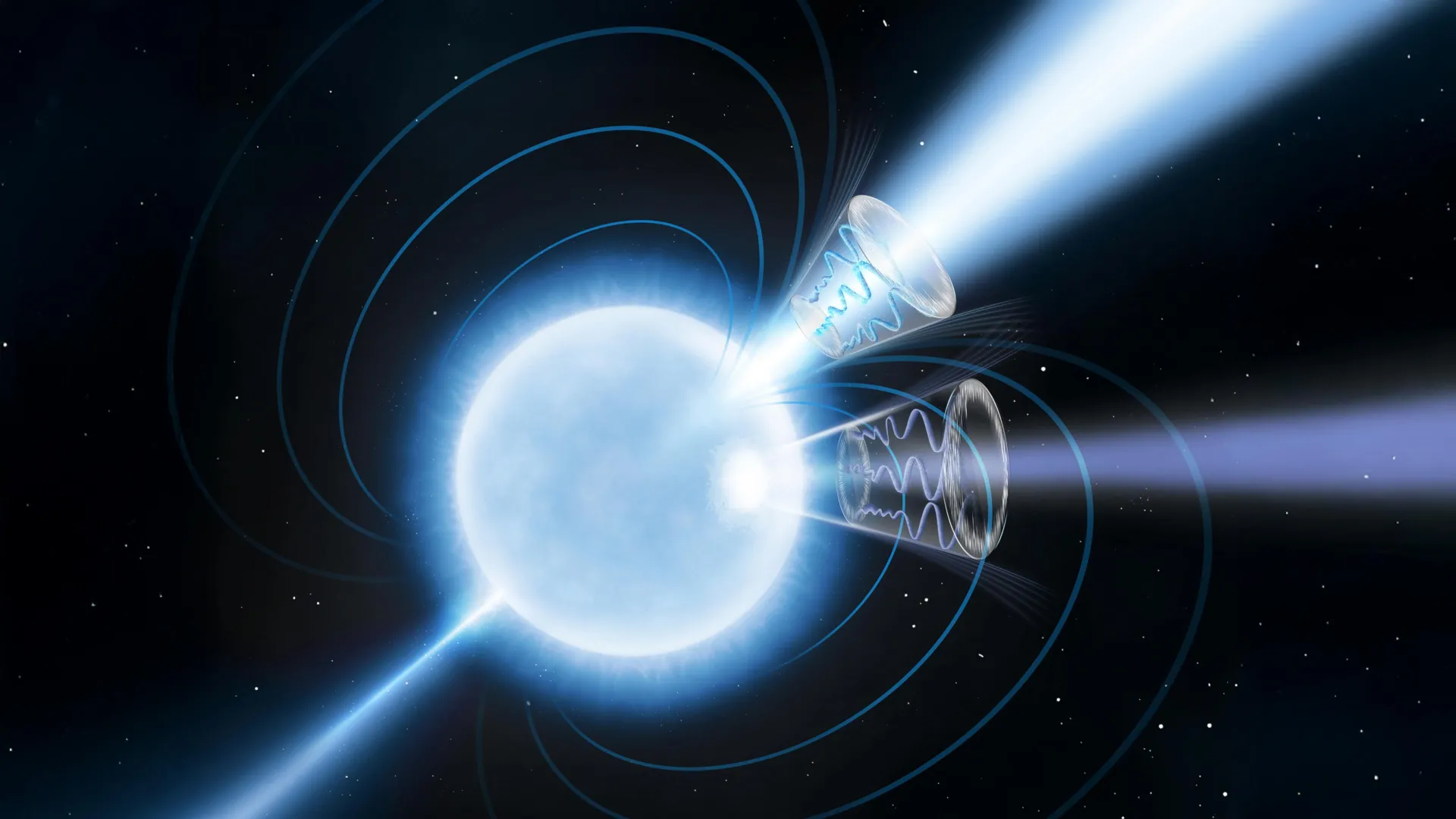
Astronomers studying the magnetar 1E 1547.0-5408 have reported what may be the first direct detection of vacuum birefringence, a quantum electrodynamics effect predicted by Werner Heisenberg in the 1930s. The phenomenon holds that a perfect vacuum contains virtual particles that can be aligned by an extremely strong magnetic field, altering the polarization of light passing through it. Magnetars, neutron stars with magnetic fields over a trillion times stronger than Earth's, provide the only known natural laboratories where this effect could become observable.
The research team, including Dr. Marcus Lower from Swinburne University of Technology, used NASA's Imaging X-ray Polarimetry Explorer (IXPE) to measure X-ray polarization from the magnetar. Supporting data came from the NICER X-ray telescope on the International Space Station and the Murriyang radio telescope operated by CSIRO in Australia. Radio observations collected by Dr. Lower and processed on Swinburne's Ngarrgu Tindebeek supercomputer helped establish the magnetar's geometry.
The magnetar's magnetic and rotational axes are nearly aligned, and it is viewed from a nearly pole-on perspective. This geometry gives researchers an unusually clear view for testing vacuum birefringence. IXPE detected extremely high X-ray polarization levels of 40% and 80% from two emission regions, and the polarization direction tracked the magnetic field orientation in the same way seen in the radio data.
According to Dr. Lower, the strong magnetic field aligns the virtual particles predicted by Heisenberg, causing the observed polarization behavior. The coherent variation of polarization across the magnetar's 2.1-second rotation period matches theoretical expectations for vacuum birefringence. The findings were published in Nature.
The researchers caution that the interpretation is not yet confirmed. Additional observations and more advanced computer simulations are needed to distinguish the quantum signature from other physical processes around the magnetar. Dr. Lower said future data and updated simulations may finally complete the quest begun nearly 90 years ago.
Scientists may have finally proved that “empty” space isn’t really empty
This is an independent summary. The complete reporting, supporting context and any primary documents remain with ScienceDaily.