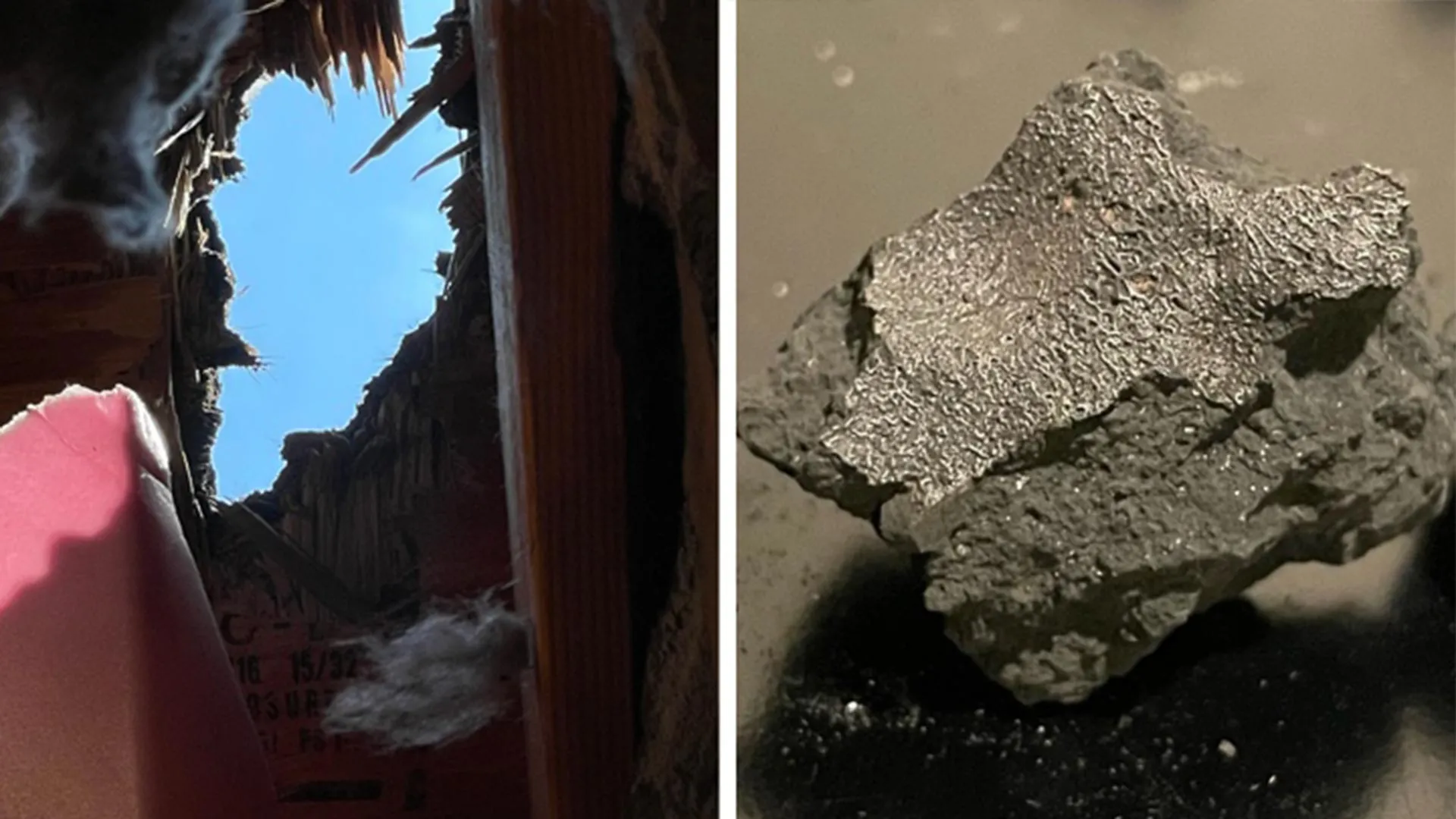
A meteorite weighing more than two pounds punched through the roof of a home in Hillsborough, New Jersey, on July 16, 2024, after a daytime fireball was seen across the New York City area and tracked by cameras in Connecticut, Pennsylvania and New Jersey. The homeowner collected fragments within hours using gloves and aluminum foil, preserving the material from contamination. Laboratory analysis identified the rock as a CM1/2 carbonaceous chondrite, a rare intermediate type between the more common CM2 and the scarcely seen CM1 classes; only 22 CM-type falls have been witnessed, and this is just the second CM1/2 fall ever recorded.
Researchers led by Peter Jenniskens of the SETI Institute and NASA Ames found that parts of the meteorite experienced more extensive water alteration on its parent asteroid than typical CM2 chondrites. Mike Zolensky and JangMi Han at NASA's Johnson Space Center discovered small CM1 fragments rich in salt minerals, indicating the material originated near the asteroid's surface where liquid water evaporated and left concentrated brines. The team is now identifying the specific salts to compare them with those found in samples returned from asteroids Ryugu and Bennu by the Hayabusa2 and OSIRIS-REx missions.
The meteorite contains 1.8 percent carbon and 0.07 percent nitrogen by weight, with isotope ratios typical of CM-type chondrites. A broad range of soluble organic compounds was detected, including numerous amino acids similar to those seen in moderately altered CM2 meteorites. Phil Schmitt-Kopplin of the Technical University of Munich noted a high fraction of compounds appear to be products of organic-mineral chemistry, though it remains unclear whether magnesium-organometallic compounds formed through brine chemistry or earlier impact shock processes.
Astrobiologist Danny Glavin and colleagues at NASA's Goddard Space Flight Center concluded that CM-type bodies could have delivered amino acids, carboxylic acids and other soluble organics to early Earth, potentially contributing to the prebiotic inventory before life emerged. Their analysis indicates the meteorite's complex amino acid suite formed inside the parent asteroid, with briny fluids likely driving at least some of that synthesis. Concentrated brines can keep phosphate dissolved and promote reactions between organics and precipitating minerals, conditions relevant to the emergence of biological molecules.
Fragments of the Hillsborough meteorite will be curated by the American Museum of Natural History in New York for future study. Denton Ebel, the museum's curator, described the fall as a precious asteroid sample delivered to scientists' doorstep. The findings were published in Science Advances by an international team of more than 40 researchers from institutions in the United States, Japan, England, Germany and Switzerland.
Meteorite that smashed through a New Jersey roof reveals clues to life’s origins
This is an independent summary. The complete reporting, supporting context and any primary documents remain with ScienceDaily.