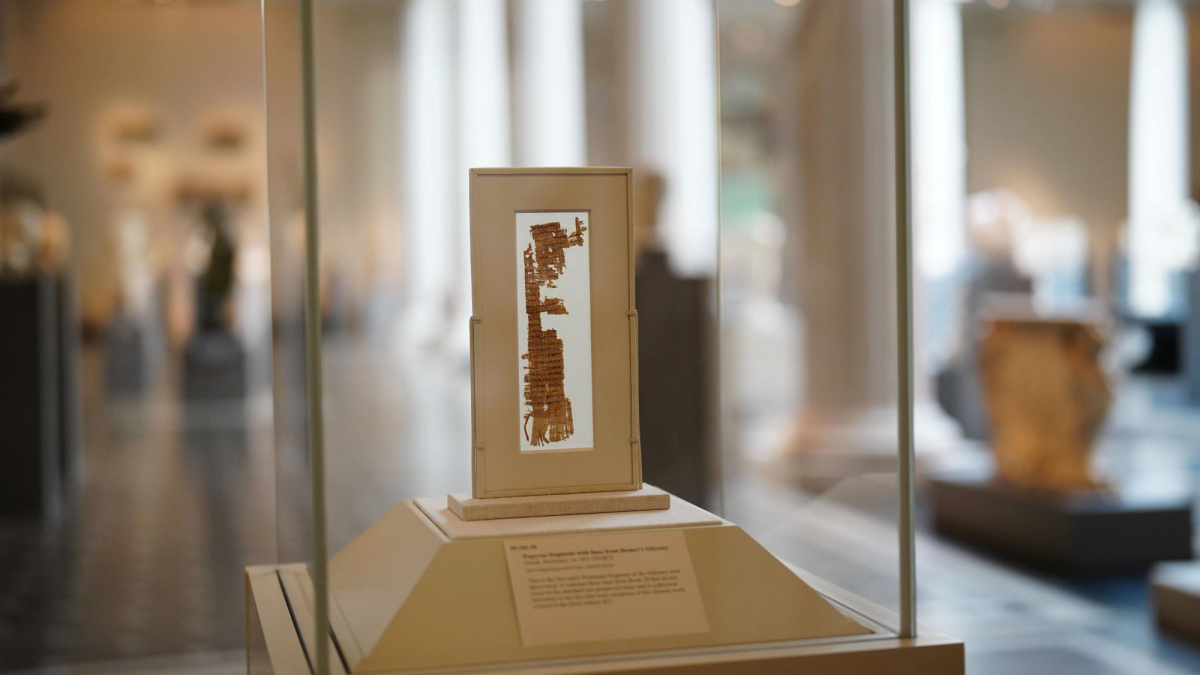
The Metropolitan Museum of Art in New York City has returned to public view the earliest known fragment of Homer's "Odyssey," a papyrus scrap dating to the third century BCE. The fragment was discovered in 1902 at Hibeh, Egypt, and acquired by the museum in 1909. It represents the first known early Ptolemaic fragment of the epic poem.
Scholars generally believe the "Iliad" and "Odyssey" were composed between the eighth and mid-seventh centuries BCE and written down by the mid-sixth century BCE. Before that, bards recited the poems orally across the Greek world, producing many variant versions.
The Met's fragment contains three lines that differ from the standard text of the "Odyssey" known today. Séan Hemingway, the museum's curator of Greek and Roman art, said the variations illustrate how oral poets embellished and altered the stories in different performances.
The papyrus sheet, made from woven papyrus stalks, shows its construction clearly on the reverse side. Hemingway noted that it is rare to have such an early book fragment where both sides are visible, revealing the weave pattern of the material.
During the third century BCE, Egypt was ruled by the Macedonian Ptolemaic dynasty, which founded the city of Alexandria and its great library. That library became the Hellenistic world's largest collection of Homeric texts, providing the context for this fragment's creation.
The fragment had been off view for many years before its recent reinstallation in the museum's Greek and Roman galleries. Its display offers a tangible link to the poem's transmission from oral tradition to written text.
No new scientific analysis or conservation treatment was announced with the reinstallation. The significance lies in the object's age, its textual variants, and its physical evidence of early book production.
The Met has not indicated how long the fragment will remain on display. Light-sensitive papyrus objects are typically rotated to prevent damage.
Oldest known ‘Odyssey’ fragment on display in New York City
This is an independent summary. The complete reporting, supporting context and any primary documents remain with Popular Science.