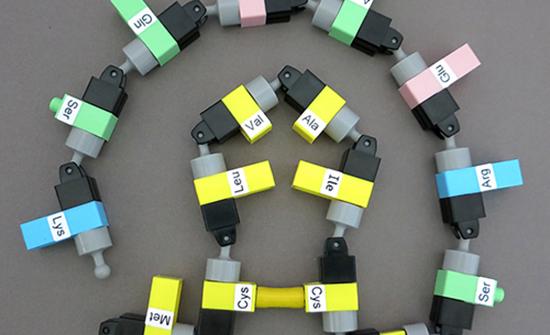
The MIT Edgerton Center has expanded its hands-on molecular biology curriculum from a single museum classroom to every biology classroom in Worcester Public Schools, the second-largest district in Massachusetts. The rollout includes 55 class sets of DNA, RNA, protein, and tRNA modeling kits, along with instructional booklets and districtwide professional development for all biology teachers, funded by a grant from the Massachusetts Life Sciences Center.
The curriculum was developed by Kathy Vandiver, the Edgerton Center's life science project leader, who holds a PhD in cellular biology. Her approach reverses the traditional teaching sequence: students first build and manipulate protein structures to understand their form and function, then trace the DNA-to-RNA-to-protein pathway using genes that code for the proteins they have already constructed.
Vandiver argues that teaching the central dogma — DNA makes RNA, RNA makes proteins — without first explaining what proteins are is like handing students blueprints for a building they have never seen. The manipulable models use color-coded, tactile pieces that snap together, with yellow subunits representing hydrophobic regions to activate existing student schemas.
The materials were refined over years at the MIT Museum's "Learning Lab: The Cell" gallery, where Vandiver and collaborator Amanda Gruhl Mayer taught more than 1,000 students from middle school through AP biology, as well as nurses, biotech executives, and federal judges. That experience showed the curriculum works best when students work in pairs with a molecular build set and participate in role-playing demonstrations of cellular processes.
Previous outreach efforts could not scale because teachers were trained individually. Worcester solved this by training its entire cohort of biology teachers at once, creating a sustainable districtwide program. Science curriculum specialist David Mangus, who first encountered the materials at a Massachusetts Association of Science Teachers conference, championed the adoption after becoming the district's curriculum specialist.
At a recent training in Rapid City, South Dakota, the district's 2025 Teacher of the Year, Ross Hunter, noted the models' value as non-technology-based tools at a time when education may be swinging back toward less screen-dependent classrooms. Vandiver frames the philosophy with a quote attributed to Confucius: "I hear and I forget. I see and I remember. I do and I understand."
The Edgerton Center will present the molecular biology sets at the National Association of Biology Teachers Conference in Dallas this October, aiming to expand the proteins-first approach nationally. The curriculum represents three key reversals: making proteins the focus instead of DNA, replacing screens and memorization with physical models, and starting at the functional endpoint so the molecular pathway becomes comprehensible.
Flipping the script on biology education, and scaling it up
This is an independent summary. The complete reporting, supporting context and any primary documents remain with MIT News.