MIT physicists have identified two fundamentally different ways that electronic phases can emerge within the same quantum material. The study, published in Nature Physics, examined erbium tritelluride, a rare-earth compound that hosts two charge density waves — organized, wave-like patterns of electron density — at low temperatures.
When cooled to about -8 degrees Celsius, a dominant charge density wave appears along one direction in the material. At roughly -113 degrees Celsius, a second, subdominant wave forms perpendicular to the first, creating an atomic-scale checkerboard pattern. Researchers led by Nuh Gedik, the Donner Professor of Physics at MIT, wanted to understand how each phase forms and recovers after being disrupted.
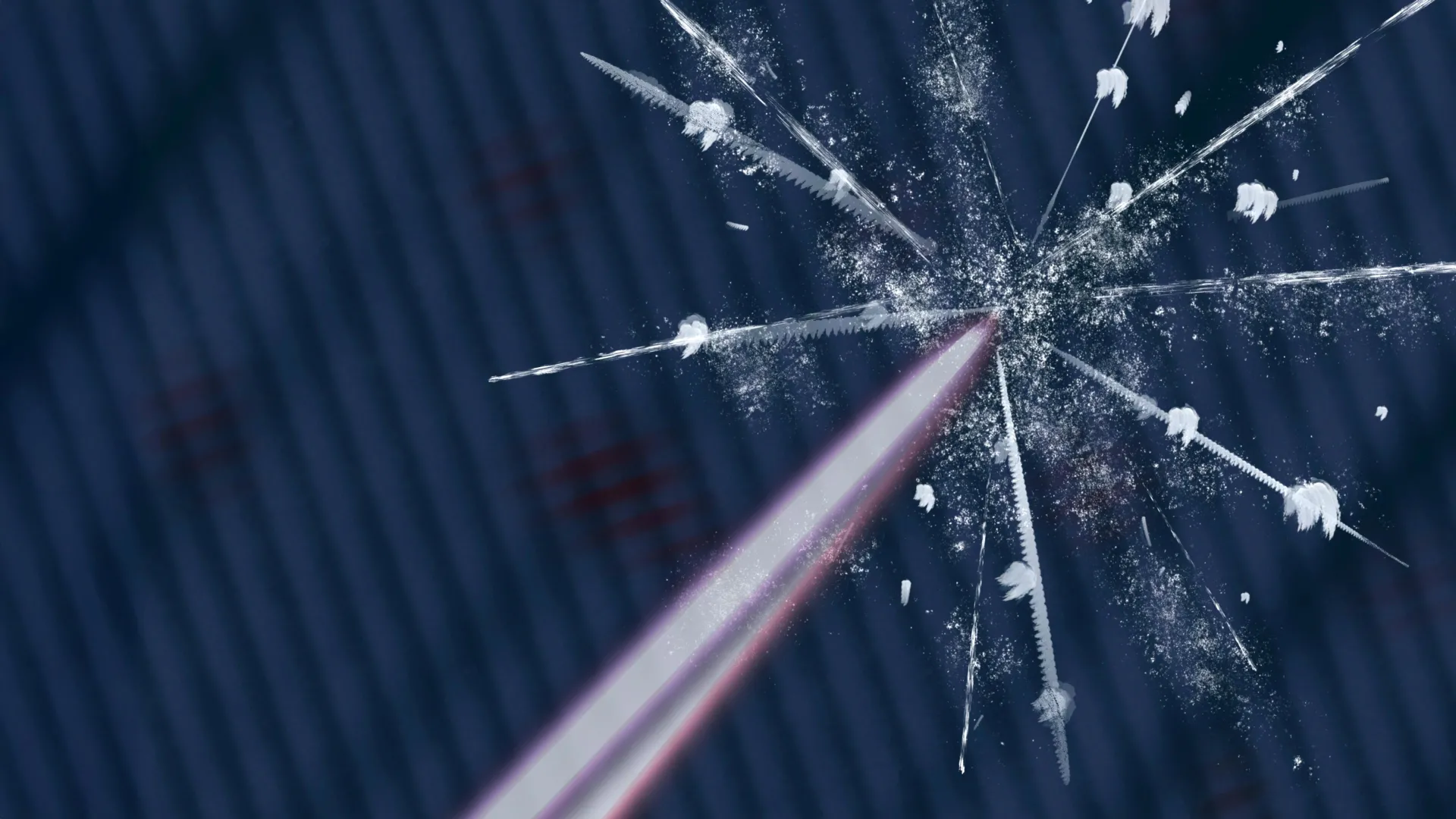
The team cooled atomically thin samples to approximately -230 degrees Celsius, where both waves coexist. They then used a two-pulse laser technique: an initial "pump" pulse broke apart the electronic checkerboard, and a delayed "probe" pulse ejected electrons from the material. By measuring the energy and momentum of those photoemitted electrons at varying time intervals, the researchers captured snapshots of how each phase rebuilt itself.
The dominant wave returned gradually and uniformly across the sample, a behavior consistent with a conventional second-order phase transition. This smooth recovery occurred regardless of how strongly the initial laser pulse had disturbed the system.
The subdominant wave behaved differently. Instead of reappearing evenly, it nucleated in isolated pockets that then expanded outward through the material. This growth pattern resembles the way ice crystals form and spread in liquid water, and it corresponds to a first-order phase transition. The mechanism behind this second transition had been debated, and the experiment provides direct evidence for the nucleation-and-growth process.
Lead author Yifan Su, who completed the work as an MIT graduate student, noted that charge density waves are simpler collective electron states than superconductivity, making them useful model systems. Co-author Alfred Zong, now an assistant professor at Stanford University, said the ability to disentangle multiple coexisting phases could help researchers understand more complex quantum materials such as high-temperature superconductors, where magnetism, superconductivity, and charge density waves all interact.
The research was supported by the U.S. Department of Energy, the U.S. National Science Foundation, and the Gordon and Betty Moore Foundation's EPiQS Initiative. Collaborators included researchers from Stanford University and other institutions.
MIT physicists discover electrons rebuilding like ice inside a quantum material
This is an independent summary. The complete reporting, supporting context and any primary documents remain with ScienceDaily.