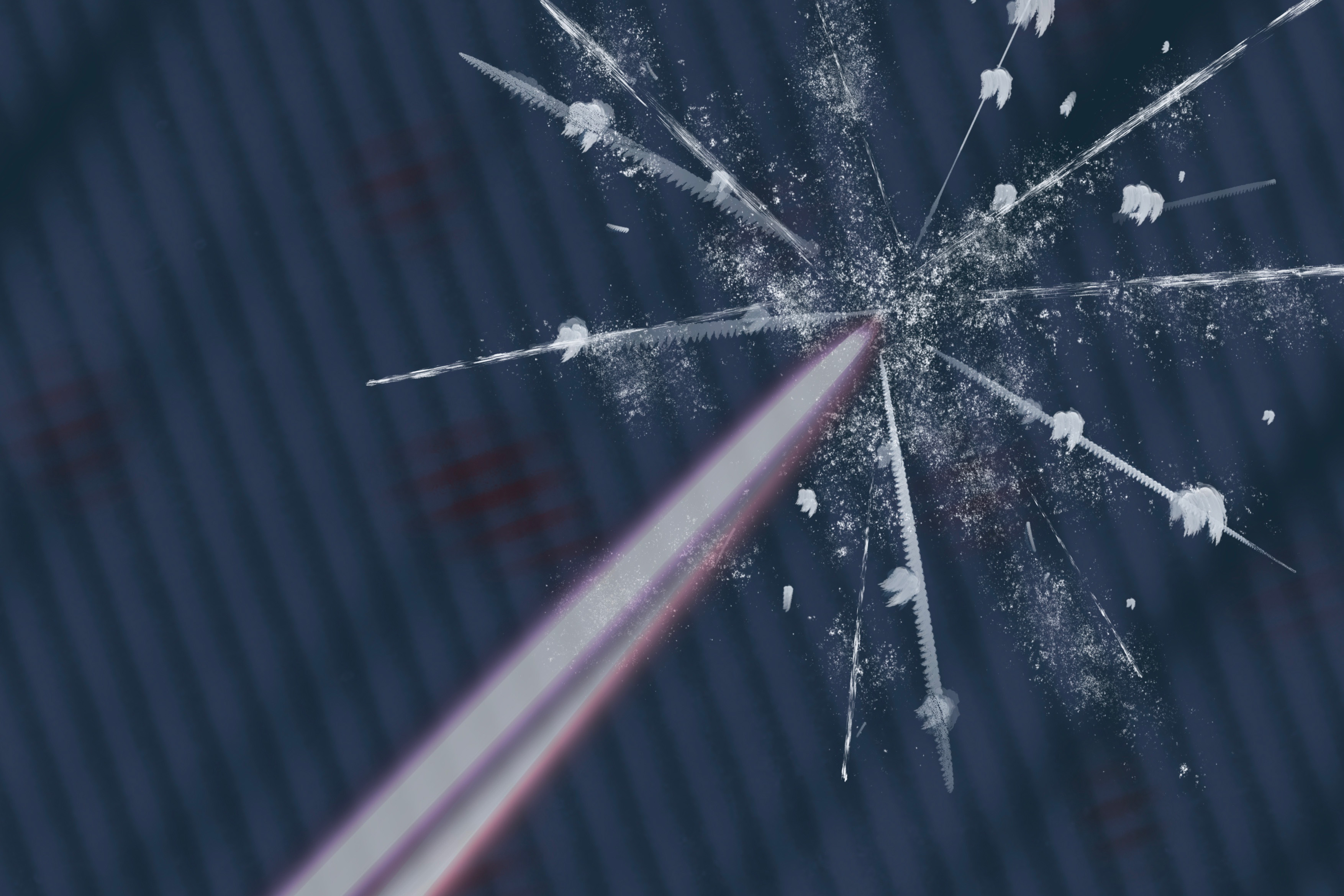
MIT physicists have directly observed how two different charge density waves emerge and coexist in the quantum material erbium tritelluride, finding that each follows a fundamentally different transition mechanism. The study, published in Nature Physics, used ultrafast laser pulses to disrupt and then track the recovery of electronic phases in atomically thin samples cooled to about -230 degrees Celsius.
At higher temperatures, erbium tritelluride's electrons are uniformly distributed. When cooled to roughly -8 degrees Celsius, they organize into a dominant charge density wave — a periodic modulation of electron density — extending in one direction. Further cooling to about -113 degrees Celsius produces a second, subdominant wave perpendicular to the first, creating a checkerboard pattern of coexisting electronic orders.
To study how these phases form, the researchers used a pump-probe technique: an initial laser pulse melted the checkerboard pattern, and a delayed high-energy probe pulse ejected electrons whose energy and momentum revealed the phases' recovery. The dominant wave reemerged gradually and uniformly regardless of the initial disturbance, consistent with a textbook second-order phase transition.
The subdominant wave, however, reappeared through a first-order transition: electrons assembled into isolated pockets that expanded like ice crystals forming in water. This nucleation-and-growth mechanism had been debated but not directly observed in such materials.
The team, led by MIT physics professor Nuh Gedik and including first authors Yifan Su and Bai-Qing Lv, says the ability to distinguish these mechanisms in a relatively simple system provides a test case for understanding more complex quantum materials where superconductivity, magnetism, and charge density waves intertwine.
The work was supported by the U.S. Department of Energy, the National Science Foundation, and the Gordon and Betty Moore Foundation's EPiQS Initiative.
Physicists watch a material’s electrons assemble, and reassemble, into coexisting phases
This is an independent summary. The complete reporting, supporting context and any primary documents remain with MIT News.