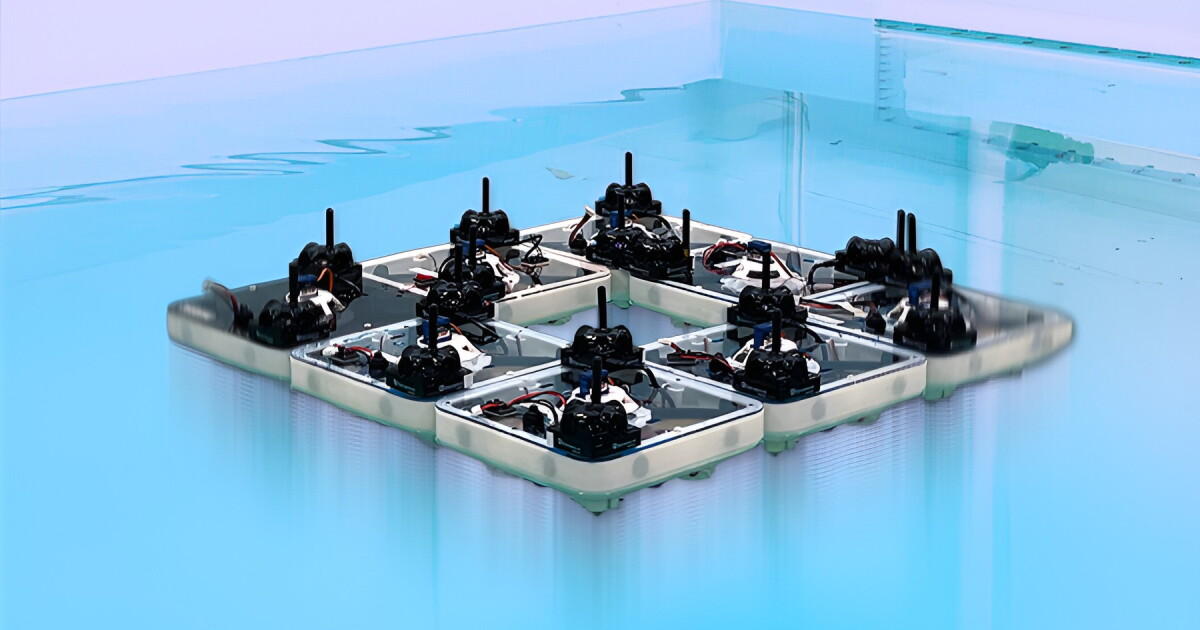
Researchers at MIT's Computer Science and Artificial Intelligence Laboratory have developed FloatForm, a fleet of self-propelled robotic tiles that autonomously assemble into floating platforms of varying shapes. Each tile measures 21 by 21 centimeters and uses magnetic latches, onboard sensors, and thrusters to connect with neighbors up to 15 centimeters away.
The system employs a hybrid coordination framework that assigns each robot a target position in the final structure while delegating navigation, collision avoidance, and adaptation to local interactions. In simulations, 64 units moved simultaneously without a central coordinator, reducing bandwidth bottlenecks and single-point-of-failure risks.
Lead author Wei Wang, now head of the Marine Robotics Lab at the University of Wisconsin–Madison, describes the approach as turning static water surfaces into dynamic, programmable spaces. Co-author Carlo Ratti, director of MIT's Senseable City Lab, previously deployed human-scale autonomous "Roboats" on Amsterdam's canals for transport and waste collection.
The design draws inspiration from fire-ant colonies, which link their bodies to form floating rafts and bridges using simple decentralized rules. FloatForm units similarly gain stability by latching together, allowing them to withstand waves and currents better than individual robots.
Current prototypes are too small for open-water deployment; ripples in a test tank pose challenges that would be magnified in rivers or oceans. Scaling up will require mechanically reinforced or interlocked latches, larger power systems, and GPS or visual sensing for localization.
The research team envisions future applications including emergency bridges, floating markets, performance stages, environmental monitoring platforms, and temporary shelter. The open-access findings were published in Nature Communications with co-authors Niklas Hagemann, Alejandro Gonzalez-Garcia, and Carlo Ratti.
Gonzalez-Garcia notes that any city with rivers, canals, or coastal waterways — such as Venice, the Netherlands, Belgium, or Norwegian fjords — could eventually use such modular aquatic infrastructure. The work aims to expand usable public space onto underutilized water surfaces in dense urban areas.
Robotic tiles autonomously Lego-snap into floating smart structures
This is an independent summary. The complete reporting, supporting context and any primary documents remain with New Atlas.