Researchers at MIT's Computer Science and Artificial Intelligence Laboratory (CSAIL) and Tsinghua University have introduced GeoPT, a pre-training approach that helps AI models simulate a wider range of physical scenarios more efficiently. Current simulation models rely on numerical solvers to calculate physical properties across 3D shapes, a thorough but time-consuming process that limits the amount of training data available for tasks such as testing vehicle aerodynamics.
GeoPT uses what the team calls "synthetic dynamics" — 1.3 million samples of tiny spheres moving at various speeds and angles until they contact and stick to complex 3D shapes. These particle interactions give the model a foundational sense of how physics works before it trains on labeled data, similar to learning physical intuition by watching marbles interact with objects.
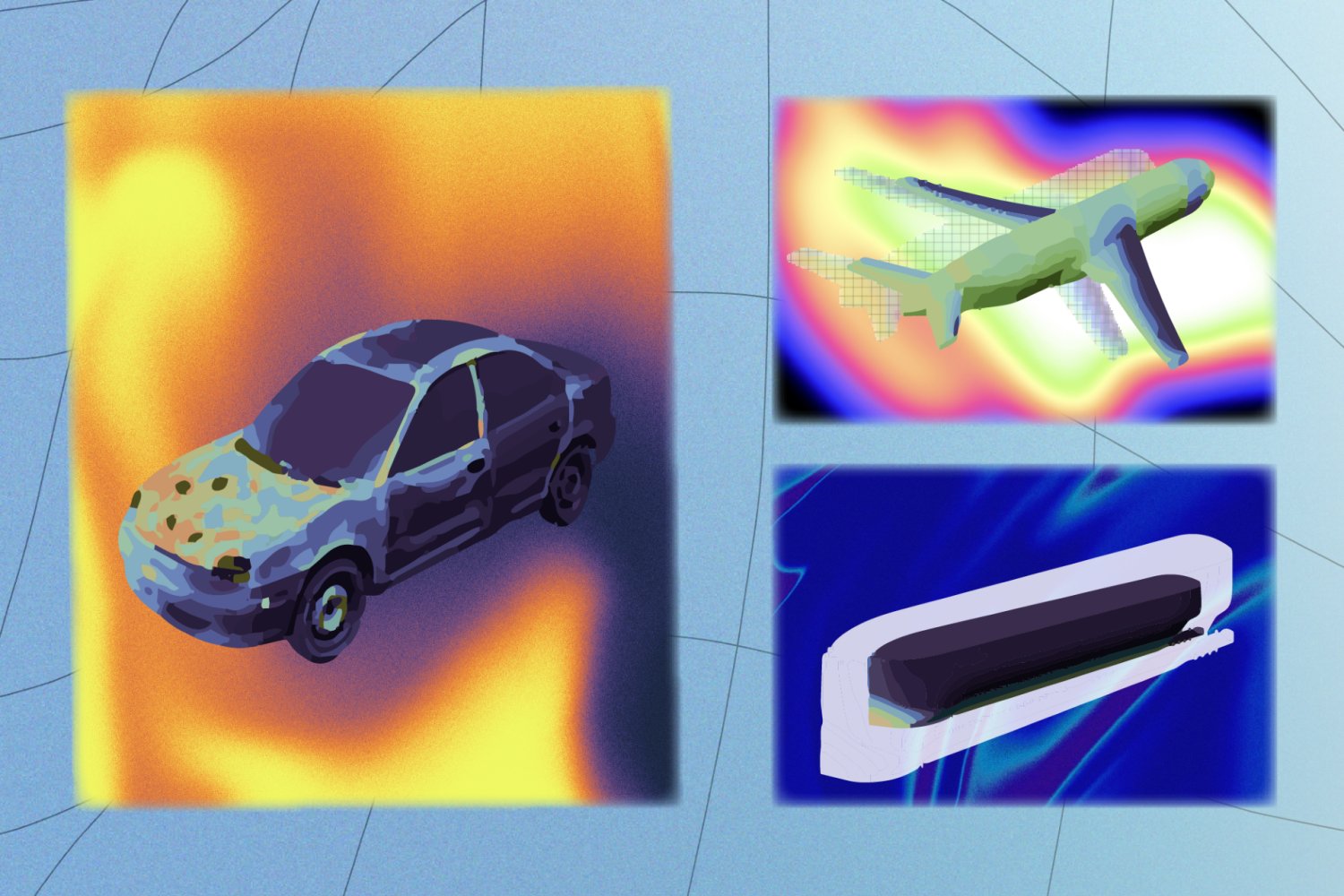
Users upload 3D models of objects such as vehicles or containers and specify the direction and speed of forces like wind, water, or collisions. The system produces a heat-map-style visualization showing how the object responds across its surface, enabling rapid simulation of scenarios including car crashes, light transport, and boat hulls in turbulent waves.
In benchmark tests, GeoPT outperformed state-of-the-art simulation models on industrial tasks. It surpassed leading baselines in speed, accuracy, and efficiency on datasets involving complex 3D shapes responding to wind currents and surface pressure, and achieved similar gains simulating fighter jets in wind. For a boat hull facing both air and waves, GeoPT reached peak accuracy four times faster while using 60 percent less labeled data.
The model also correctly predicted how various car designs deform in collisions using less data than baselines, and accurately simulated light passing through a toy rabbit shape despite never training on that geometry or light physics. Co-lead author Haixu Wu, an MIT postdoc and CSAIL researcher, noted the system performs high-fidelity simulations with over 100 million mesh points in seconds.
The researchers view GeoPT as a step toward a physics foundation model — a backbone system trained on large-scale data that can generalize across tasks. Co-lead author Minghao Guo, an MIT PhD student and CSAIL researcher, described physics as the third modality for AI after text and pixels. The team aims to scale the system to more shapes and complex phenomena such as weather patterns, material testing, and realistic video generation.
The work was presented at the International Conference on Machine Learning in July. Authors include MIT CSAIL researchers Zongyi Li, Zhiyang (Frank) Dou, Kaiming He, and senior author Wojciech Matusik, along with Tsinghua University Associate Professor Mingsheng Long. Support came in part from Neural Modular Physics Twin for Robotics.
With a feel for physics, AI models simulate a wider range of real-world scenarios
This is an independent summary. The complete reporting, supporting context and any primary documents remain with MIT News.