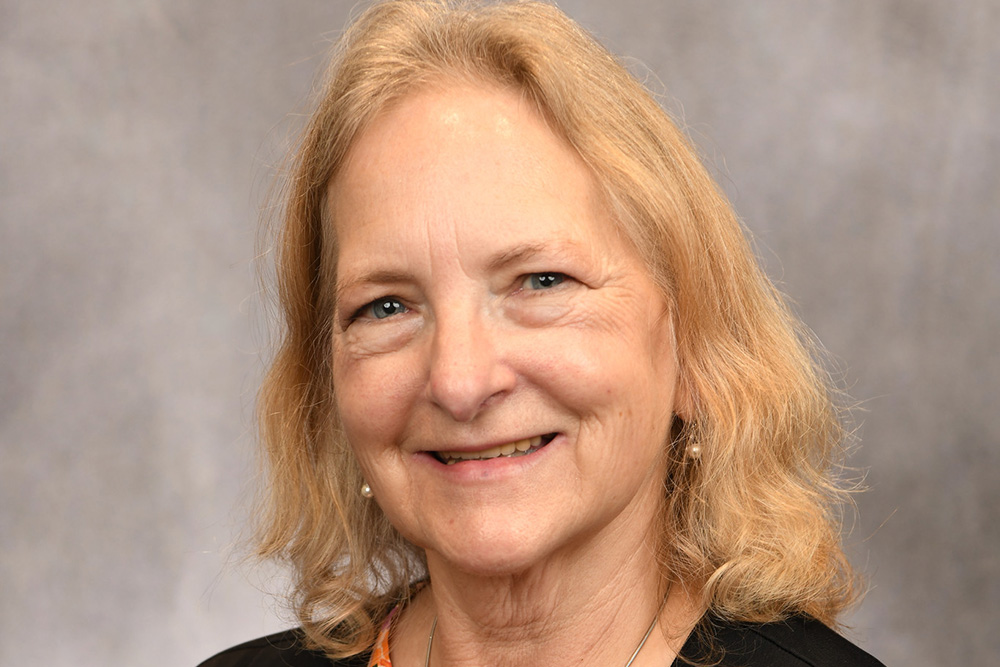
MIT Haystack Observatory principal research scientist Anthea J. Coster received the 2026 Appleton Prize from the International Union of Radio Science (URSI) at its General Assembly in Krakow, Poland, on August 16. The prize recognizes career achievements and outstanding contributions to ionospheric physics, citing Coster's pioneering research in Global Navigation Satellite System (GNSS) science and development of techniques for global-scale views of storm responses in the ionosphere.
Coster joined MIT in 1984 at Lincoln Laboratory, where she worked on satellite tracking and was introduced to the Global Positioning System (GPS). She later moved to Haystack's geospace and atmospheric science group, becoming a principal research scientist in 2012 and serving as assistant director from 2015 to 2024. Her research spans the physics of the ionosphere, magnetosphere, and thermosphere, with particular expertise in GNSS positioning and measurement accuracy.
Among her breakthrough contributions, Coster developed the first real-time GNSS ionospheric monitoring system and pioneered monitoring of tropospheric water vapor using GNSS signals. She was also responsible for the first GNSS observations of storm-enhanced density, a significant ionospheric feature spanning the continental United States that affects the Federal Aviation Administration's Wide Area Augmentation System for GPS navigation.
Haystack Observatory director Phil Erickson noted that Coster's application of GNSS signals to create precise global maps of total ionospheric electron density has produced scientific output that anchors multi-sensor fusion techniques at the forefront of near-Earth space weather research. Her data products, including total electron content and scintillation measurements, are widely used by the research community through NSF's CEDAR Madrigal database and the Millstone Hill Geospace Facility.
Coster has authored or co-authored more than 200 peer-reviewed publications and served as principal investigator on numerous federal grants from NASA, the National Science Foundation, the Office of Naval Research, and the Air Force Office of Scientific Research. She has held leadership positions with the U.S. chapter of URSI, the Institute of Navigation, and the American Geophysical Union, and currently serves on the U.S. National Academies Space Weather Roundtable.
Her outreach efforts include deploying radio instrumentation with MIT graduate students in Brazil and Peru, presenting talks to students in Rwanda and Zambia, and installing GNSS receivers in Inuit villages and along Alaska's remote Steese Highway. She has also taught UN-sponsored GNSS workshops for workforce education in disadvantaged countries.
Coster earned her undergraduate degree from the University of Texas at Austin and her master's and doctorate from Rice University, where she conducted ionospheric experiments at the Arecibo Observatory. With this award, Haystack Observatory now hosts three URSI prize recipients, joining former director John Evans (Appleton Prize, 1975) and research scientist Alan Rogers (John Howard Dellinger Gold Medal, 2008).
Anthea Coster awarded International Union of Radio Science Appleton Prize
This is an independent summary. The complete reporting, supporting context and any primary documents remain with MIT News.