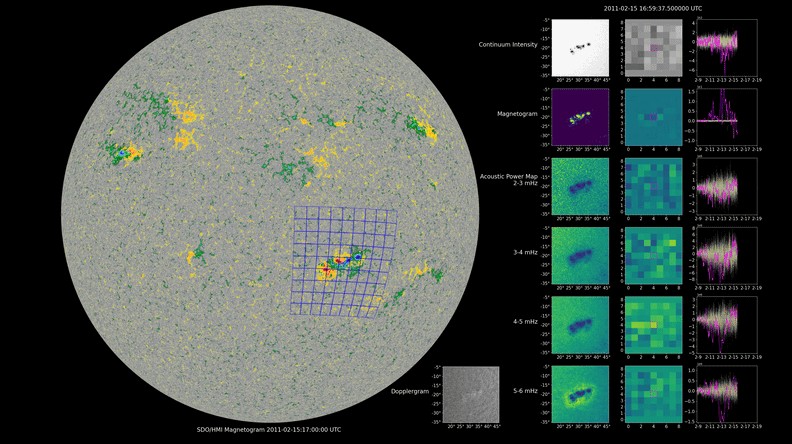
Researchers with NASA's COFFIES (Consequence Of Fields and Flows in the Interior and Exterior of the Sun) program have developed a machine-learning model that predicts the emergence of active regions on the Sun up to 12 hours before they become visible.
Active regions are concentrations of intense magnetic fields that break through the solar surface, forming sunspots that serve as the primary sources of solar flares and coronal mass ejections.
These eruptions release high-energy radiation and charged particles that can endanger astronauts, damage satellites, and disrupt radio communications on Earth.
The model analyzes data from the Sun's interior to identify signatures that precede the appearance of active regions on the surface.
Current space weather forecasting relies on observing sunspots after they have already formed, limiting warning time for protective measures.
The COFFIES team combined expertise in astrophysics and data science to train the model on solar dynamics observations.
NASA's Solar Dynamics Observatory continues to provide the extreme ultraviolet imagery that captures solar flares and active region evolution.
The advance represents a shift toward predictive capability rather than reactive monitoring for space weather events.
NASA’s COFFIES Uses AI to Predict Storm-Causing Active Regions on Sun
This is an independent summary. The complete reporting, supporting context and any primary documents remain with NASA.