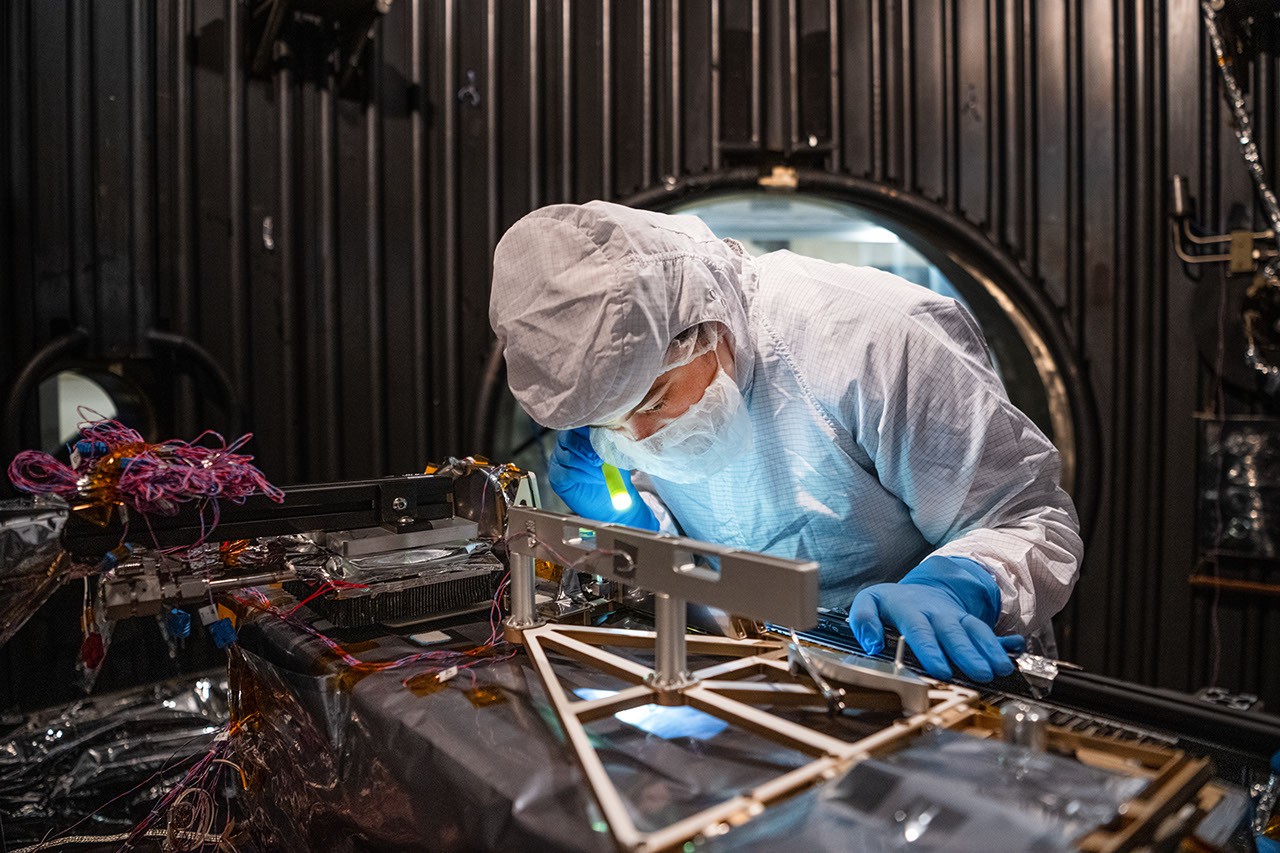
NASA has completed hardware development and testing on the Lunar Environment Monitoring Station (LEMS), the first science payload designed for Artemis astronauts to deploy on the Moon's surface. The instrument suite, built at NASA's Goddard Space Flight Center in Greenbelt, Maryland, is now ready for assignment to a future Artemis mission targeting the lunar South Pole.
LEMS contains two highly sensitive seismometers intended to monitor ground vibrations from moonquakes and meteorite impacts. The data will provide insights into the Moon's interior structure and help assess seismic hazards for astronauts operating on the surface. The payload builds on the Apollo-era seismic network, which operated on the nearside equatorial region from 1969 to 1977 and recorded approximately 13,000 seismic events.
The station is roughly the size of a small suitcase and weighs 11 pounds in lunar gravity. It is designed to operate autonomously for years after deployment, managing its own power via a flexible solar array and maintaining a stable internal temperature through the extreme day-night cycles at the South Pole, where temperatures can drop to minus 400 degrees Fahrenheit.
Unlike previous lunar instruments that relied on radioisotope heaters, LEMS uses advanced insulation, low-thermal-conductivity cables, and a thermal regulator to survive the two-week lunar night without external heat sources. The system also handles its own operational scheduling and monthly data transmission to Earth.
The payload's modular design allows it to be adapted or expanded with new instruments in the future, creating a reusable platform for evolving scientific priorities. Principal investigator Mehdi Benna of the University of Maryland Baltimore County described the concept as a "scientific buoy for the Moon," analogous to ocean buoys on Earth.
Over the past five months, LEMS underwent environmental testing to verify it can withstand launch vibration, the journey to the lunar surface, and the Moon's temperature and radiation environment. Engineers also confirmed the mechanical and electrical design is safe for astronaut handling, including tests with a prototype spacesuit in a simulated reduced-gravity environment at NASA's Johnson Space Center.
The project is led by the University of Maryland Baltimore County and University of Maryland College Park, with technical implementation by NASA Goddard. The University of Arizona and Silicon Audio, Inc. supplied the seismometers; Morehead State University provided the telecommunications system and will operate the instrument; and Washington University in St. Louis will manage data processing and dissemination to the scientific community.
LEMS will remain in a clean room at Goddard until it is assigned to a specific Artemis mission for deployment. NASA officials characterized the completion as a major step toward sustained lunar surface science and exploration.
NASA Completes Astronaut-Deployed Science Instrument for Lunar Surface
This is an independent summary. The complete reporting, supporting context and any primary documents remain with NASA.