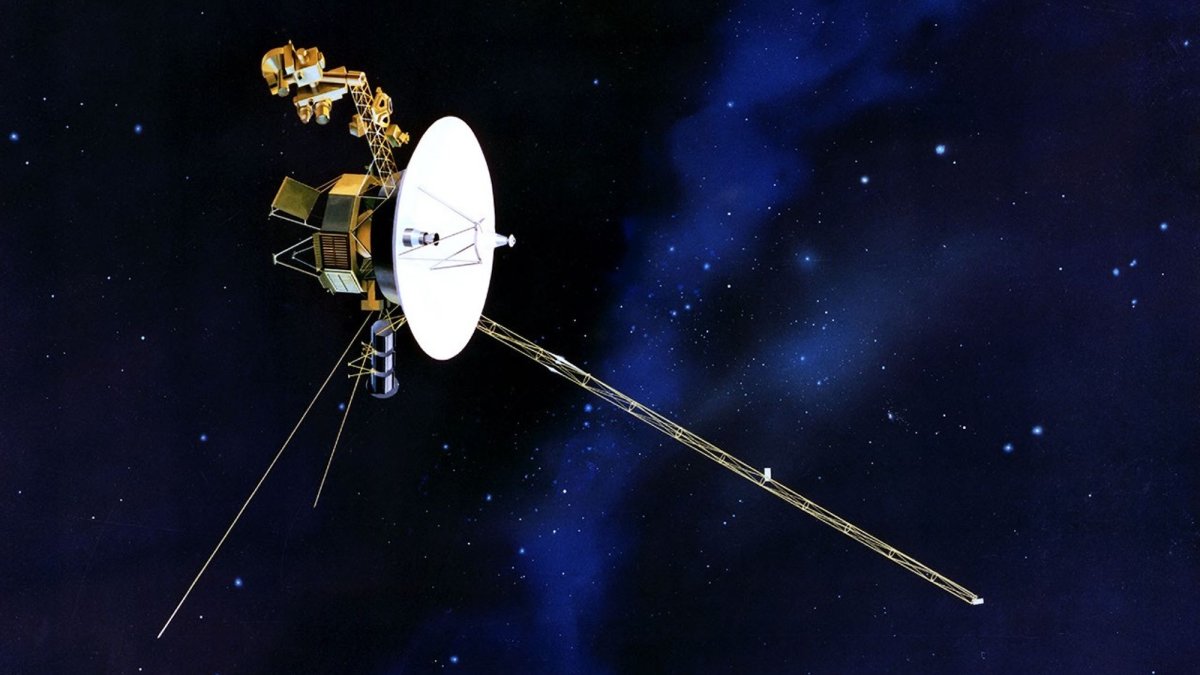
NASA's Voyager 2 spacecraft, now more than 49 years into its journey, has gained an additional year of science operations after mission engineers executed a power-management maneuver they nicknamed the "Big Bang." The probe, currently in interstellar space, draws electricity from three radioisotope thermoelectric generators fueled by decaying plutonium-238. Output has declined by roughly four watts per year since launch in 1977, leaving the spacecraft with about two-thirds of its original 470 watts.
In 2024, NASA began turning off nonessential systems, including Voyager 2's plasma science instrument, which had become less relevant after the probe exited the heliosphere in 2018. Three instruments remain active: a magnetometer, a plasma wave subsystem, and a cosmic ray subsystem. To extend their lifetimes, engineers recently powered down a heater on the spacecraft's backup attitude-control thrusters and moved thruster operations to the primary circuit, which consumes less power.
The change reduces the probe's overall electrical load while keeping it warm enough to avoid a permanent freeze. NASA says the saved power will allow the three remaining instruments to continue returning data through at least 2027. Voyager 1, which is farther from Earth, is slated to receive a similar energy-saving adjustment in the near future.
Both spacecraft have far exceeded their original planetary-flyby missions. If the power-management strategies succeed, at least one instrument on one or both probes could remain in communication with Earth into the 2030s. Voyager 1 is also approaching a distance milestone: on November 18, 2026, it will reach one light-day from Earth, approximately 16.1 billion miles, a record for a human-made object.
The Voyagers' radioisotope generators lose output predictably due to plutonium-238's 87.74-year half-life. Mission planners have managed the declining budget by sequentially deactivating heaters and instruments, prioritizing the science payload that studies the interstellar medium. The latest maneuver demonstrates that careful thermal and electrical balancing can still yield meaningful extensions.
No new hardware or software uploads were required for the "Big Bang" procedure; it relied on existing command sequences and the spacecraft's redundant systems. Engineers monitored the probe's temperature and power margins closely during the transition to ensure stability. The operation was completed successfully, according to NASA's Jet Propulsion Laboratory.
Voyager 2's continued data stream provides unique measurements of magnetic fields, plasma waves, and cosmic rays in a region no other spacecraft has reached. The mission team plans to apply lessons from this maneuver to Voyager 1 and to future deep-space mission designs.
The extended operations are not guaranteed beyond the additional year, as power will continue to decline and component degradation remains a factor. However, the successful execution of this power swap adds a concrete increment of observing time for humanity's most distant active sensors.
NASA successfully gives Voyager 2 another year of life
This is an independent summary. The complete reporting, supporting context and any primary documents remain with Popular Science.