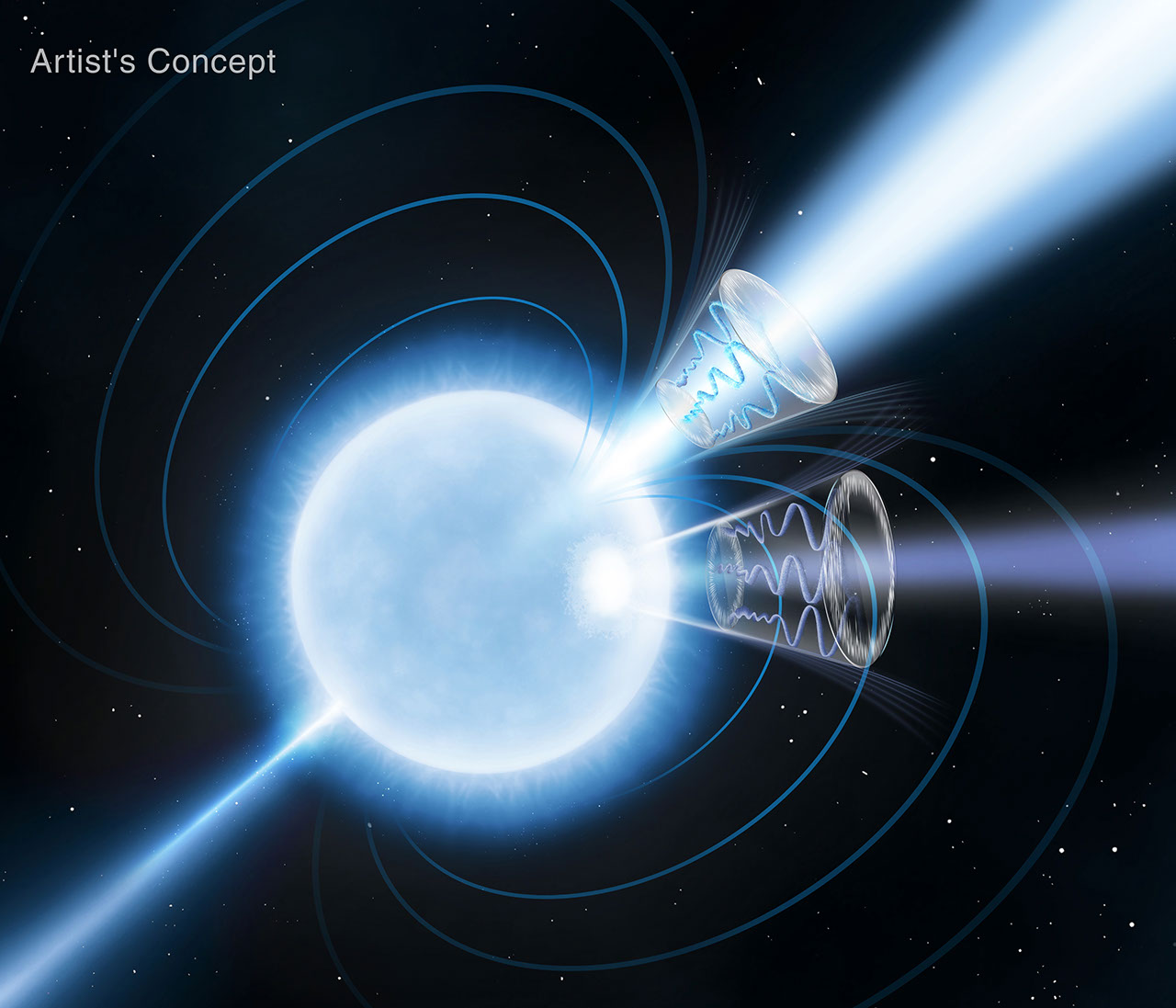
NASA's Imaging X-ray Polarimetry Explorer (IXPE) has measured X-ray polarization from the magnetar 1E 1547.0-5408, a rapidly rotating neutron star with magnetic fields over a trillion times stronger than Earth's. The results, published in Nature, represent the first measurement of its kind for this object.
The magnetar emits both radio and X-ray radiation, with emission peaks offset during its 2.1-second rotation period. This indicates the primary X-ray source is a secondary hot spot offset from the magnetic axis, while radio emission peaks at the magnetic field's symmetry axis.
IXPE detected X-ray polarization degrees of 40% and 80% from the upper and lower emission cones, respectively. These high values, combined with smooth, coherent variations in polarization across the rotation period, provide the most definitive signal to date of vacuum birefringence.
Vacuum birefringence is a prediction of quantum electrodynamics (QED) dating back approximately 90 years. The theory holds that in extremely strong magnetic fields, empty space behaves like a birefringent crystal, affecting the polarization of light passing through it.
The effect has been long-sought but never directly observed until these measurements. The high polarization degrees and their coherent variation with the star's rotation match theoretical expectations for vacuum birefringence in the magnetar's extreme magnetic environment.
Magnetars are a type of neutron star distinguished by their extraordinarily powerful magnetic fields. The field strength around 1E 1547.0-5408 exceeds a trillion times Earth's magnetic field, creating conditions where QED effects become observable.
The offset between radio and X-ray emission peaks provides additional context for interpreting the polarization data. The geometry of the emission regions relative to the magnetic axis helps explain the observed polarization patterns.
Researchers note that while the signal is the most definitive to date, the measurement represents a first-of-its-kind observation and further study will be needed to fully confirm the interpretation and explore its implications for fundamental physics.
NASA’s IXPE May Have Proven 90-Year-Old Theory
This is an independent summary. The complete reporting, supporting context and any primary documents remain with NASA.