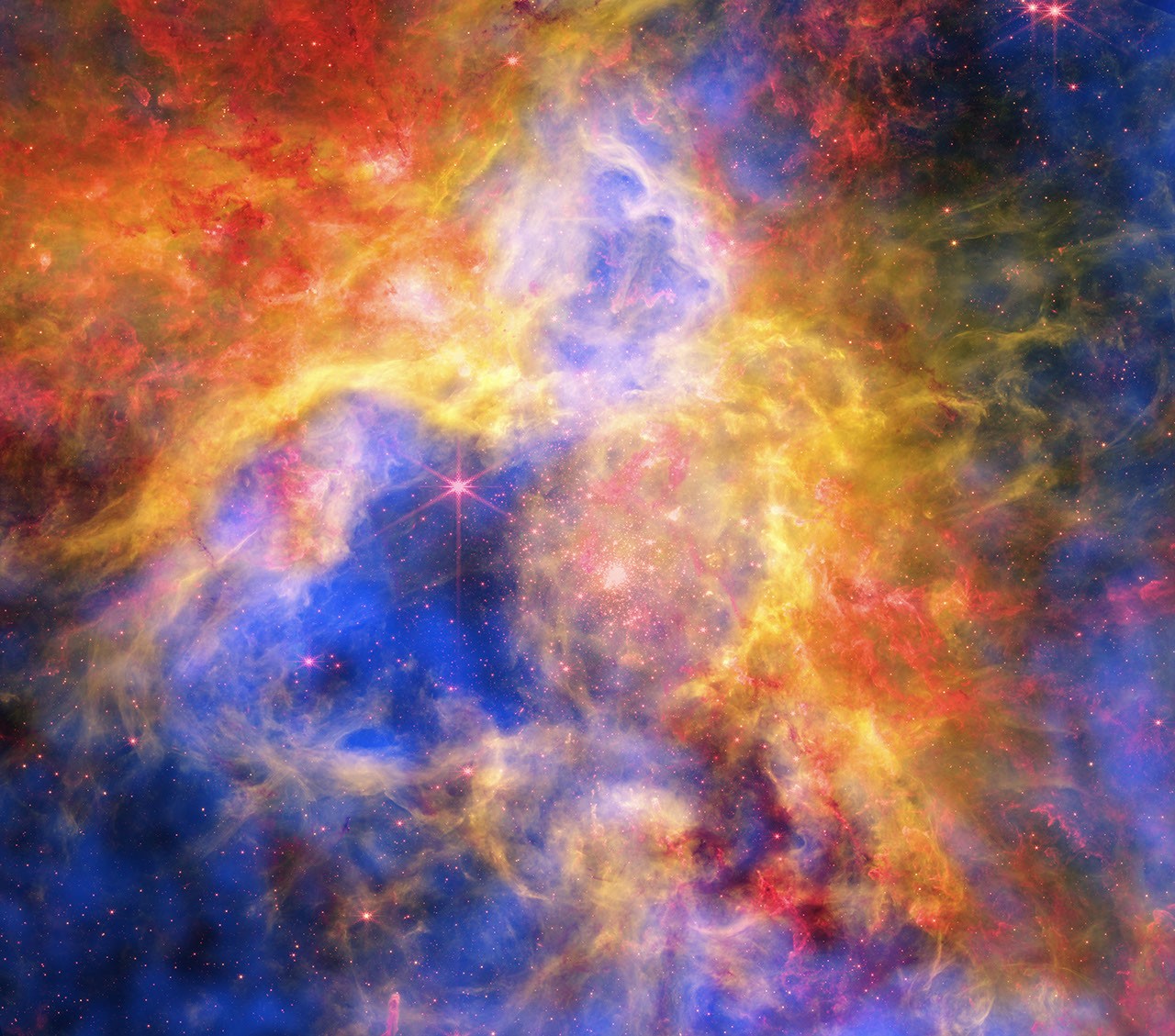
NASA has released a new composite image of the Tarantula Nebula, also known as 30 Doradus, created by layering observations from multiple space telescopes. The image combines X-ray data from the Chandra X-ray Observatory, infrared data from the James Webb Space Telescope, and optical data from the Hubble Space Telescope.
Located in the Large Magellanic Cloud, a satellite galaxy of the Milky Way approximately 160,000 light-years from Earth, 30 Doradus is one of the largest and most active star-forming regions in the local group of galaxies. It contains thousands of young, massive stars embedded within complex structures of gas and dust.
The multi-wavelength approach allows astronomers to observe different physical processes simultaneously. X-ray observations highlight extremely hot gas heated by stellar winds and supernova explosions, while infrared data penetrates dust clouds to reveal embedded protostars and cooler structures. Optical data maps the distribution of ionized gas and the nebula's large-scale morphology.
Researchers note that the layered view resembles a collage of colored cellophane, with the combined dataset revealing a vibrant honeycomb-like structure. This perspective provides new details on the interaction between young stars and their natal environment, specifically how stellar feedback shapes the surrounding interstellar medium.
The image processing was conducted by the Chandra X-ray Center at the Smithsonian Astrophysical Observatory. Scientific analysis of the combined dataset is led by researchers at Ohio State University.
By comparing the different wavelengths, scientists can better understand the lifecycle of massive stars and the dynamics of starburst regions. The Tarantula Nebula serves as a nearby analog for the intense star formation conditions common in the early universe.
The composite image is intended to support ongoing studies of stellar feedback, the triggering of new star formation, and the chemical enrichment of galaxies. Further analysis of the dataset is expected to yield additional insights into the nebula's three-dimensional structure.
NASA Telescopes Create Colorful ‘Craft’ From Nearby Nebula
This is an independent summary. The complete reporting, supporting context and any primary documents remain with NASA.