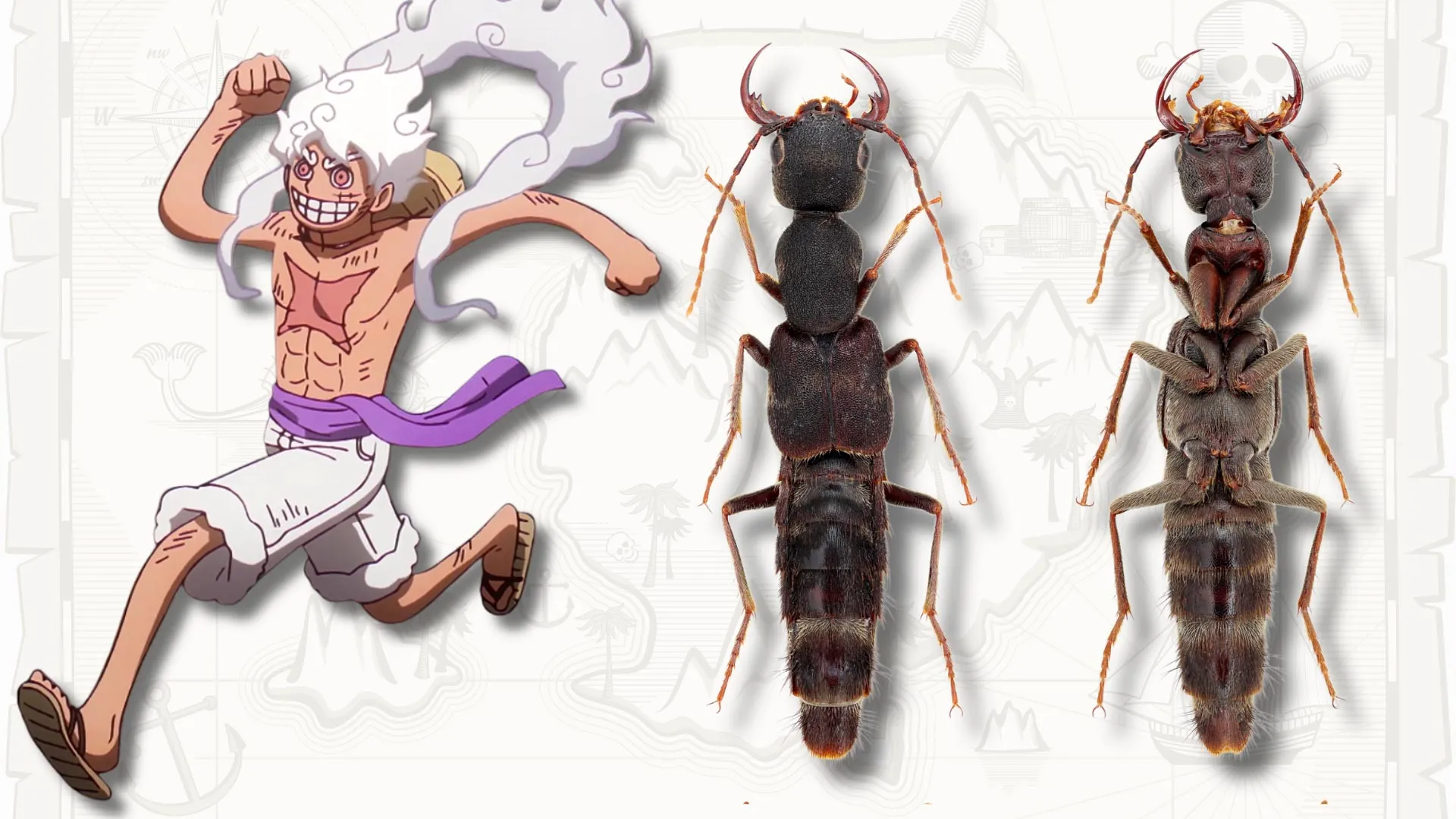
Scientists have established a new beetle genus named Luffy after the elastic protagonist of the manga and anime One Piece. The insects possess exceptionally long, slender mandibles, antennae, and maxillary palps that reminded researchers of the character's rubber-like ability to extend his limbs.
PhD student Fang-Shuo Hu and Alexey Solodovnikov of the Natural History Museum of Denmark published the complete taxonomic descriptions in the peer-reviewed journal ZooKeys. Two species have been identified so far: Luffy schillhammeri, found in broadleaf forests of Yunnan Province, China, and Luffy nika, discovered in Louang Namtha, northern Laos.
The species name schillhammeri honors Dr. Harald Schillhammer of the Natural History Museum Vienna for his contributions to rove beetle research. The name nika references Luffy's Gear 5 transformation, known as the Hito Hito no Mi, Model: Nika awakening, because prominent white bands of hair on the beetle's elytra and body resemble the character's smoke-covered form in that state.
Beyond the pop-culture reference, the discovery addresses a gap in the classification of the Ocypus group of rove beetles. The researchers conducted a broad review of every known genus in the group, including several with uncertain phylogenetic positions such as Acupronotes, Apostenolinus, and Staphylinus.
By comparing numerous specimens and small anatomical differences, they identified shared derived characteristics defining the Eucibdelus lineage, including dorsal ridge teeth on the left mandible and a completely sclerotized labrum. Luffy beetles possess the dorsal ridge teeth but lack a fully sclerotized labrum, along with other distinctive features not seen in related groups.
Based on this combination of traits, the researchers concluded that Luffy is probably the sister group of the entire Eucibdelus lineage. The genus exhibits a unique combination of characters intermediate between that lineage and other members of the Ocypus group, helping to fill an important gap in the existing classification system.
The study offers a fresh perspective on the evolutionary history of the subtribe Staphylinina. The researchers hope the memorable name will bring taxonomy closer to the public, increase awareness of biological classification, and encourage more young people to explore biodiversity research.
These bizarre new beetles look so stretchy scientists named them Luffy
This is an independent summary. The complete reporting, supporting context and any primary documents remain with ScienceDaily.