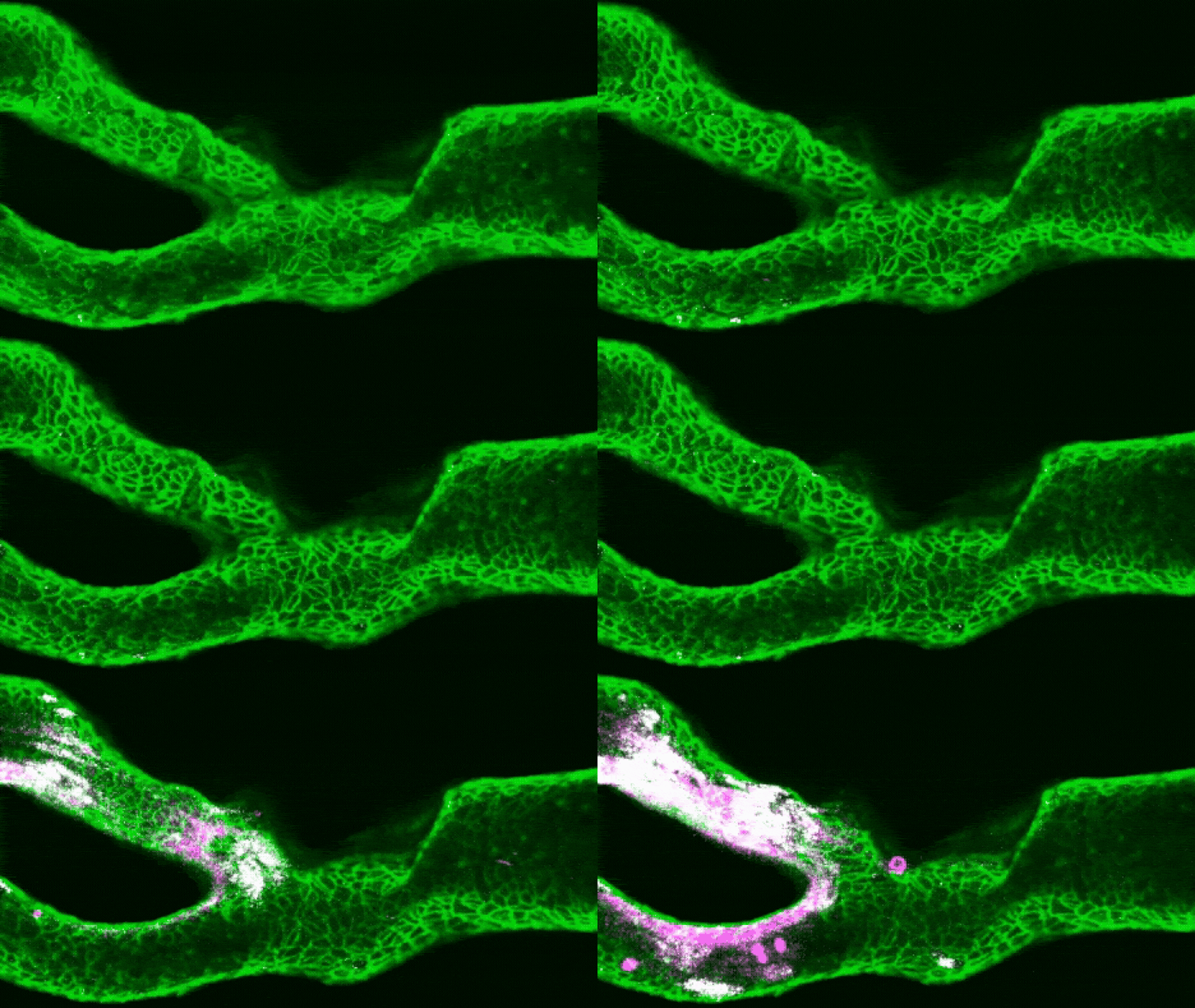
Researchers at the University of Sydney have created miniature, personalized replicas of patients' carotid arteries using 3D printing and living cells. The study, published in July in Cell Biomaterials, describes a proof-of-concept platform that combines medical imaging, microfabrication, and real blood flow to observe clot formation in vitro.
To build each device, the team used a patient's CT scans to 3D-print a plastic replica of their carotid artery, including any atherosclerotic narrowing. The interior was coated with collagen and seeded with endothelial cells that line the artery. Human blood was then pumped through the model at physiological speed and pressure.
A laser injury exposed the underlying collagen, triggering clot formation. Under a microscope, the researchers watched how von Willebrand factor captured platelets and how the resulting thrombus grew or shed fragments. They tested six patients with different patterns of arterial damage.
The models revealed that two arteries with visually similar narrowing behaved differently because their three-dimensional shapes created distinct blood-flow patterns. Those local flow conditions determined whether a clot remained stable or released fragments that could travel to the brain and cause ischemic stroke.
Because different anti-thrombotic drugs target different steps — platelet aggregation, platelet adhesion, or von Willebrand factor activity — the chip's ability to show how a specific patient's clot forms and grows could help clinicians choose the most effective medication. The approach is intended for difficult cases where standard imaging does not provide enough functional information.
The researchers aim to expand the work toward establishing artery-on-a-chip testing as an additional diagnostic step between imaging and treatment selection. The current study demonstrates feasibility; further validation in larger cohorts would be needed before clinical adoption.
Mini 'arteries-on-a-chip' could help predict a person's risk of stroke
This is an independent summary. The complete reporting, supporting context and any primary documents remain with Live Science.