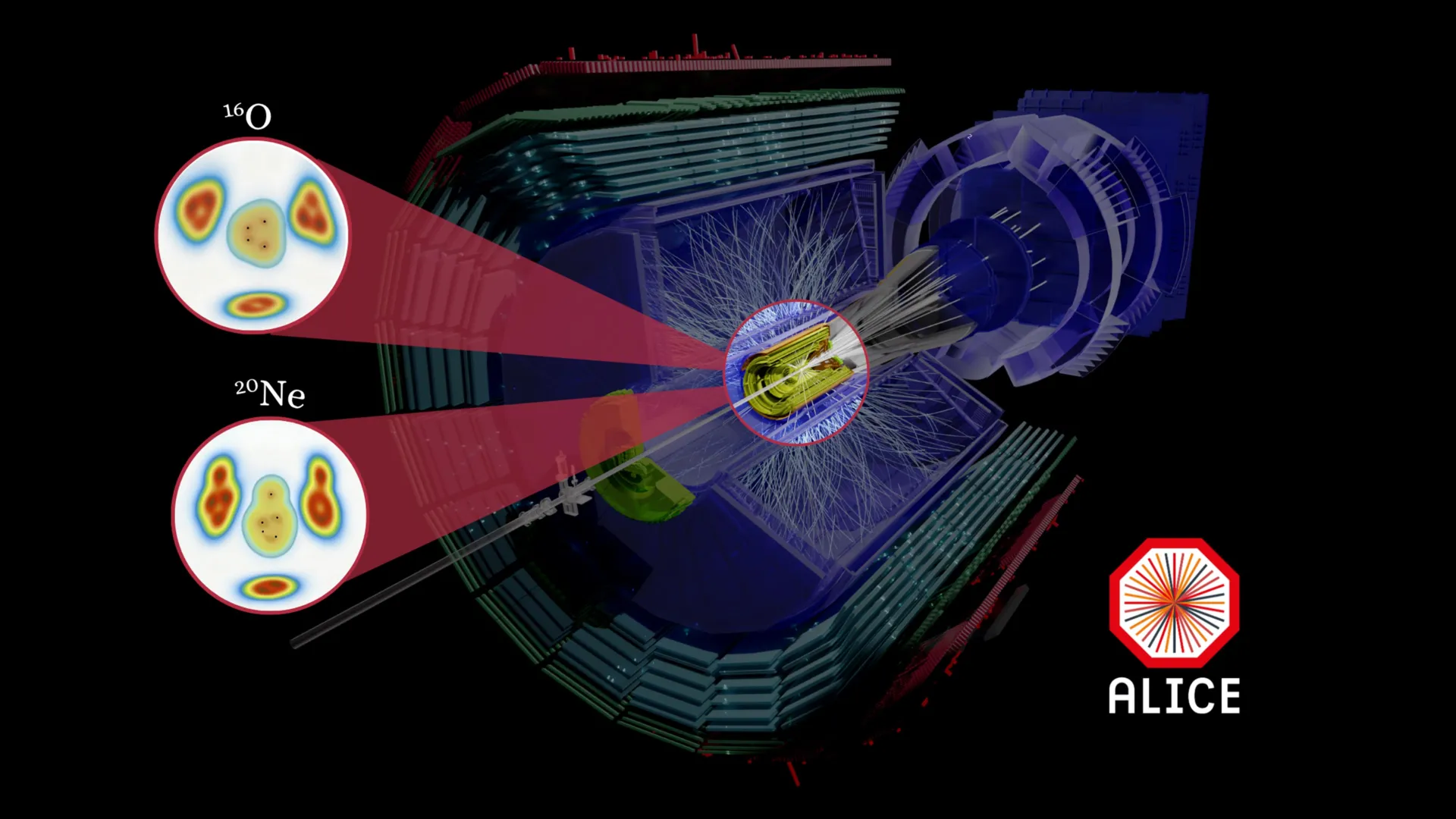
Researchers at the University of Copenhagen, working with the international ALICE collaboration at CERN, have generated quark-gluon plasma by colliding oxygen-16 and neon-20 nuclei at nearly the speed of light. Quark-gluon plasma is the ultra-hot state of matter thought to have existed during the first millionth of a second after the Big Bang, before protons and neutrons formed.
Scientists had long assumed that producing this plasma required collisions of very heavy nuclei such as lead. The new experiments demonstrate that much lighter nuclei can also create the primordial material, pushing the known lower boundary for the collision systems that can generate it.
The plasma droplets survive only a tiny fraction of a second before expanding into other particles. Because the plasma itself cannot be observed directly, physicists measure the emerging particles and study their movement patterns to infer the plasma's properties.
The new results show that these particle flow patterns preserve information about the geometric shape of the original colliding nuclei. Collisions between two spherical oxygen nuclei produce a relatively rounded pattern, while collisions involving elongated neon-20 nuclei create a distinctive bowling-pin-shaped pattern.
This connection allows researchers to deduce nuclear shapes from high-energy collision data, offering a new method to probe nuclear structure. Traditional low-energy experiments measure nuclear rotation and vibration; the new approach reconstructs shapes from the imprint left by extreme collisions.
Associate Professor You Zhou, who led the experiment, said the technique could represent a paradigm shift for studying atomic nuclei whose internal structures remain poorly understood. A precise understanding of nuclear structure helps illuminate the strong force, one of nature's four fundamental forces.
The team plans further experiments with even lighter nuclei, including helium-4, to determine how small a collision system can become while still producing quark-gluon plasma. The findings were published in Physical Review Letters.
Physicists create a tiny “Big Bang” with surprisingly small atomic nuclei
This is an independent summary. The complete reporting, supporting context and any primary documents remain with ScienceDaily.