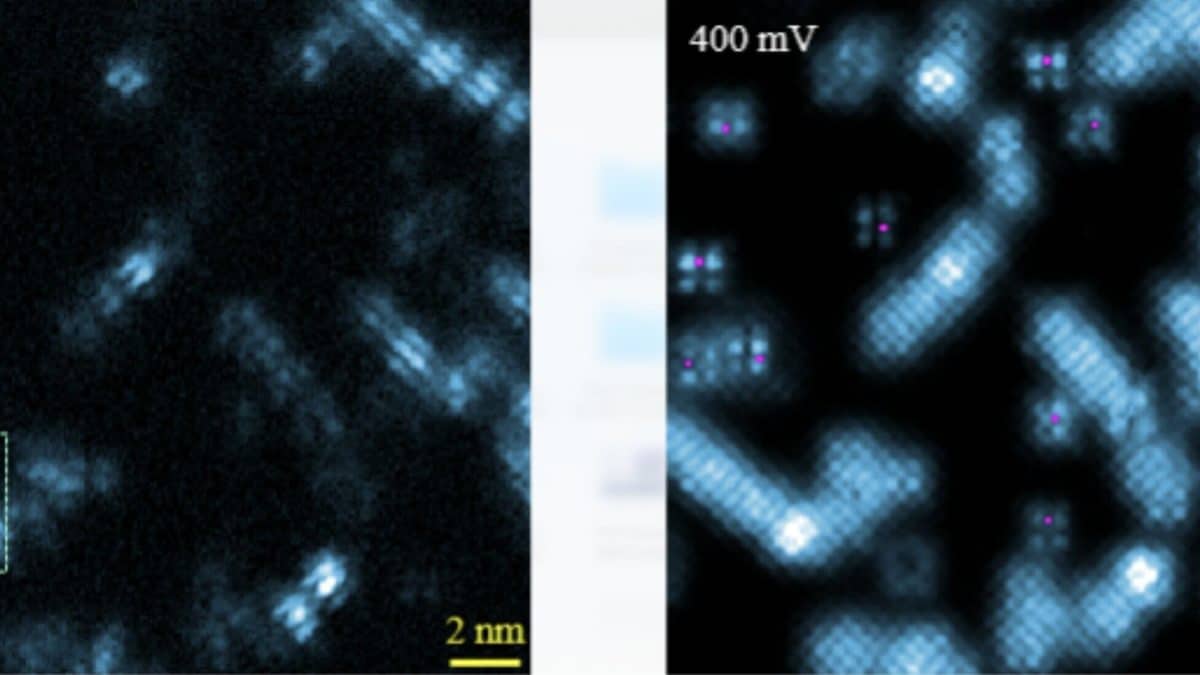
Researchers have directly visualized the quantum structures that underlie high-temperature superconductivity, filling a long-standing gap between single-particle behavior and the emergence of a superconducting current.
The experiment used scanning tunneling microscopy to observe how isolated electronic holes inside a crystal lattice combine into quasi-one-dimensional molecules.
This pairing mechanism had been predicted theoretically but had never been directly imaged before, despite a 30-year search by the physics community.
The observations connect the microscopic behavior of individual charge carriers to the macroscopic phenomenon of resistance-free electrical flow.
High-temperature superconductors have remained poorly understood compared to conventional low-temperature materials, largely because the pairing glue is not phonon-mediated.
Seeing the spatial arrangement and formation of these hole pairs provides experimental constraints for theoretical models of unconventional superconductivity.
The imaging technique achieved sufficient resolution to distinguish the internal structure of the paired states within the crystal.
Researchers note that while the visualization confirms a key microscopic process, the full mechanism driving the superconducting transition temperature remains under investigation.
Физики впервые смогли увидеть квантовый процесс в сверхпроводнике, который искали 30 лет
This is an independent summary. The complete reporting, supporting context and any primary documents remain with Naked Science.