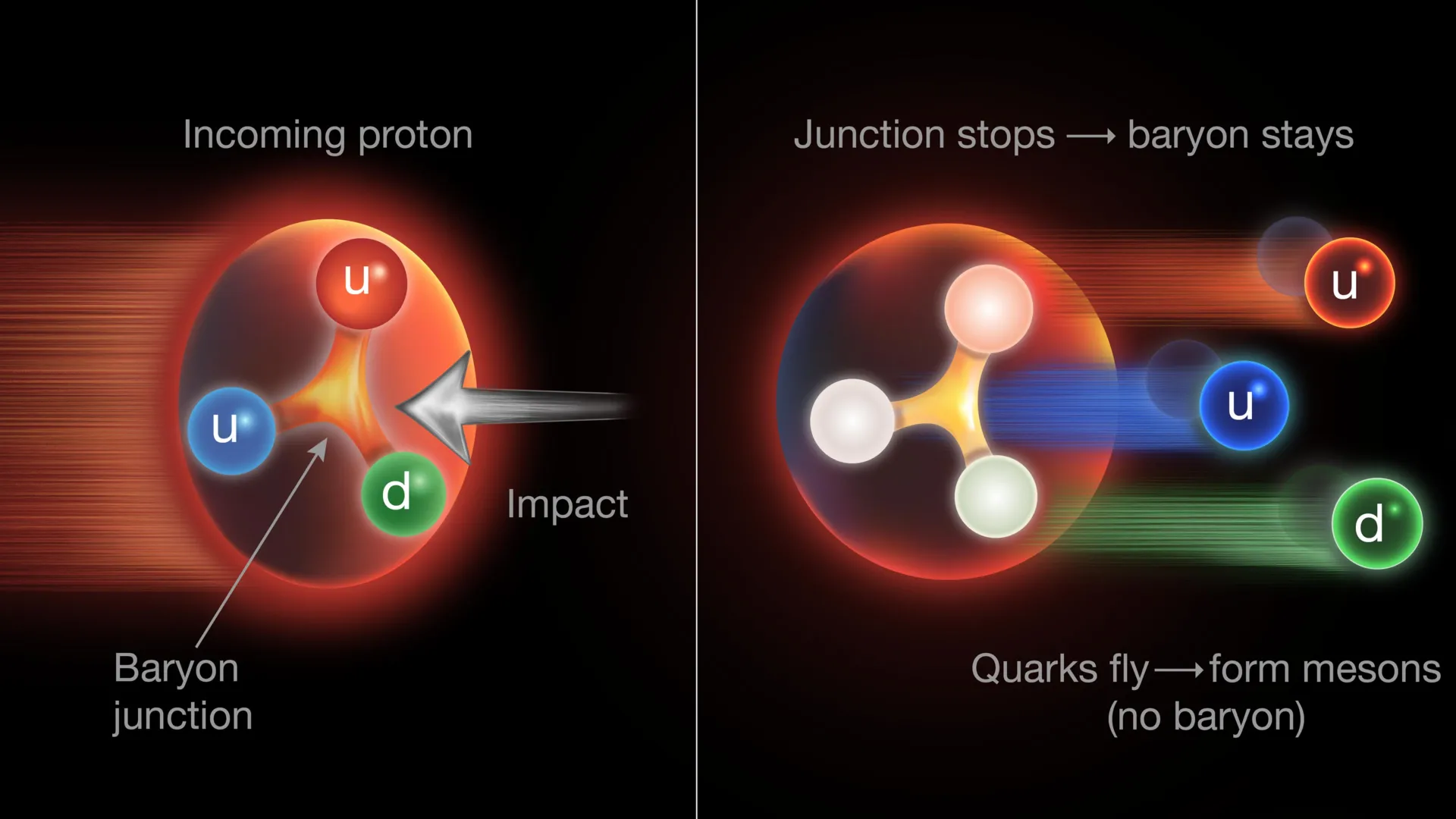
Physicists analyzing data from the STAR detector at the Relativistic Heavy Ion Collider (RHIC) have found evidence that baryon number, a fundamental quantum property conserved since the Big Bang, may be carried by a Y-shaped junction of gluons inside the proton rather than by its three valence quarks alone. The results, published in Science, challenge the standard textbook picture in which each valence quark carries one-third of the proton's baryon number.
The concept of a gluon junction connecting the three valence quarks was proposed in the 1970s, and in 1996 theorist Dmitri Kharzeev suggested the junction itself might transport baryon number. The STAR collaboration developed a way to test this idea using several collision types at RHIC, a U.S. Department of Energy user facility at Brookhaven National Laboratory that operated from 2000 to early 2026.
The key observation was an excess of baryons over antibaryons emerging perpendicular to the beam direction, a region known as midrapidity. If only valence quarks carried baryon number, explaining this excess would require all three quarks from a proton to stop near the collision center and convert their energy into new baryons moving sideways.
To investigate, researchers compared net baryon number with the redistribution of electric charge in the same collisions. Electric charge is carried by quarks, so measuring charge flow perpendicular to the beam reveals how many quarks were stopped. The data showed roughly twice as many baryons as the stopped-quark charge could account for, indicating an additional carrier of baryon number.
The team argues that the three-pronged gluon junction is easier to stop in a collision than the rapidly moving valence quarks. As proton energy increases, gluons multiply and share the proton's momentum, so each gluon carries less forward momentum. The valence quarks retain most of the forward motion, while the junction lags behind and can be stopped, converting its energy into new baryons that travel outward perpendicular to the beam.
After the collision, the stopped junction behaves like a Y-shaped magnet, pulling three new quarks from the vacuum to form a new baryon, while the freed valence quarks pair with antiquarks to form mesons. Collisions producing more particles showed a larger midrapidity baryon excess relative to quark-only models, which the researchers say strengthens the case for the junction's role.
Baryon number conservation underpins the stability of protons, which do not appear to decay under ordinary conditions, allowing atomic nuclei and matter as we know it to exist. The finding suggests that one of the proton's defining quantum properties resides in its gluon structure, reshaping the understanding of how matter's most fundamental building blocks are organized.
Physicists discover a hidden gluon structure inside protons that could rewrite textbooks
This is an independent summary. The complete reporting, supporting context and any primary documents remain with ScienceDaily.