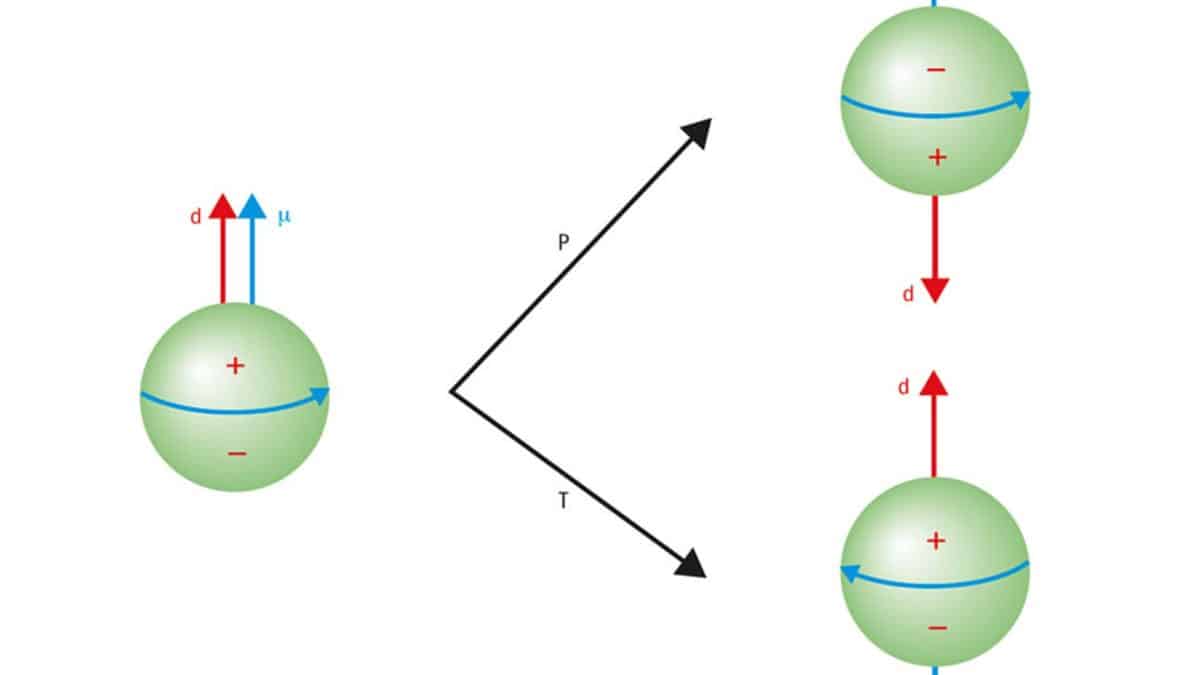
Researchers from the Moscow Institute of Physics and Technology, the Institute for Nuclear Research of the Russian Academy of Sciences, the National Research Nuclear University MEPhI, and the L.D. Landau Institute for Theoretical Physics have proposed a unified experimental concept. Their design allows precision measurements of the electric dipole moments (EDMs) of protons and deuterons within a single storage ring.
An electric dipole moment would indicate a separation of positive and negative charge along a particle's spin axis, signaling violation of time-reversal symmetry and, by extension, CP symmetry. Such CP violation is a necessary condition for the matter-antimatter asymmetry observed in the cosmos, but the Standard Model predicts EDMs far too small to explain it.
Current experimental efforts typically target one particle species per facility. The new proposal shows that protons and deuterons can be studied sequentially or simultaneously in the same ring by exploiting their different magnetic rigidities and spin dynamics. The concept is compatible with a purpose-built ring or with modifications to an existing accelerator complex.
The method relies on frozen-spin techniques, where the particle spin is kept aligned with its momentum using combined electric and magnetic fields. By tuning the ring parameters, the frozen-spin condition can be satisfied for both particle types without major hardware changes.
The authors note that deuterons offer complementary sensitivity to certain CP-violating mechanisms, such as the QCD theta term and quark chromo-EDMs, while protons are more directly sensitive to the QCD theta term and the electron EDM. Measuring both in one apparatus reduces systematic uncertainties and cost.
The proposal remains at the conceptual stage; no construction schedule or funding commitment has been announced. Further simulations and engineering studies are needed to validate the required field precision and beam lifetime.
If realized, the dual-species ring would join a small set of global efforts — including the JEDI collaboration at COSY and the proposed proton EDM experiment at Brookhaven — aiming to reach sensitivities below 10^-29 e·cm.
A confirmed non-zero EDM for either particle would constitute evidence of physics beyond the Standard Model and help explain why the universe contains matter rather than equal amounts of matter and antimatter.
Физики нашли способ исследовать протон и дейтрон в одном накопительном кольце
This is an independent summary. The complete reporting, supporting context and any primary documents remain with Naked Science.