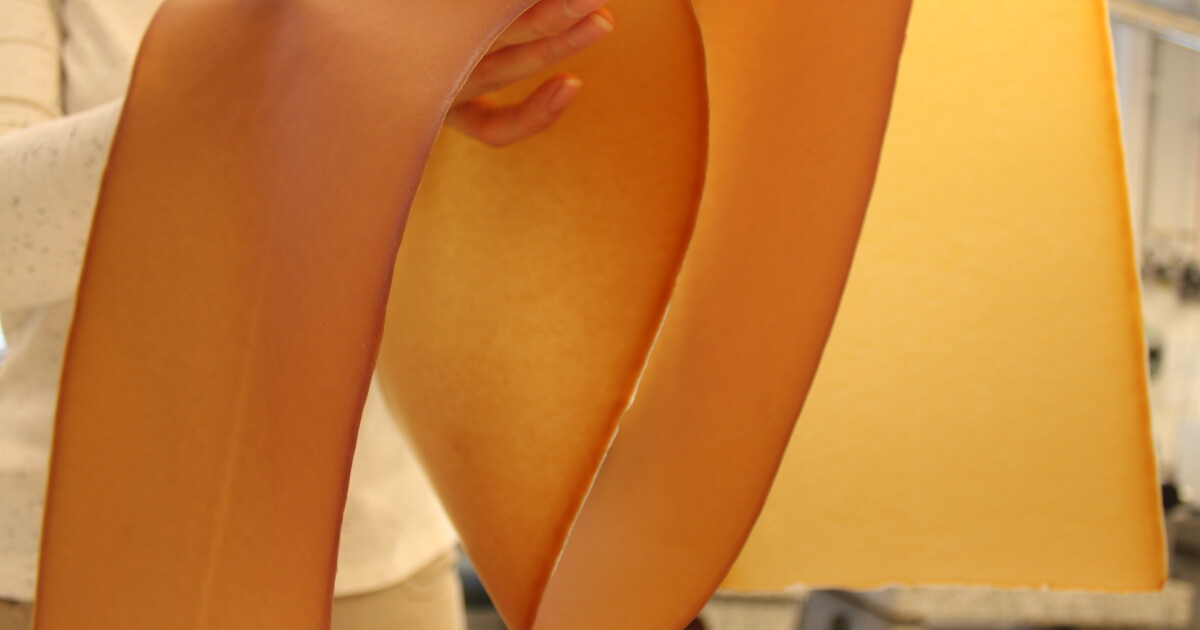
Researchers at VTT Technical Research Centre of Finland have manufactured continuous sheets of plastic-free mycelium leather at dimensions suitable for industrial processing. The sheets measure roughly 20 centimeters wide and 8 meters long, produced on a roller system adapted from paper manufacturing.
The process first grows fungal biomass in a nutrient-rich liquid, then harvests and washes the resulting pulp. Sorbitol and cellulose are mixed in to provide flexibility and strength before the blend is spread into a thin layer and dried.
Earlier work from the same group demonstrated a continuous production rate of one meter per minute, but the material lacked sufficient durability. The new formulation addresses that gap while retaining compatibility with existing biotechnology and printing equipment.
Laboratory tests show the material's tensile strength and durability are comparable to animal leather. A prototype handbag was constructed to demonstrate handling and stitching properties.
Color can be added directly to the pulp and surface texture adjusted during rolling, giving designers control over appearance without post-treatments.
End-of-life testing found the material disintegrates in water after 28 days and fully breaks down under industrial composting conditions within six weeks.
The researchers note tear resistance still needs improvement before the material can enter mass production. The study was published in ACS Applied Bio Materials.
Plastic-free vegan leather sees production-scale breakthrough
This is an independent summary. The complete reporting, supporting context and any primary documents remain with New Atlas.