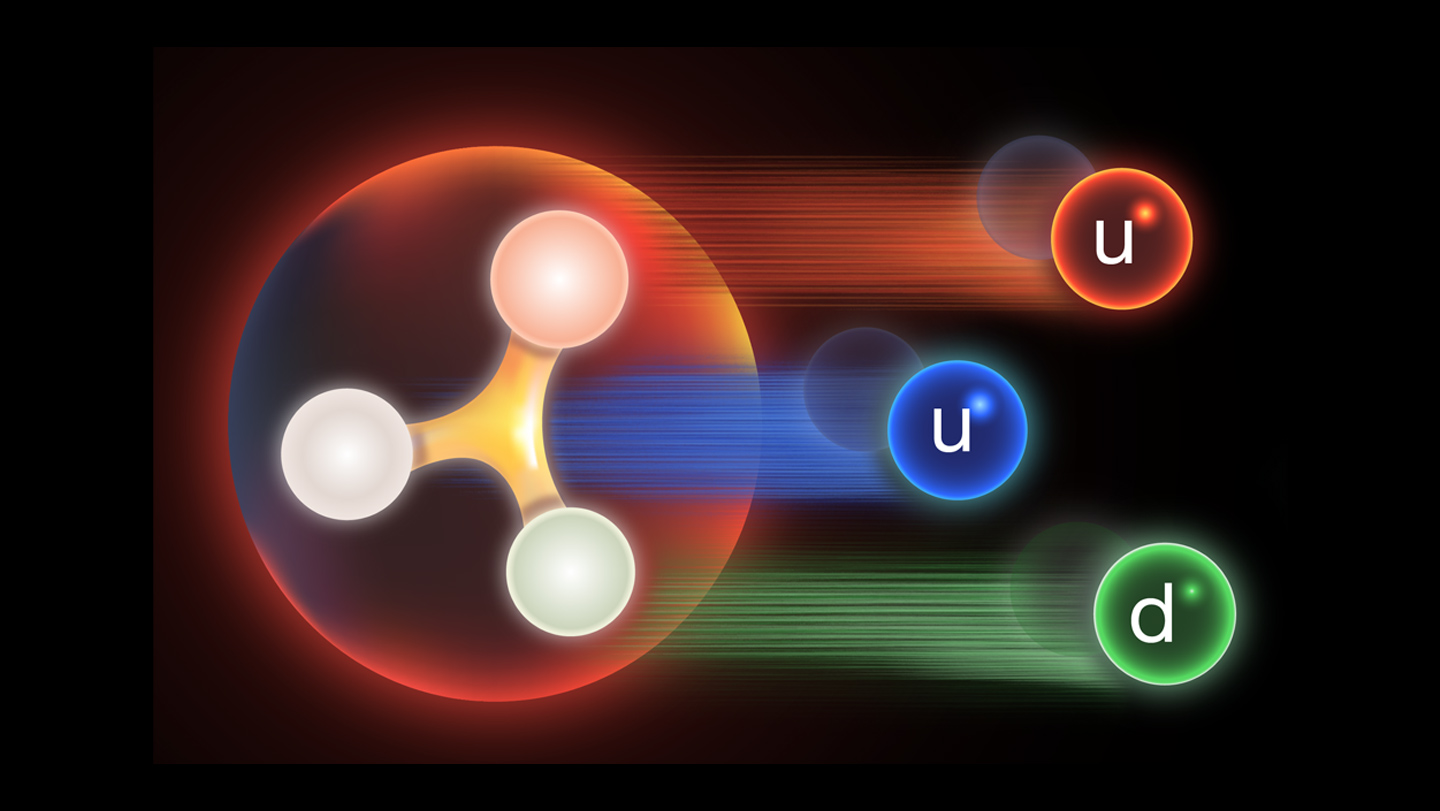
A study from the STAR collaboration at Brookhaven National Laboratory indicates that a proton's baryon number — a conserved quantum property that defines it as a baryon — may be carried by gluons rather than quarks. The research, published in Science on August 13, 2026, analyzes particle emissions from collisions of atomic nuclei at nearly the speed of light.
For decades, the standard view held that each of a proton's three valence quarks carries one-third of the baryon number, summing to one. However, isolated quarks have never been observed; attempting to separate one produces a quark-antiquark pair, forming a meson with baryon number zero.
An alternative model proposes that the baryon number resides in a Y-shaped gluon configuration called a baryon junction, which connects the three quarks. Gluons are the particles that mediate the strong force binding quarks together.
The distinction has measurable consequences in high-energy collisions. Quarks carry a larger fraction of the proton's momentum than the junction, making them harder to deflect. If quarks carry the baryon number, net baryon production should peak in the forward beam direction. If the junction carries it, the peak should appear perpendicular to the beam.
Data from several collision types at the Relativistic Heavy Ion Collider show enhanced net baryon production at perpendicular angles, favoring the junction model. Theoretical physicist Chun Shen of Wayne State University, who was not involved, said the evidence strongly suggests the junction picture but is not yet a definitive smoking gun.
Physicist Zi-Wei Lin of East Carolina University noted the two pictures may be compatible, since the junction does not exist independently of quarks. The collider used for these experiments shut down in February 2026; future data from the planned Electron-Ion Collider could refine the comparison.
Gluons have previously been shown to contribute the majority of the proton's mass and spin. If confirmed, the baryon number would be another fundamental proton property anchored in its gluon structure rather than its quarks.
The STAR collaboration's paper appears in Science with doi: 10.1126/science.ads5962.
The glue that binds a proton may be key to its identity
This is an independent summary. The complete reporting, supporting context and any primary documents remain with Science News.