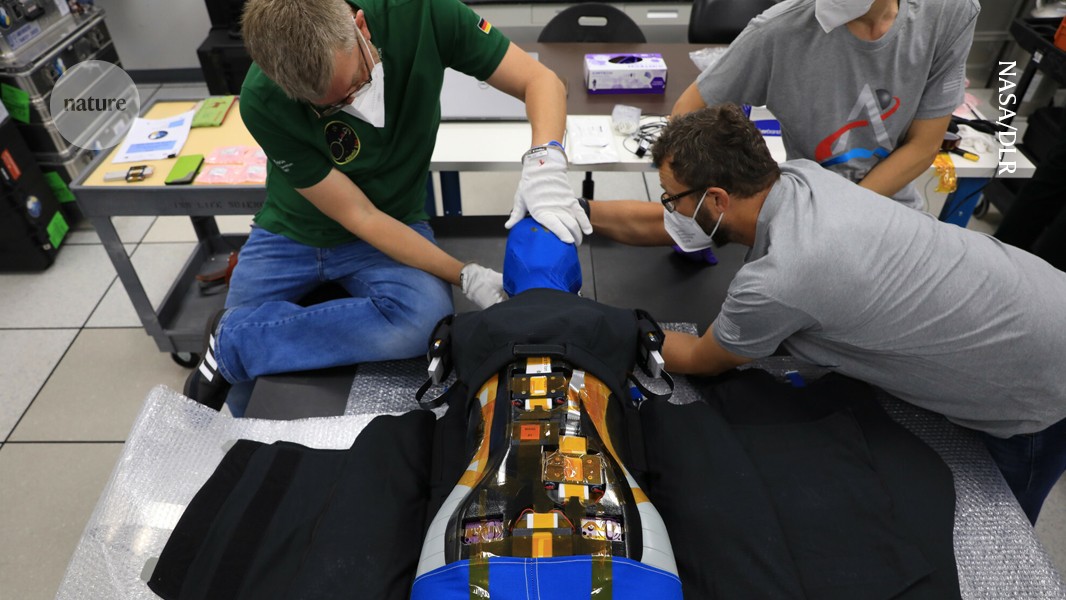
A radiation-protective vest tested on NASA's uncrewed Artemis I mission in 2022 cut the radiation dose reaching a mannequin's torso by roughly half, according to results published in Science Advances. Researchers from the German Aerospace Center (DLR) and NASA equipped one of two identical mannequins, named Zohar, with the prototype vest while the other, Helga, flew unprotected.
The mannequins were fitted with more than 6,000 passive and active detectors to measure radiation exposure throughout the 25-day mission beyond low Earth orbit. Data showed the vest reduced the effective dose to shielded organs by approximately 50 percent during the transit through the Van Allen belts and in deep space.
The garment, developed by StemRad in collaboration with Lockheed Martin, uses high-density polymer layers shaped to cover the torso and protect bone marrow, lungs, stomach and other radiation-sensitive organs. It is designed to be worn during solar particle events, which can deliver dangerous radiation doses in a matter of hours.
Artemis I provided the first opportunity to test such a vest in the actual deep-space radiation environment, which includes both galactic cosmic rays and trapped radiation belts. Previous evaluations had relied on ground-based simulators or low Earth orbit exposures that do not fully replicate the mixed radiation field beyond Earth's magnetosphere.
The study notes that the vest does not block all radiation types equally; it is most effective against lower-energy protons typical of solar storms, while high-energy galactic cosmic rays penetrate more readily. Researchers emphasize the vest is intended as a supplement to spacecraft shielding, not a replacement.
NASA plans to evaluate the vest further on future crewed Artemis missions, where astronauts will face longer durations in deep space. The agency is also assessing how the garment's weight, mobility constraints and thermal properties affect crew operations during extended wear.
Astronaut vest cuts radiation exposure in half
This is an independent summary. The complete reporting, supporting context and any primary documents remain with Nature.