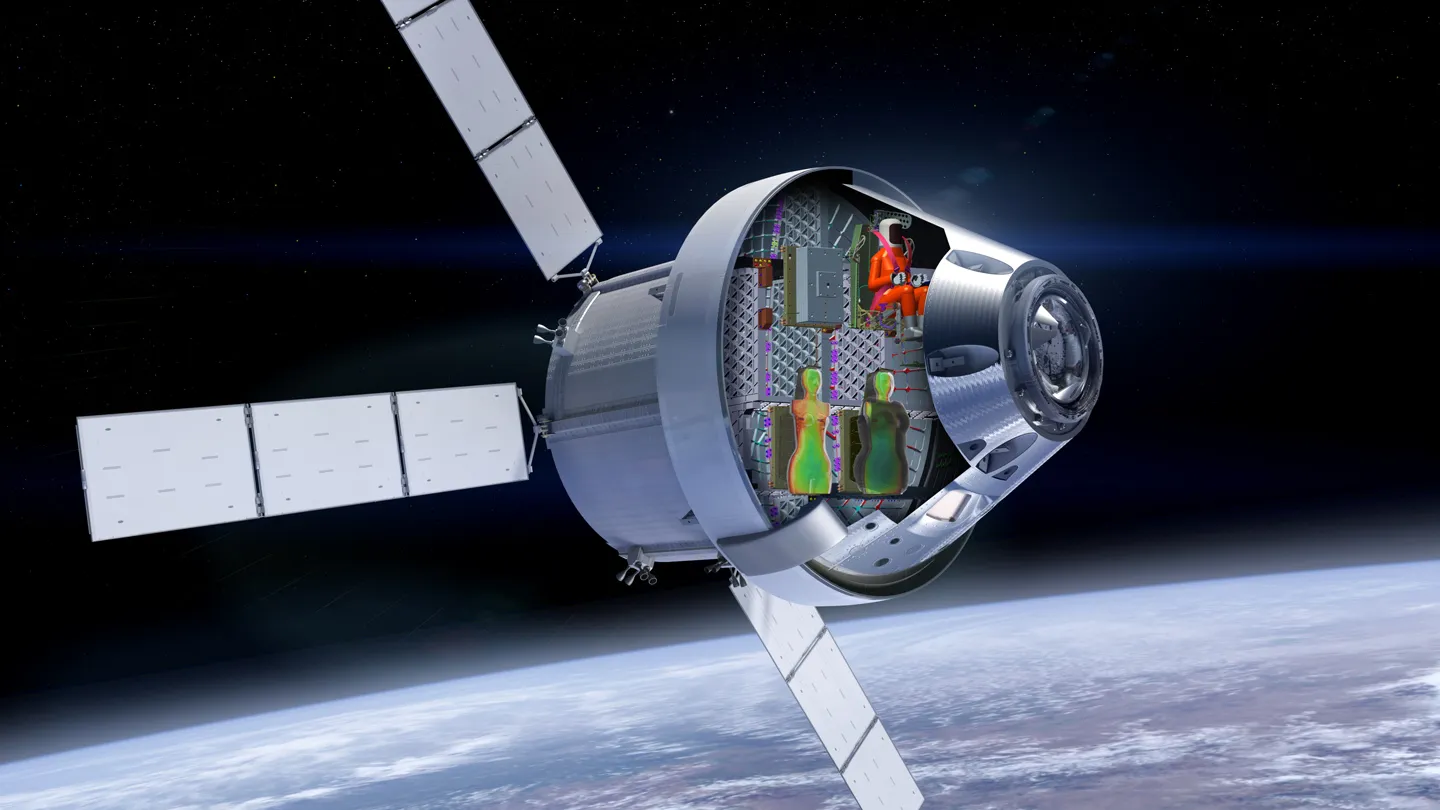
A wearable radiation vest tested on NASA's uncrewed Artemis I mission in 2022 could significantly lower the radiation dose astronauts receive during solar particle events, researchers report in Science Advances. The AstroRad vest, developed by StemRad with Lockheed Martin, weighs 26 kilograms and is made from high-density polyethylene designed to shield sensitive organs including bone marrow, lungs, the gastrointestinal tract, breasts and ovaries.
During the 25-day flight around the moon, two anatomically detailed female torso phantoms flew inside the Orion spacecraft. One, nicknamed Zohar, wore the vest; the other, Helga, wore no protection. Both carried embedded radiation sensors at multiple locations. Artemis I did not encounter a solar storm, but the spacecraft passed through the inner Van Allen belt, a region of high-energy charged particles trapped by Earth's magnetic field.
Using the Van Allen belt measurements, the team modeled how the vest would have performed during two historical solar particle events: one in August 1972 and another in October 1989. The calculations show the vest would have reduced an astronaut's radiation exposure by about 60 percent during the 1972 event, lowering the dose from 222 millisieverts to 87.5 millisieverts. For the higher-energy 1989 event, the reduction was about 40 percent.
People on Earth's surface typically absorb around 3 millisieverts of natural background radiation per year. By comparison, the unshielded dose from the 1972 event would have been roughly equivalent to 74 years of that background exposure. Reducing the dose to 87.5 millisieverts could help astronauts stay within NASA's career radiation limit of 600 millisieverts during longer deep-space missions.
Lead scientist Jordan Houri of StemRad said the amount of dose reduction observed was surprising. The current vests can be tailor-made for each astronaut, but the team is now developing a modular design that would allow a single baseline vest to be adjusted for different body shapes and sizes. That approach would reduce the total mass launched and could let one astronaut work outside a storm shelter during a solar event while others remain protected inside.
The study marks the first evaluation of wearable radiation protection for human deep-space exploration based on actual flight data. Researchers caution that the results are extrapolations from Van Allen belt measurements to historical solar storm spectra, and that real-world performance during a future solar particle event remains to be verified.
A vest tested on the Artemis I mission blocked some radiation exposure
This is an independent summary. The complete reporting, supporting context and any primary documents remain with Science News.