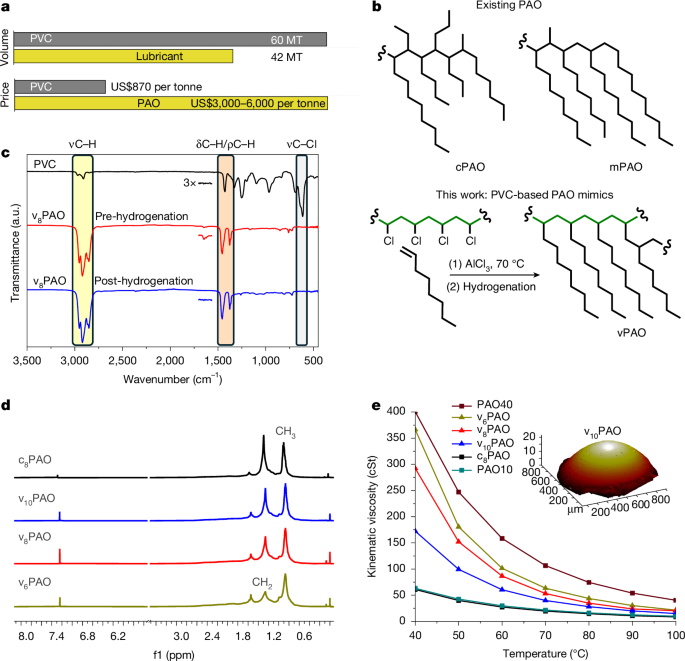
Scientists have developed a method to transform polyvinyl chloride (PVC), one of the world's most widely produced plastics, into high-value lubricants. The process uses aluminum chloride as a catalyst at a relatively mild temperature of 70 °C to remove chlorine from the polymer, break its chains, and attach alkyl groups derived from alpha-olefins.
The resulting vinyl-derived polyalphaolefins (vPAO) have controllable molar masses and kinematic viscosities at 100 °C ranging from approximately 14.9 to 26.3 centistokes. They also exhibit a low coefficient of friction between 0.08 and 0.15 and a high viscosity index of up to 130, indicating stable performance across temperature changes.
Unlike conventional polyalphaolefin production, which relies on expensive metallocene catalysts, the new method uses the PVC polymer itself as a template for alkylation. This eliminates the need for specialized catalysts and leverages a low-cost, abundant waste stream as feedstock.
Global PVC production reaches about 60 million tonnes annually, and its disposal poses environmental risks due to the leaching of chlorinated hydrocarbons and additives into soil and groundwater. Converting this waste into valuable lubricants could provide a financial incentive for collection and recycling.
The researchers note that the process achieves dechlorination, alkylation, and chain scission in a single step. The tunable properties of the resulting lubricants suggest they could be tailored for specific industrial applications.
The work demonstrates a pathway toward carbon circularity for PVC by turning a problematic waste material into a product with superior tribological properties. Further research would be needed to assess the scalability of the process and the full lifecycle impacts of the resulting lubricants.
Upcycling of polyvinyl chloride into polyalphaolefin lubricants
This is an independent summary. The complete reporting, supporting context and any primary documents remain with Nature.