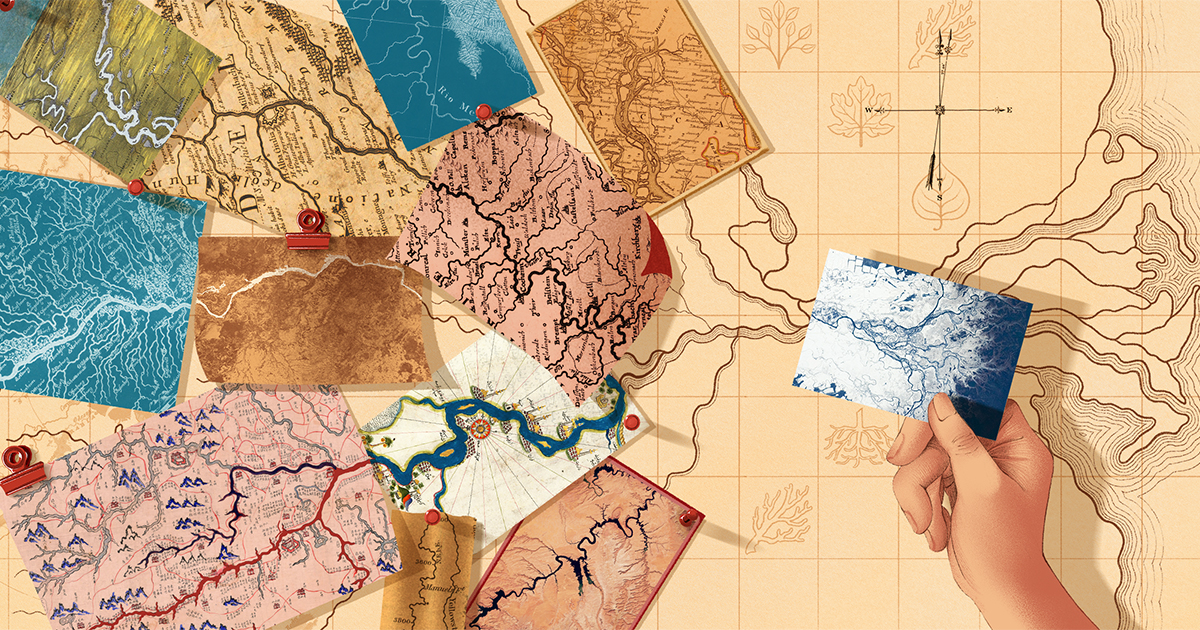
In April 2026, researchers led by Tian Dong of the University of Texas, Rio Grande Valley, published a study in Science showing that Hack's law extends to river deltas. The law, first documented in 1957 by U.S. Geological Survey scientist John Hack, states that a stream's length is proportional to its drainage area raised to the power of 0.6. This scaling relationship has been confirmed worldwide for tributary networks that collect water.
The new analysis used satellite data to distinguish land from water in delta regions, which are flat and highly dynamic. The team measured the length of distributary channels and the size of their nourishment areas — the regions supplied with sediment — and found the same 0.6 exponent.
Hack's law is considered remarkable because a simple geometric expectation would yield an exponent of 0.5, implying self-similar basins at all scales. Instead, the 0.6 value means larger basins become elongated, giving river networks an inherent directionality toward the sea.
Two complementary explanations underlie the law for tributary networks. The optimal channel network theory, developed by Andrea Rinaldo and colleagues in the 1990s, argues that the 0.6 scaling minimizes total energy dissipation in transporting water downhill. Landscape evolution models show how gravity-driven erosion and friction dynamically reorganize channels toward this efficient configuration over thousands of years.
Deltas represent the inverse process: sediment is deposited rather than eroded, and water decelerates upon meeting the ocean. That the same mathematical law governs both the erosional tributary network and the depositional distributary network was unexpected.
Geomorphologists are now investigating why Hack's law applies in this inverse context. The finding suggests a deeper universality in how transport networks organize themselves, whether moving water toward a single outlet or distributing sediment across a fan.
Chris Paola, a river scientist at the University of Minnesota, noted that the coexistence of simple deterministic laws with chaotic natural processes makes river networks particularly revealing. Unlike vascular or urban networks, river patterns arise purely from physical Earth processes.
Research continues on rivers that deviate from Hack's law and on classifying transport networks into families with different optimal scaling laws, such as three-dimensional tree branching versus two-dimensional river systems.
Why Are Rivers So Mathematical?
This is an independent summary. The complete reporting, supporting context and any primary documents remain with Quanta Magazine.