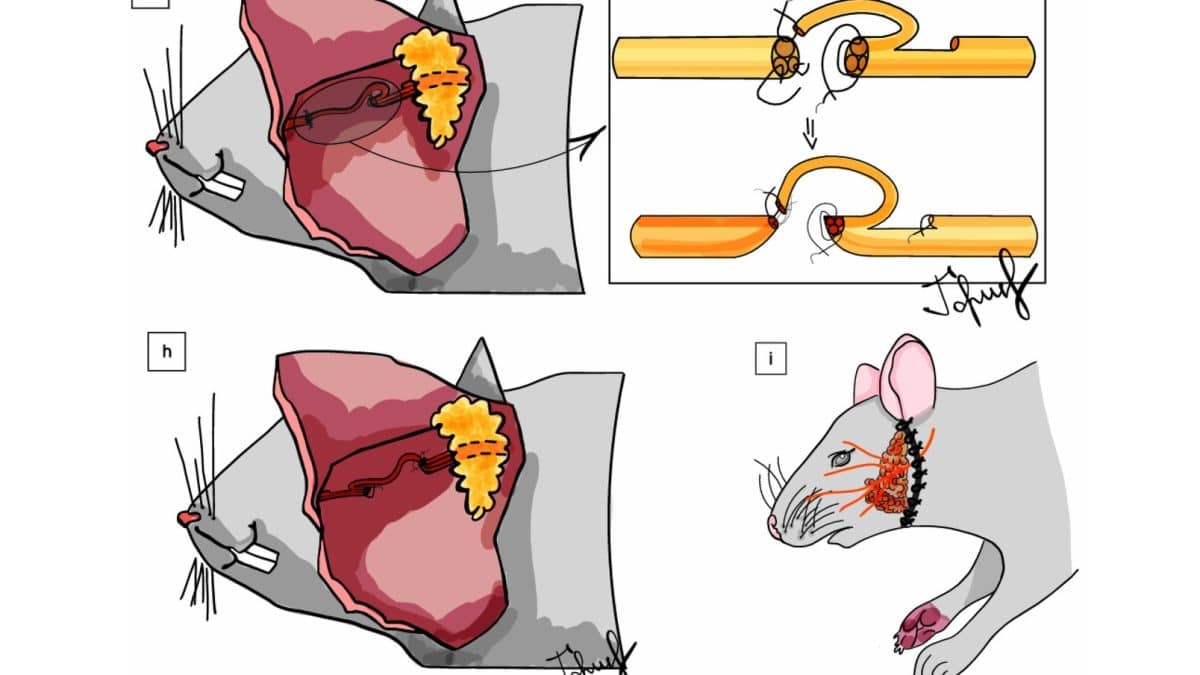
Researchers at Sechenov University and collaborating institutions have demonstrated a technique for repairing injured facial nerves that uses a segment of the damaged nerve trunk itself rather than a graft taken from another part of the patient's body.
The standard approach for bridging a nerve gap has been autologous nerve grafting, which requires surgically removing a healthy nerve segment from a donor site, creating an additional injury.
In the new method, surgeons mobilize and reposition a portion of the proximal facial nerve stump to span the defect, eliminating the donor-site morbidity associated with conventional grafting.
The study compared outcomes between the nerve-sparing technique and traditional autologous grafting. Results indicated that the standard graft produced a more pronounced degree of functional recovery.
Because the conventional method still yields superior restoration, the authors describe their approach not as a replacement but as a tissue-sparing alternative for selected cases where avoiding a second surgical site is a priority.
The findings were published as part of ongoing research into less invasive peripheral nerve repair strategies.
Further investigation is needed to refine the technique and define the clinical scenarios in which it offers the best balance of benefit and recovery.
Uncertainty remains regarding long-term functional equivalence and the optimal patient selection criteria for the nerve-sparing method.
Щадящий метод позволил частично восстановить лицевой нерв без пересадки фрагмента другого нерва
This is an independent summary. The complete reporting, supporting context and any primary documents remain with Naked Science.