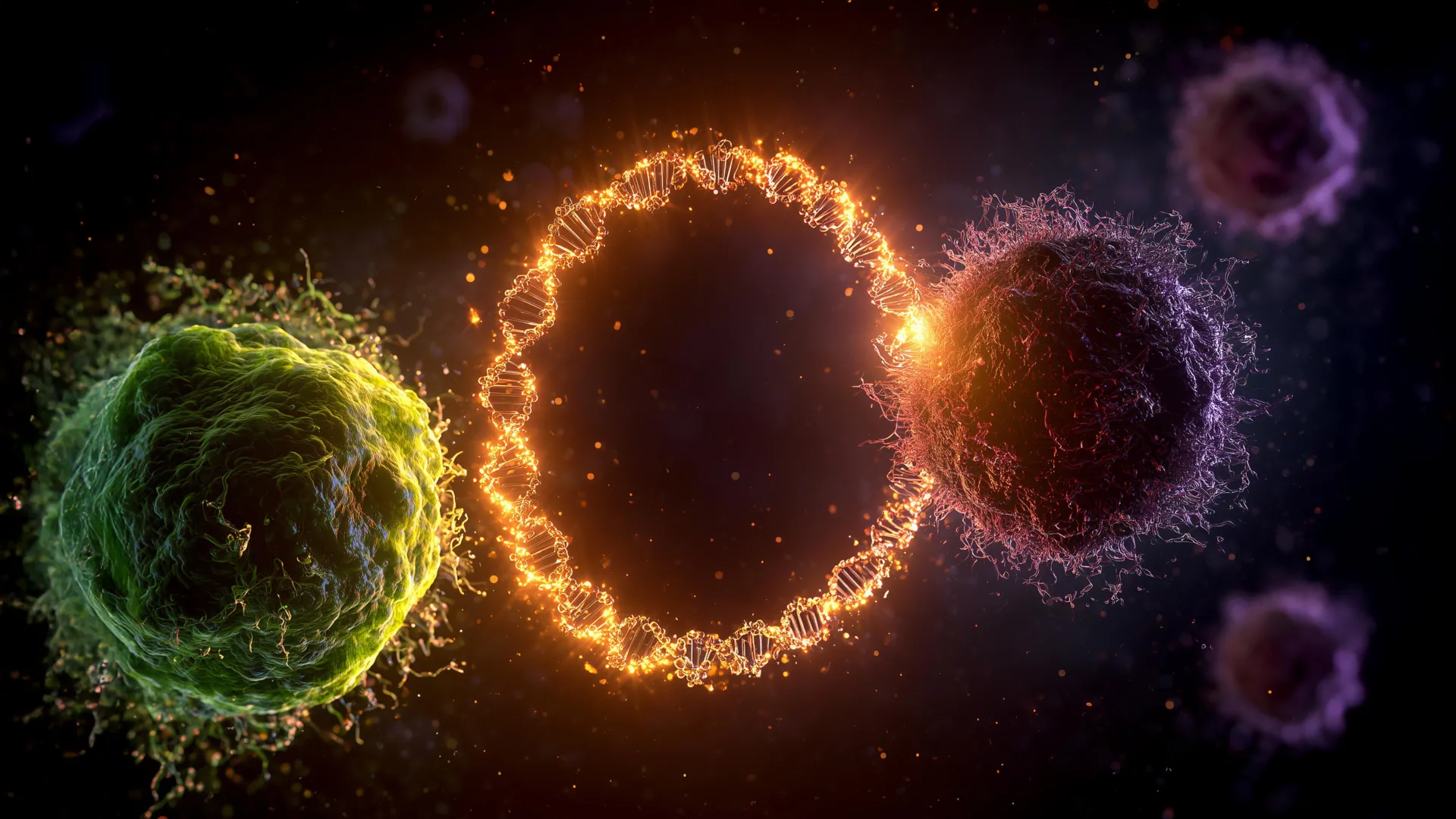
Researchers at the Max Planck Institute for Marine Microbiology have documented a mobile intron RNA moving from a predatory bacterium into the cells of a different microbial species. The study focused on a methane-producing enrichment culture dominated by Candidatus Velamenicoccus archaeovorus, a tiny bacterium that preys on Methanothrix soehngenii, a globally significant methane-producing archaeon.
While examining the predator's genome, the team identified a self-splicing intron that functions as a jumping gene. Using highly sensitive nucleic acid probes, they visualized the circular intron RNA inside living Ca. Velamenicoccus cells and, crucially, inside dead Methanothrix cells. The RNA was caught in the act of attempting to replicate in a new host, though the host had already been killed by the predator.
Jumping genes are known to move within genomes, but transfers between species have been difficult to observe directly. Scientists have generally assumed such horizontal transfers occur via viruses or plasmids. This discovery suggests that stable, circular RNA molecules can serve as an independent vehicle for gene mobility across species boundaries.
The intron RNA persists because its circular structure lacks free ends, protecting it from rapid degradation by cellular enzymes. Linear RNA is typically broken down quickly, especially in dead cells, but the ring-shaped intron RNA accumulated in the dead archaeal cells, making its detection possible.
Jens Harder, who led the research, noted that circular RNA molecules are already known to play roles in human metabolism and are being explored for RNA vaccine applications. The study demonstrates that in microorganisms, these stable RNA circles can mediate the transfer of mobile genetic elements to other species.
The findings were published in Scientific Reports and represent a direct observation of a mechanism that could accelerate evolutionary change by spreading functional genetic modules between distantly related microbes.
Scientists catch a “jumping gene” mid-leap between species
This is an independent summary. The complete reporting, supporting context and any primary documents remain with ScienceDaily.