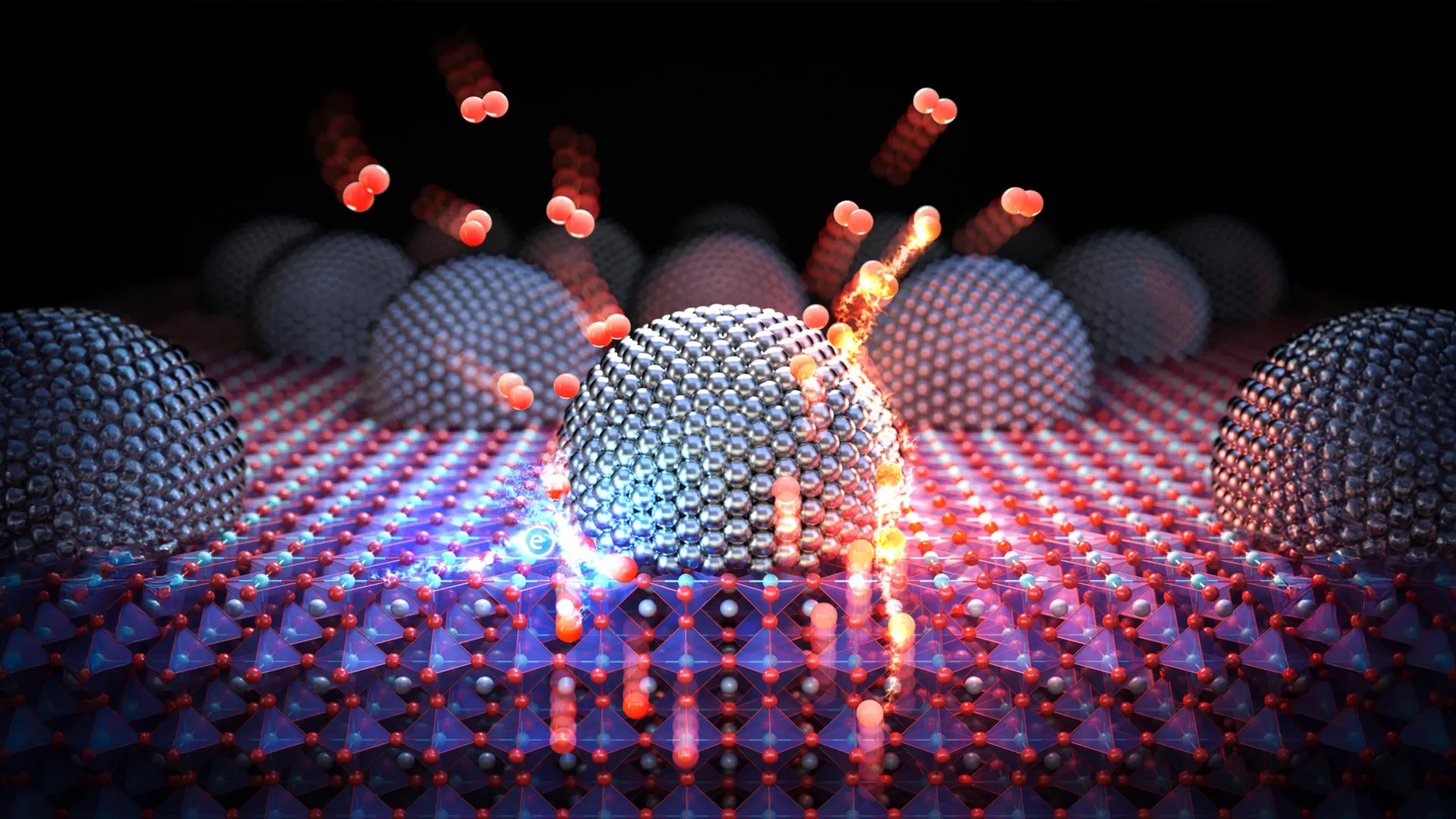
A team from Seoul National University, KAIST, and the Korea Basic Science Institute discovered that silver nanocatalysts in solid oxide cells change their primary reaction site depending on whether the device generates electricity or produces hydrogen. The study, published in Energy & Environmental Science, used model electrodes with uniformly spaced silver nanoparticles to isolate catalytic behavior.
Solid oxide cells transport oxygen ions through a solid electrolyte to either generate power or split water for hydrogen. The speed of oxygen reactions at the air electrode limits performance, but the exact locations where nanocatalysts act have been unclear because conventional electrodes have complex, disordered structures.
The researchers compared silver, cobalt, palladium, and platinum nanoparticles on thin-film perovskite electrodes. Silver showed the strongest improvement in oxygen reaction rates. By varying nanoparticle size and spacing, they measured how reaction rates scaled with either the length of the silver-electrode boundary or the silver surface area.
During oxygen reduction, which occurs in electricity-generating mode, reaction rates increased with the length of the interface between silver particles and the electrode. This indicated the boundary is the active site for power generation. In oxygen evolution mode, used for hydrogen production, rates scaled with the silver surface area, showing the nanoparticle surfaces themselves become the main reaction sites.
Synchrotron-based ambient-pressure X-ray photoelectron spectroscopy and atomic-scale calculations revealed that silver modifies the electrode's electronic structure to favor electron transfer to oxygen during reduction. During evolution, the catalyst creates conditions that help oxygen atoms combine into molecules and desorb.
The findings suggest catalyst design should account for operating mode. Instead of treating nanocatalysts as uniform additives, engineers could separately optimize the catalyst surface for electrolysis and the catalyst-electrode interface for fuel-cell operation. This principle may improve efficiency in distributed power systems and lower electricity demand for green hydrogen production.
The ordered nanoparticle array platform developed for this study can also be applied to other electrochemical systems, including hydrogen production devices and oxygen separation technologies. The research was supported by South Korea's Ministry of Science and ICT and the National Research Foundation of Korea.
Scientists discover a hidden switch inside silver nanocatalysts
This is an independent summary. The complete reporting, supporting context and any primary documents remain with ScienceDaily.