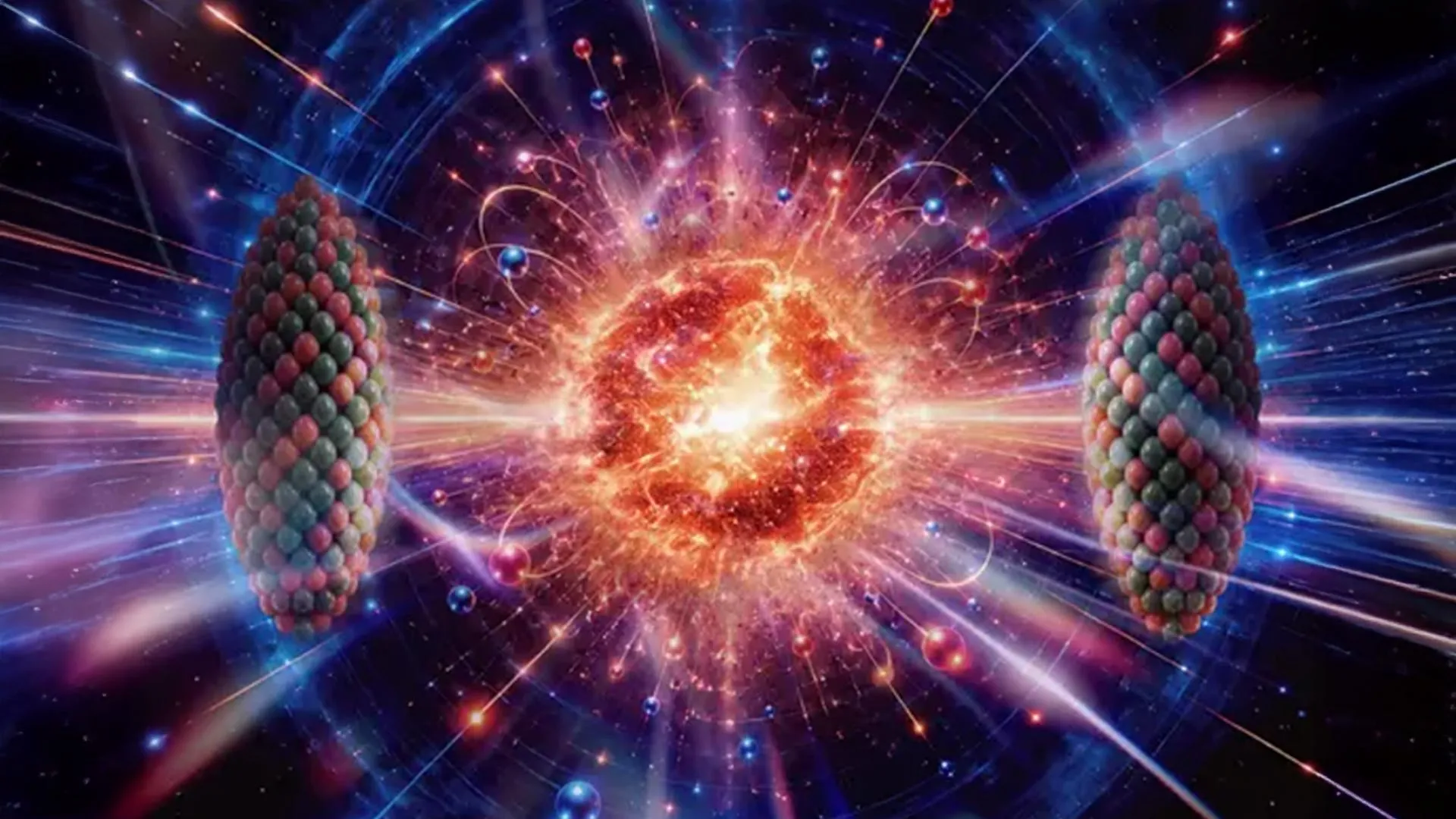
Physicists at Fudan University have used combined transport models to map how acceleration forms and evolves inside quark-gluon plasma, the ultra-hot fluid created when atomic nuclei collide at near-light speed. The team, led by Yu-Gang Ma and Xu-Guang Huang, merged the AMPT and UrQMD models with a Gaussian smearing technique to convert discrete particle data into continuous fluid fields across collision energies from 3.5 GeV to 2.76 TeV.
The simulations reveal that peak proper acceleration reaches several hundred MeV at both low and high energies. The strongest transverse acceleration consistently points outward and concentrates near the fireball's outer boundary, where pressure drops sharply while enthalpy density remains low. According to the relativistic Euler equation, these conditions reinforce each other to produce the acceleration hotspot.
Collision energy changes the plasma's acceleration pattern. At lower energies, nuclear stopping initially decelerates matter by up to about 500 MeV. At ultrarelativistic energies, the nuclei pass through each other so quickly that they pull the newly formed plasma into brief, intense acceleration pulses. The boundary concentration persists regardless of whether collisions are head-on or oblique.
The researchers suggest acceleration may influence more than fluid motion. Through the Unruh effect, an accelerating observer perceives a thermal bath; accelerations of several hundred MeV correspond to temperatures near the QCD transition temperature. This raises the possibility that acceleration could add a new "acceleration axis" to the QCD phase diagram, affecting both the chiral transition and the deconfinement transition.
Acceleration could also generate novel transport effects and influence particle spin alignment, complementing known vorticity-driven effects. Such mechanisms may help explain unresolved spin polarization measurements at RHIC and the LHC. The work frames acceleration as a potential thermodynamic control parameter for QCD matter, not merely a kinematic detail.
The team plans to incorporate more realistic hydrodynamic evolution into their calculations and to identify experimental signatures, particularly patterns in hyperon spin polarization. Connecting non-inertial quantum effects to measurable particle behavior could open a new direction for studying strongly interacting matter.
Scientists reveal the hidden force driving the universe’s hottest fluid
This is an independent summary. The complete reporting, supporting context and any primary documents remain with ScienceDaily.