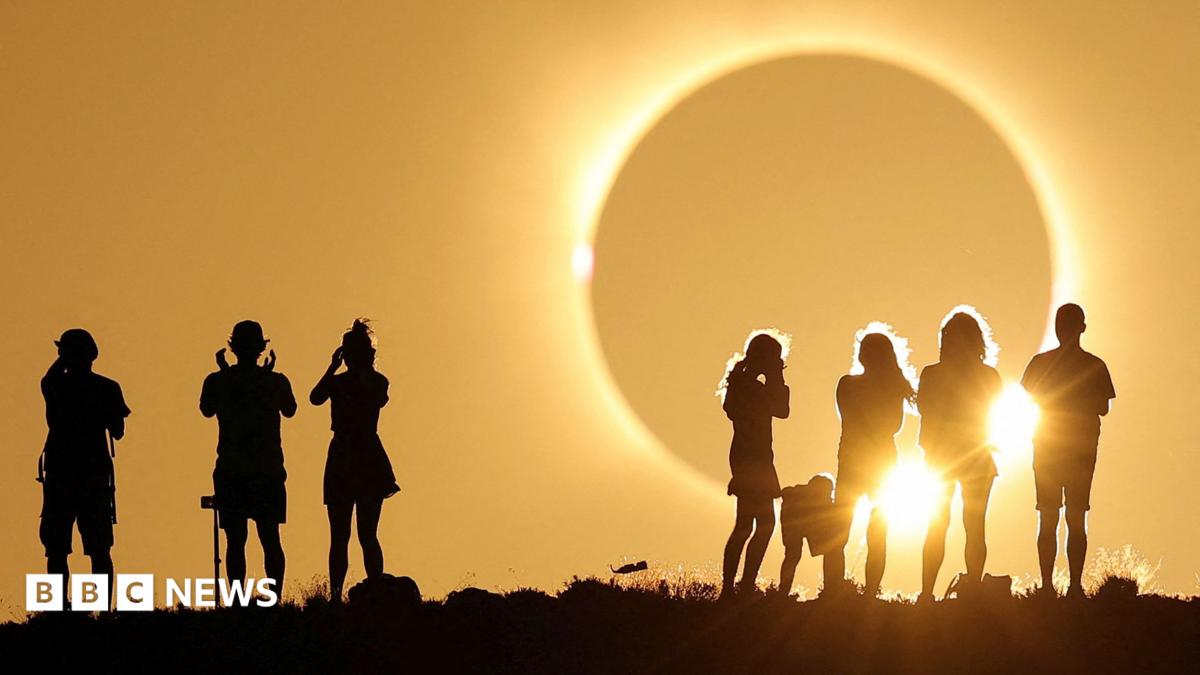
Millions of people across the UK and Europe witnessed a significant solar eclipse on 12 August 2026, the most dramatic such event visible from the UK in nearly 30 years. In the UK, the partial eclipse peaked shortly after 19:00 BST, with the Moon covering more than 90% of the Sun for most observers and up to 95% in Cornwall.
The path of totality, where the Moon completely blocks the Sun, began in northern Siberia before curving across the Arctic Ocean to Iceland and then sweeping south into Spain. Observers in those regions experienced complete darkness for nearly two minutes, revealing the Sun's corona and pink prominences.
Large crowds gathered at landmarks across the UK despite variable cloud cover. Northern England, Scotland and Northern Ireland faced cloudier conditions, while central and southern England and Wales enjoyed largely clear skies.
Demand for certified solar eclipse glasses far outstripped supply in the days before the event, with retailers including opticians, hardware shops and bakeries selling out. Many viewers improvised safe viewing methods using colanders, cereal boxes and pinhole projectors.
A total solar eclipse occurs somewhere on Earth roughly every 18 months, but they are rare for any specific location, occurring about once every 400 years. The alignment is a cosmological coincidence: the Sun is 400 times farther away than the Moon, but the Moon's diameter is 400 times smaller, making them appear nearly identical in size.
Chilean scientist Yasmin Catricheo travelled to A Coruña in north-west Spain for the total eclipse. She described the moment of totality as indescribable, with crowds cheering in shared excitement at the spectacle.
The UK will not see a comparable partial eclipse until 2081, when up to 99% coverage is expected, and the next total solar eclipse visible from the UK will not occur until 2090. A 'golden age' of total eclipses is predicted globally between 2026 and 2028, though none will be visible from the UK.
The event provided a rare, shared public experience of an astronomical phenomenon, prompting widespread engagement with science and the natural world across the continent.
Once-in-a-generation solar eclipse wows millions in UK and Europe
This is an independent summary. The complete reporting, supporting context and any primary documents remain with BBC News.