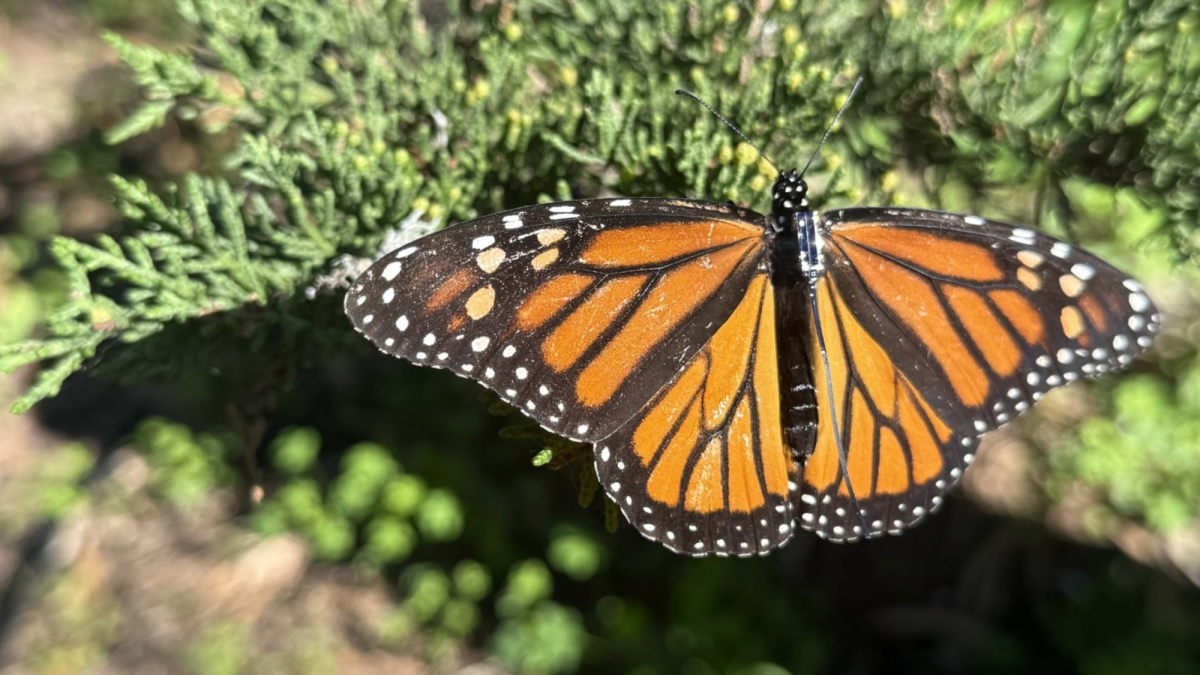
In November 2025, staff from the U.S. Fish and Wildlife Service Coastal Program and the consulting firm Althouse & Meade tagged monarch butterflies at three locations across San Luis Obispo and Santa Barbara Counties in central California. The migratory monarch subspecies was listed as endangered by the IUCN Red List in 2022, and researchers aim to learn how the insects use overwintering habitat and nearby nectar sources.
Each tag consists of a small rectangular box with an antenna, weighing little enough that only butterflies meeting minimum size and weight thresholds were selected. Biologists attached the solar-powered radio telemetry transmitters to the butterflies' backs using eyelash glue. The tags send geospatial data via radio waves, allowing researchers to monitor movement patterns within the overwintering groves.
To minimize stress and prevent flight during handling, the team collected butterflies early in the morning when temperatures were below 55 degrees Fahrenheit. As cold-blooded insects, monarchs cannot fly easily at lower temperatures. Collected individuals were kept in a cooler maintained at or below that threshold while technicians recorded each butterfly's sex, weight, and size before tagging and release.
Weather stations at the overwintering sites are recording environmental conditions simultaneously. The U.S. Fish and Wildlife Service stated that weather data will be analyzed alongside movement data to better understand the monarchs' habitat needs. The project's goal is to inform restoration and management of coastal overwintering groves.
The study also incorporates citizen science through the Project Monarch smartphone application. The app displays a map of all tagged monarchs and allows members of the public to submit observation data, expanding the spatial and temporal coverage of the monitoring effort.
Researchers emphasize that the technology is still being tested. The current deployment serves as a pilot to evaluate whether solar-powered radio telemetry can reliably track monarch movements at the fine scale needed for habitat management decisions.
Monarchs are native to North America and occur in more than 90 countries and island groups wherever milkweed, their caterpillars' sole food source, grows. Both migratory and non-migratory populations exist, but the migratory population has declined sharply in recent decades.
Understanding fine-scale habitat use during the overwintering period is considered critical because the butterflies spend months relatively stationary in coastal groves before dispersing in spring. The quality of these sites directly affects survival and reproductive success for the following breeding season.
Putting tiny backpacks on butterflies—for science
This is an independent summary. The complete reporting, supporting context and any primary documents remain with Popular Science.