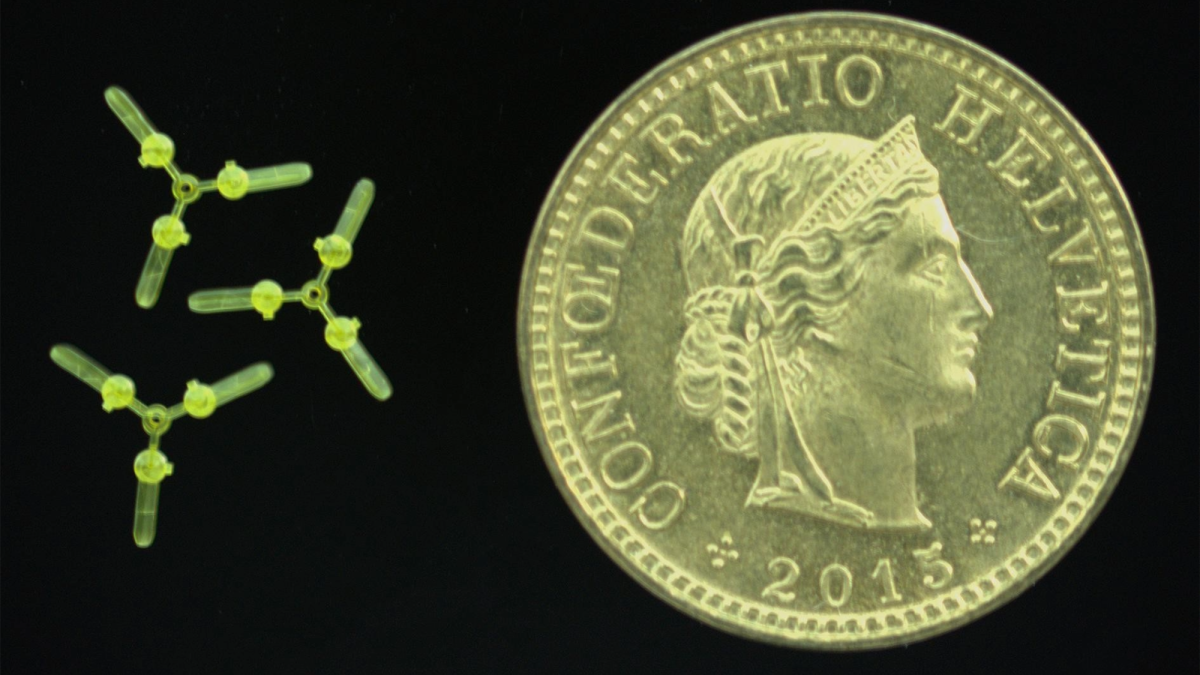
Engineers at the École polytechnique fédérale de Lausanne (EPFL) have demonstrated that sound waves can power and steer tiny drones and boats through a phenomenon called Helmholtz resonance. The study, published in Science Advances, shows that carefully designed cavities can convert acoustic energy into directed thrust.
Helmholtz resonance occurs when air trapped in a cavity oscillates in response to airflow, producing a tone like the hum heard when blowing across a bottle opening. The researchers found that when sound waves enter such cavities, the exiting air forms a concentrated jet while the incoming flow remains diffuse, creating a net force in one direction.
The team 3D-printed cavities in various shapes, sizes, and materials to maximize thrust. They then built miniature boats fitted with up to three resonators tuned to different frequencies. By changing the frequency emitted from a speaker, the researchers steered the boats around obstacles in a small pool and programmed one to trace the letters EPFL.
The lab also created coin-sized "microfliers" with microscopic cavities integrated into their structures. Powered by ultrasonic frequencies inaudible to humans, one microflier generated upward thrust while another spun tiny blades at up to 13,000 revolutions per minute to achieve helicopter-like lift.
Study co-author Selman Sakar said the approach transforms a simple mechanical piece into robotic matter by harnessing sound at specific frequencies for controlled motion. Co-author Junsun Hwang added that the concept is compatible with further miniaturization.
Future designs could embed multiple sound-responsive structures into a single flexible device, allowing specific parts to move, bend, or vibrate in response to acoustic signals. This could lead to shape-changing aerodynamic robots.
The experiments were conducted in a controlled laboratory environment using external speakers as the sound source. The paper does not specify the sound pressure levels required or the maximum operating distance from the source.
Researchers note that the technology remains at an early proof-of-concept stage. Practical deployment would require addressing power transmission efficiency, environmental noise interference, and scaling of the acoustic source.
Sound waves power these tiny drones
This is an independent summary. The complete reporting, supporting context and any primary documents remain with Popular Science.