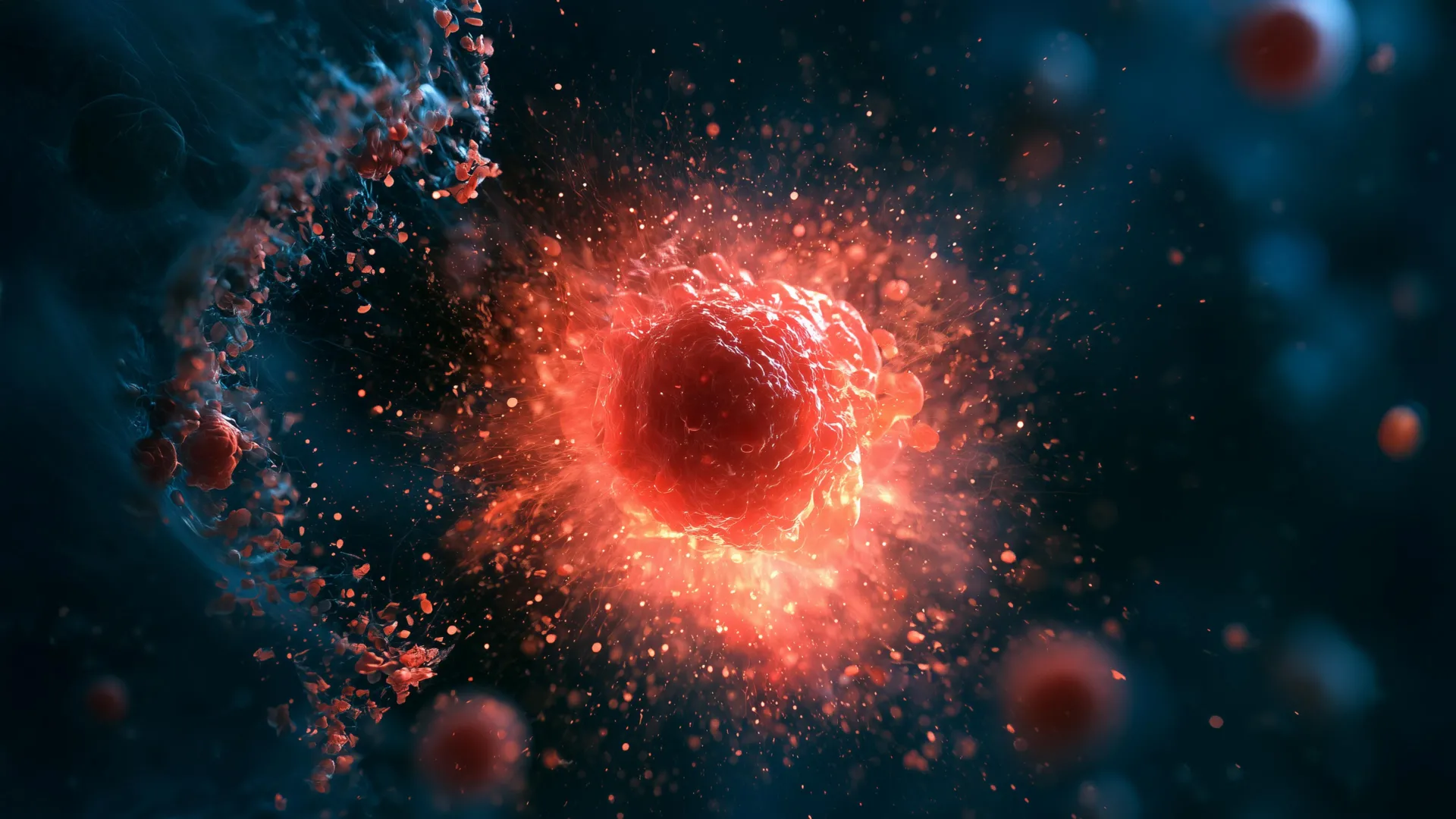
Stanford University researchers have identified a previously unknown immune cell in planarian flatworms that destroys threats by exploding. The cells, named ruptoblasts, rupture within seconds to minutes of activation, releasing substances that kill adjacent bacteria and foreign cells before the cell itself vanishes almost completely.
The discovery emerged from experiments testing whether flatworms can distinguish their own tissue from that of another individual. When researchers fused tissue from unrelated worms, the animals mounted a severe inflammatory response that rejected the foreign tissue within days. Lead author Chew Chai, a postdoctoral researcher in the lab of senior author Bo Wang, traced this reaction to a surge in the hormone activin.
Injecting activin into healthy flatworms triggered the same inflammatory cascade. Using live-cell microscopy and flow cytometry, Chai isolated a small population of cells that responded to activin by bursting open and disappearing within five minutes. The team named this explosive form of cell death "ruptosis" to distinguish it from slower, pore-based mechanisms observed in some mammalian cells and bacteria.
Ruptoblasts differ fundamentally from familiar vertebrate immune cells such as T cells and neutrophils. While those are hematopoietic cells produced in bone marrow, ruptoblasts are glandular cells that appear to intensify their normal secretion machinery to release toxic contents violently. A rapid calcium surge from the endoplasmic reticulum helps drive the process.
In laboratory tests, ruptoblasts destroyed E. coli bacteria, human kidney cells, and mouse blood cells. The damage remained tightly localized to cells in immediate proximity to the explosion, without spreading through a chain reaction or leaving persistent toxicity. Wang, an associate professor of bioengineering, suggested this precise, high-intensity attack could inspire future treatments targeting bacterial infections or tumors.
Searches for similar cells in other species found them only in basal bilaterians such as flatworms, suggesting ruptoblasts originated early in animal evolution. Wang noted that vertebrates may have lost this defense because they lack the flatworm's extraordinary capacity to regenerate damaged tissue using abundant stem cells. The findings highlight how studying non-traditional model organisms can reveal immune strategies absent from humans.
The study was published in the journal Cell and involved collaborators from Ben Gurion University of the Negev. Funding came from the National Science Foundation, Stanford fellowships, the Human Frontier Science Program, the National Institutes of Health, and the European Research Council.
Stanford scientists discover immune cells that explode like microscopic bombs
This is an independent summary. The complete reporting, supporting context and any primary documents remain with ScienceDaily.