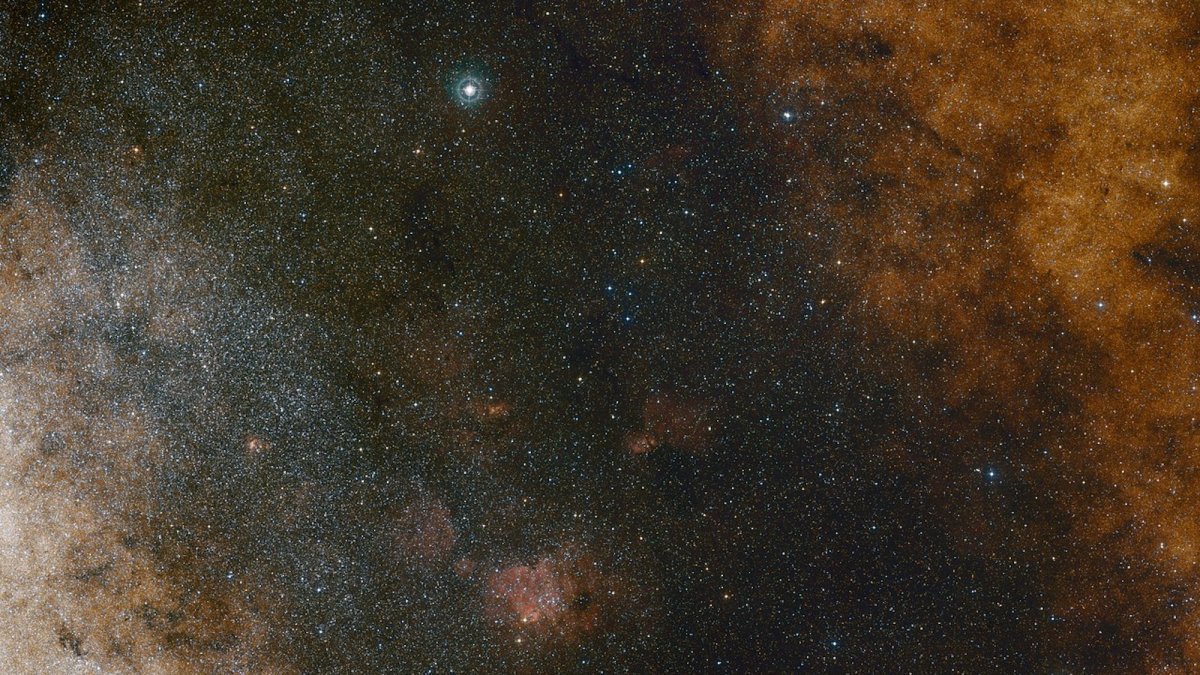
Astronomers have identified a star orbiting the Milky Way's central supermassive black hole, Sagittarius A*, at a distance of roughly 12 times the Earth-Sun separation — approximately the distance between Earth and Saturn. Designated S301, the star completes an orbit every 8.7 years while reaching speeds exceeding 15,500 miles per second, or more than eight percent of the speed of light.
The discovery, published in Nature, marks the closest and fastest star ever observed near Sagittarius A*, a black hole with a mass over four million times that of the Sun. Researchers at the Max Planck Institute for Extraterrestrial Physics (MPE) first detected S301 in 2023 using the European Southern Observatory's Very Large Telescope Interferometer (VLTI) in Chile, combined with the GRAVITY+ instrument.
The VLTI links four 26-foot telescopes to achieve a virtual aperture with 15 times the spatial resolution of a single telescope. This capability allowed the team to track S301, which is two billion times fainter than the star Betelgeuse, and reconstruct its orbital history back to 2017.
The star's extreme proximity to the black hole creates a unique laboratory for testing general relativity. Physicists have long predicted that a spinning black hole drags spacetime around it — a phenomenon known as the Lense-Thirring effect — which would subtly alter the orbits of nearby stars over time.
Prior to this discovery, measuring the spin of Sagittarius A* was expected to require decades of observations across multiple stars. Study co-authors Felix Mang and Stefan Gillessen of MPE, along with Nobel laureate Reinhard Genzel, suggest that tracking S301 alone could yield a direct measurement of the black hole's spin within a single decade.
S301 may have originated as part of a binary star system that was torn apart by the black hole's tidal forces. While one star was captured into the tight orbit observed today, the companion was likely ejected from the Milky Way entirely at hypervelocity speeds.
The researchers emphasize that S301's orbit opens a new window into the fundamental properties of spacetime in an extreme gravitational environment. A direct measurement of the black hole's spin would constitute a key test of Einstein's theory of general relativity under conditions that cannot be replicated on Earth.
Continued monitoring of S301's trajectory with the VLTI and GRAVITY+ is planned to refine orbital parameters and search for the relativistic precession effects that would reveal the black hole's rotation.
A star spinning at 15,000 miles per second tests Einstein theory of relativity
This is an independent summary. The complete reporting, supporting context and any primary documents remain with Popular Science.