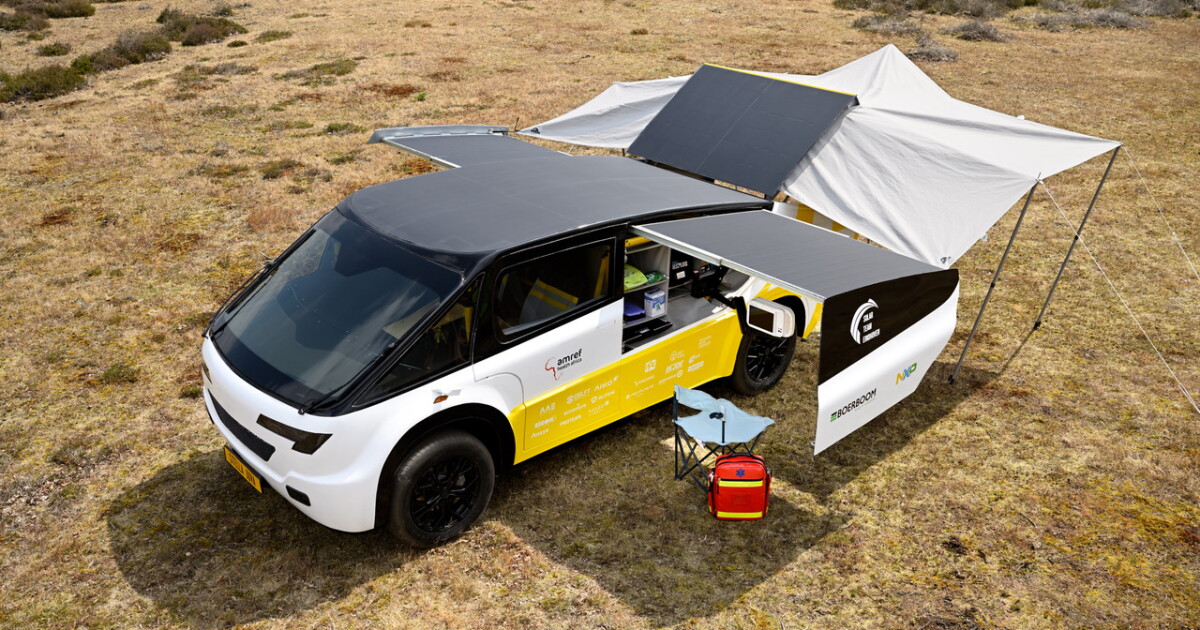
Students at Eindhoven University of Technology have completed the Stella Juva, a solar-powered ambulance designed to operate as a self-sustaining mobile clinic in remote, off-grid areas. The vehicle was developed by Solar Team Eindhoven, a non-profit student group with a history of building solar-powered vehicles for the World Solar Challenge.
The Stella Juva uses advanced All Back Contact photovoltaic cells manufactured by AIKO, which move electrical contacts to the rear of the cell to maximize energy capture and improve durability under off-road vibration. The solar array feeds a 50-kWh lithium-based battery pack, enabling a claimed range of up to 715 kilometers (444 miles) on a sunny day and a top speed of 120 km/h (75 mph).
A carbon-fiber-composite chassis keeps the vehicle weight at approximately 1,350 kg, less than half the weight of a conventional ambulance. The electrical architecture separates the drivetrain from the medical cabin, ensuring that life-support equipment remains powered even if the driving battery is depleted. Pure sine wave inverters protect sensitive diagnostic tools from voltage fluctuations.
Inside the climate-controlled cabin, the vehicle carries an X-ray machine for tuberculosis screening, ultrasound equipment for prenatal care, rapid malaria testing facilities, automated external defibrillators, and a high-efficiency refrigeration unit for vaccines and medications. The team describes the unit as a stand-alone emergency room rather than a transport ambulance.
The prototype is not intended for mass production. Instead, the team has published open-source engineering blueprints to demonstrate to manufacturers and global health organizations that zero-emission, off-grid medical transit is viable. Solar Team Eindhoven operates on corporate sponsorships, academic backing, and non-profit partnerships.
This month, the Stella Juva is being transported to Kenya for extensive field testing in collaboration with Amref Health Africa. The trials will run the vehicle through real-world medical scenarios across challenging terrain to gather operational data. The team hopes the results will help shape future rural healthcare delivery models worldwide.
World's first solar-powered ambulance hits the real world
This is an independent summary. The complete reporting, supporting context and any primary documents remain with New Atlas.