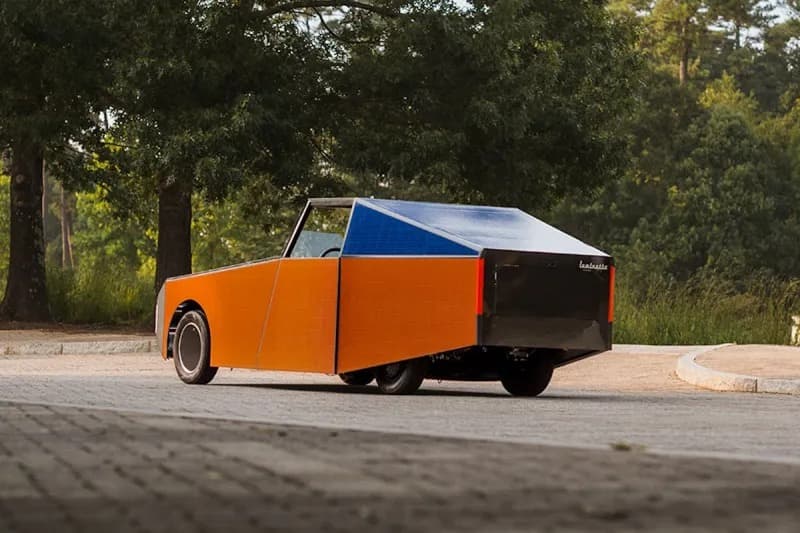
Graduate students at Clemson University have completed the Deep Orange 17 prototype, a solar-electric vehicle designed to produce more energy than it consumes during normal use. The project, supported by BMW, was finished in August 2026 after two years of development.
The vehicle, nicknamed Luminetta, weighs 550 kg, a mass comparable to lightweight track-focused cars such as the Caterham 7 or Ariel Atom. Weight savings come from a skeletal chassis that uses 3D-printed metal joints and lightweight composite body panels.
Its most distinctive feature is a flexible, shade-tolerant photovoltaic skin developed with Germany's Fraunhofer Institute for Solar Energy Systems (Fraunhofer ISE). Unlike rigid flat panels, the curved solar skin covers the entire exterior, allowing the car to harvest sunlight from multiple angles throughout the day.
Calculations from Clemson show that a typical daily drive of 20 km requires about 1.6 kWh of energy. Under optimal sunlight, the car can generate up to 5.7 kWh per day, leaving a surplus equivalent to roughly 50 km of additional range.
Researchers acknowledge that the energy-positive result depends on ideal conditions: open parking, clear skies, and no shading from trees or buildings. Crash safety and passenger comfort have not been evaluated, as the prototype was never intended for series production.
BMW's research and new technology project manager, Stefan Augustin, described the build as a multi-year ambition to see students overcome technical constraints and deliver an energy-positive vehicle. The prototype serves as a physics demonstration rather than a commercial product.
The angular, boxy appearance has drawn comparisons to structures from the game Minecraft, with some observers calling it more radical than the Tesla Cybertruck. The design prioritizes maximum solar surface area and minimal weight over conventional styling.
Deep Orange 17 remains a research platform. Its creators emphasize that the goal was to prove the concept of net-positive energy balance in a drivable vehicle, leaving further engineering for future iterations.
Солнечный автомобиль, который выглядит как из Minecraft, собирает больше энергии, чем тратит
This is an independent summary. The complete reporting, supporting context and any primary documents remain with iXBT.