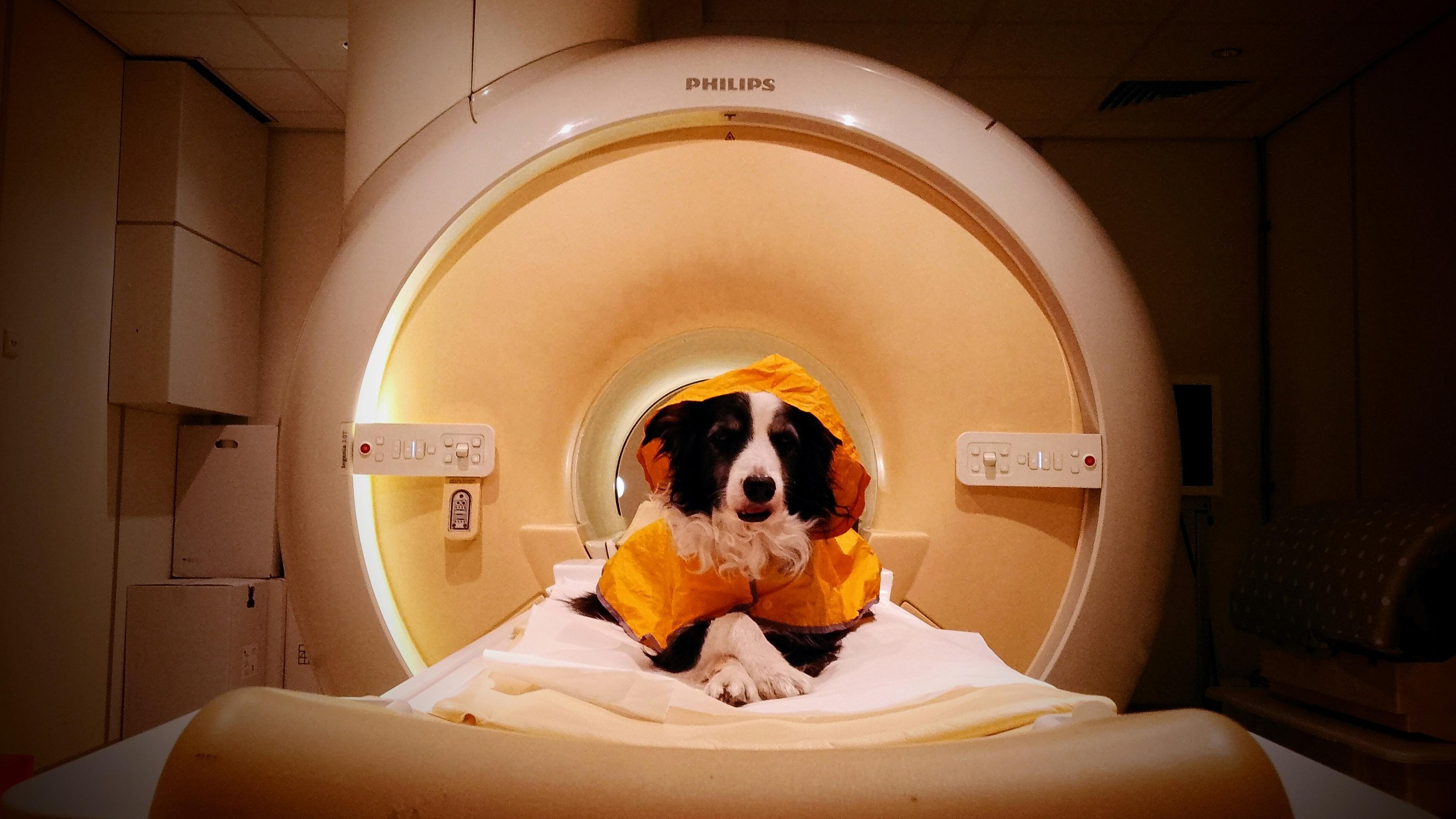
Researchers at the University of Vienna used functional magnetic resonance imaging to study how dogs process human facial expressions, publishing their findings in the journal iScience. The study involved 14 dogs — 11 border collies, two golden retrievers, and one Labrador — trained over at least 20 sessions to remain still for up to 10 minutes inside an MRI scanner.
In the first experiment, dogs viewed images of happy and neutral human faces. Happy faces activated the dogs' temporal cortex and caudate nucleus, regions associated in humans with visual processing, memory, reward, and motivation. Neutral faces did not elicit the same response in either region.
A second experiment presented happy, neutral, angry, fearful, and sad faces to test whether dogs categorize emotions simply as positive or negative. The results showed distinct neural activation patterns for different negative emotions.
Sadness and fear activated the right rostral suprasylvian gyrus, a region linked in humans to visual information processing. Anger and fear engaged the right ectosylvian gyrus, which integrates sensory information, and the left splenial gyrus, involved in visual perception and spatial orientation.
Lead author Raúl Hernández Pérez said the findings demonstrate that the dog brain exhibits detailed processing of human emotions rather than a binary positive-negative classification. Co-author Laura Cuaya noted that chimpanzees have more difficulty with this task than dogs, and wolves perform at a lower level.
Previous research has shown dogs look longer at emotional faces than neutral ones, focus more on the eyes of happy faces, and read faces of their primary caregiver's gender more accurately. The current study adds a neural basis to these behavioral observations.
The researchers suggest understanding canine emotion perception can improve human-dog communication. Cuaya noted humans often misread dog emotions, and the work may encourage greater awareness. She added that dogs in the scanner responded to strangers' faces, implying stronger activation would occur with familiar caregivers expressing affection.
The study builds on an estimated 14,000-year history of dog-human coexistence. The authors argue that deeper knowledge of the canine contribution to this bond can help humans improve their side of the relationship.
Your Dog Really Can Tell When You're Happy
This is an independent summary. The complete reporting, supporting context and any primary documents remain with TIME.