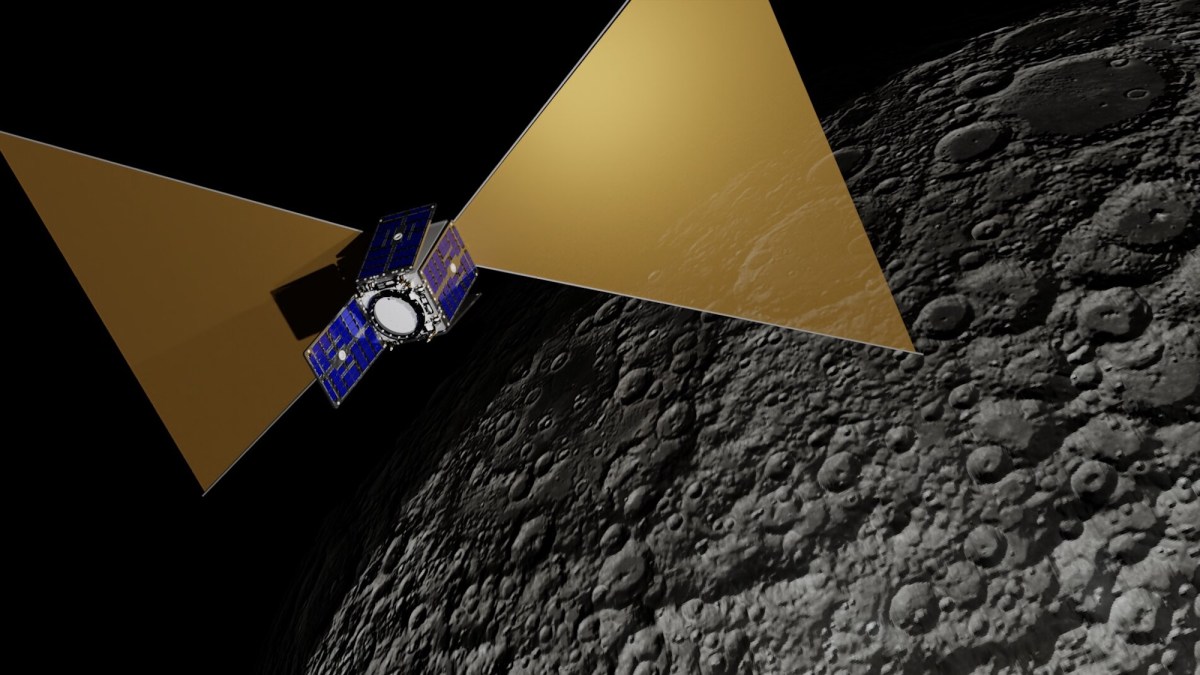
An international team of astronomers has proposed a suitcase-sized satellite called CosmoCube to detect faint radio signals from the universe's "cosmic dark ages," the period roughly 150 million years after the Big Bang before the first stars formed.
The satellite would target the 21-centimeter hydrogen line, a signal emitted by neutral hydrogen atoms over 13.5 billion years ago that carries information about early structure formation and dark matter.
Earth's ionosphere blocks these low frequencies, while human-made radio interference from FM broadcasts, telecommunications, and satellites makes ground-based observation effectively impossible.
CosmoCube would orbit the moon and use its far side as a shield, providing roughly 40 minutes of interference-free observation per two-hour orbit to accumulate an estimated 1,000 hours of data over a two-year mission.
The design includes a lightweight radio antenna and a navigation system that constantly cross-references onboard data with external references to distinguish internal satellite noise from genuine cosmic signals.
Researchers at the University of Cambridge and the U.K.'s national space laboratory are currently testing thermal models of the satellite and estimate it could be launch-ready within five years with additional support.
The team notes urgency because planned missions by the United States and India to the lunar far side may introduce new radio interference that would compromise the uniquely quiet environment required for the measurement.
If successful, the data would be processed through mathematical models to remove foreground contamination from galactic radio signals and other residual noise, potentially revealing how dark matter pulled hydrogen into the first stars and galaxies.
A suitcase-sized satellite may unlock the secrets of the early universe
This is an independent summary. The complete reporting, supporting context and any primary documents remain with Popular Science.