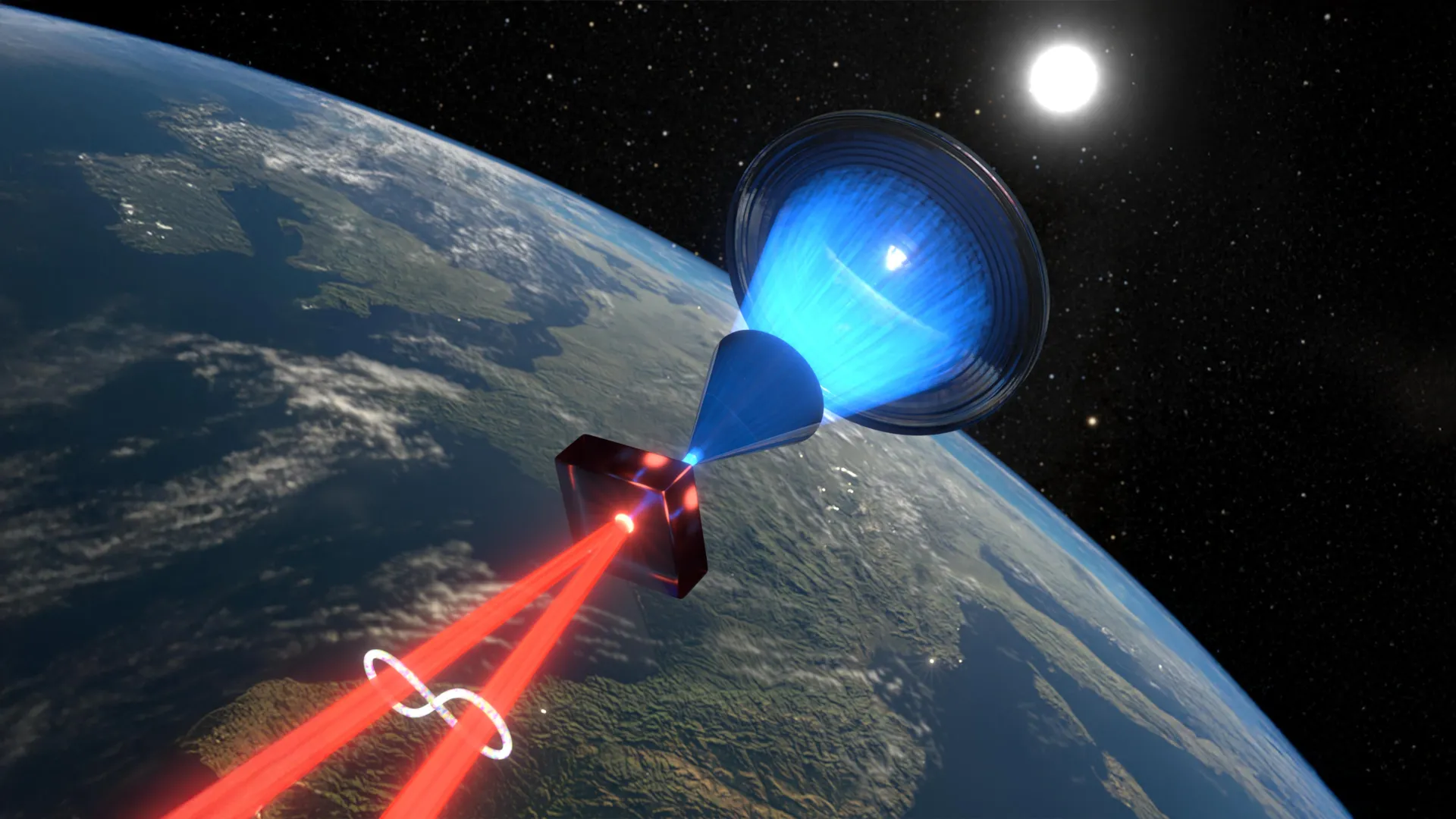
Scientists at the University of Ottawa and the Max Planck Institute for the Science of Light have demonstrated that ordinary sunlight can generate quantum entanglement between photons, a task previously thought to require highly coherent laser light. The outdoor experiment, conducted at the Max Planck Institute in Germany, used a custom all-glass solar concentrator to focus sunlight onto a millimeter-scale nonlinear crystal.
The concentrator employs a Fresnel lens roughly the size of a household window to collect sunlight and channel it into an optical fiber about the width of a human hair. This concentrated beam drives spontaneous parametric down-conversion in the crystal, splitting individual pump photons into polarization-entangled pairs. The sunlight was strongly polarized but remained highly incoherent in both space and wavelength.
Quantum state tomography showed the resulting photon pairs achieved about 94% similarity to a perfectly entangled state. The correlations also violated Bell's inequality, confirming that the entanglement is genuinely quantum and cannot be explained by classical physics. The fidelity matches levels typically obtained with laser-based sources when spectral bandwidth differences are accounted for.
The work builds on earlier theoretical predictions from Robert Boyd's group at the University of Ottawa that incoherent light could produce entanglement if the quantum correlations reside in a degree of freedom, such as polarization, that remains ordered. Previous lab tests used LEDs; the new study replaces the LED with sunlight, which is far more disordered in direction and color.
Cheng Li, first author of the paper published in Optica, said the approach could eventually allow satellites to generate secure encryption keys using abundant sunlight in orbit, reducing the need for onboard lasers and supporting hardware. The researchers are now working to increase the brightness of the source and further improve entanglement quality.
The team notes that the underlying principle is not limited to spontaneous parametric down-conversion and could extend to other nonlinear processes such as four-wave mixing. If scaled, sunlight-driven entanglement could lower the energy footprint of quantum networks and computing platforms.
Sunlight creates quantum entanglement once thought to require lasers
This is an independent summary. The complete reporting, supporting context and any primary documents remain with ScienceDaily.