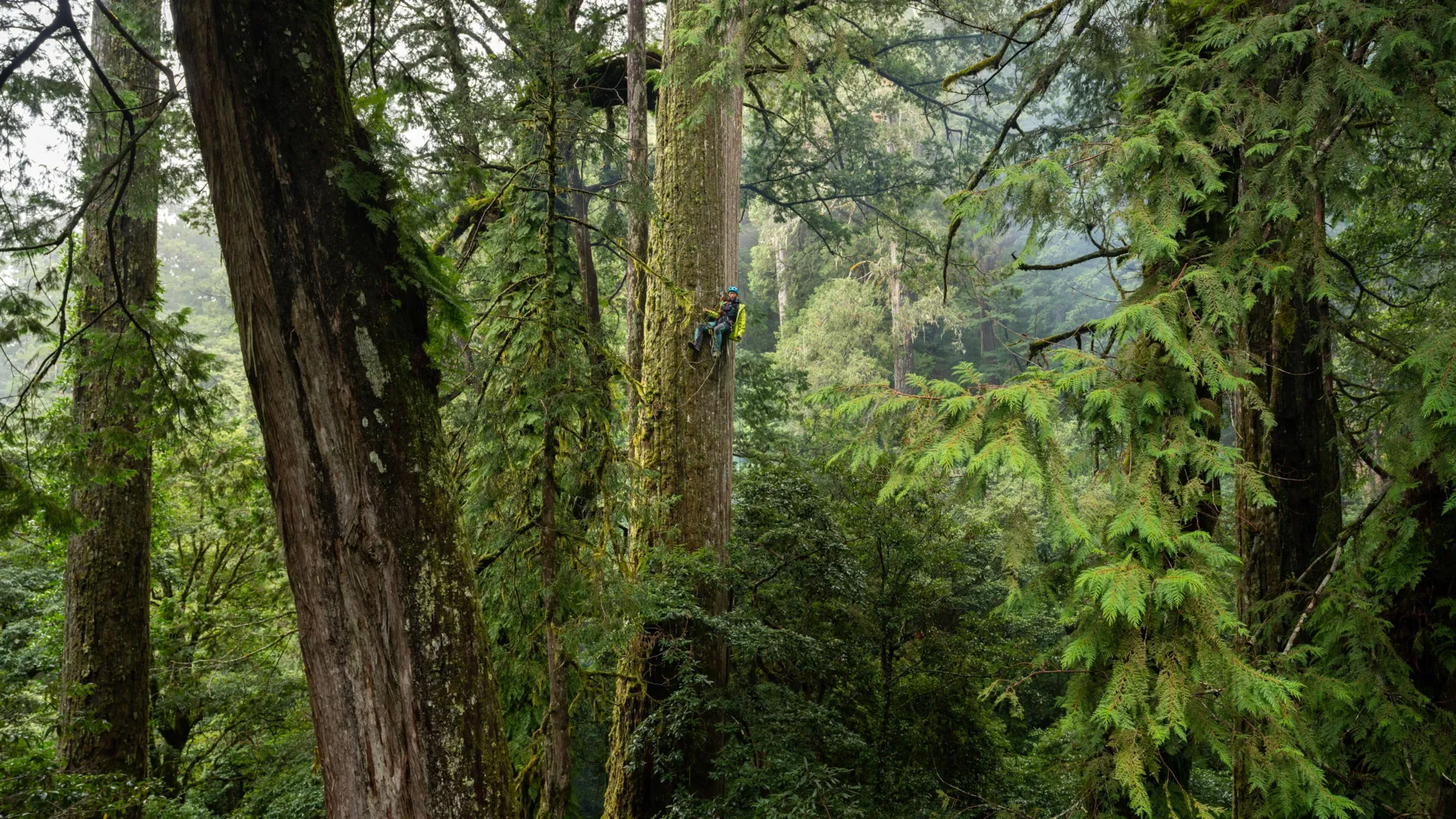
A research team known as the Taiwan Tree Seekers has spent more than a decade searching for and measuring giant Taiwania firs (Taiwania cryptomerioides) in the island's remote, steep mountains. The group combines professional tree climbers, ecologists, geologists, and remote-sensing specialists from the Taiwan Forestry Research Institute and National Cheng Kung University.
Early expeditions in 2014 documented the "Chilan Three Sisters" in the Cilan conservation area, with the tallest reaching 69.3 meters. Ground surveys proved unreliable in dense, multi-layered canopies, prompting the team to adopt airborne LiDAR scanning to map tree heights across vast, inaccessible terrain.
Automated LiDAR analysis initially misidentified 93 percent of candidate trees due to terrain effects such as cliffs and sharp elevation changes. Starting in 2020, hundreds of citizen scientists reviewed LiDAR profiles to filter false positives, producing a "Taiwan Giant Tree Map" of 941 trees taller than 65 meters by late 2022.
In January 2023, the team used the map to locate and climb the strongest candidate near the Da'an River. After a 20-kilometer river trace and two days of uphill hiking, climbers lowered a tape from the crown to confirm a height of 84.1 meters, making it the tallest known tree in Taiwan and all of East Asia. The tree was named the "Heaven Sword of the Da'an River."
By early 2026, the project had identified and climbed ten Taiwania trees exceeding 70 meters, with two surpassing 80 meters. The map also revealed extraordinary concentrations dubbed "temples of giants," including one hectare near Mt. Benya containing 11 trees over 65 meters and a dense stand of roughly 30 giant Taiwania firs growing together in a pure forest.
A 2024 carbon-density study in the "Tao Tree" valley, involving 15 citizen scientists, measured total aboveground carbon at 1,384.5 megagrams per hectare, excluding root systems. This figure places Taiwan's giant forests among the most carbon-dense ecosystems on Earth, comparable to the planet's most celebrated old-growth forests.
Industrial logging from 1912 to 1991 removed much of Taiwan's primary forest, but the steepest and most inaccessible terrain acted as a natural barrier, preserving these old-growth stands. About 60 percent of the island remains forested, with an estimated 950 million trees across elevations ranging from tropical lowlands to alpine tundra.
The Indigenous Rukai people refer to these firs as "the tree that hits the moon." The findings are detailed in a 2026 paper in Frontiers in Forests and Global Change by Rebecca Chia-Chun Hsu, Chi-Kuei Wang, and Chung-Cheng Lee.
Scientists went looking for giant trees in Taiwan and found a lost world
This is an independent summary. The complete reporting, supporting context and any primary documents remain with ScienceDaily.