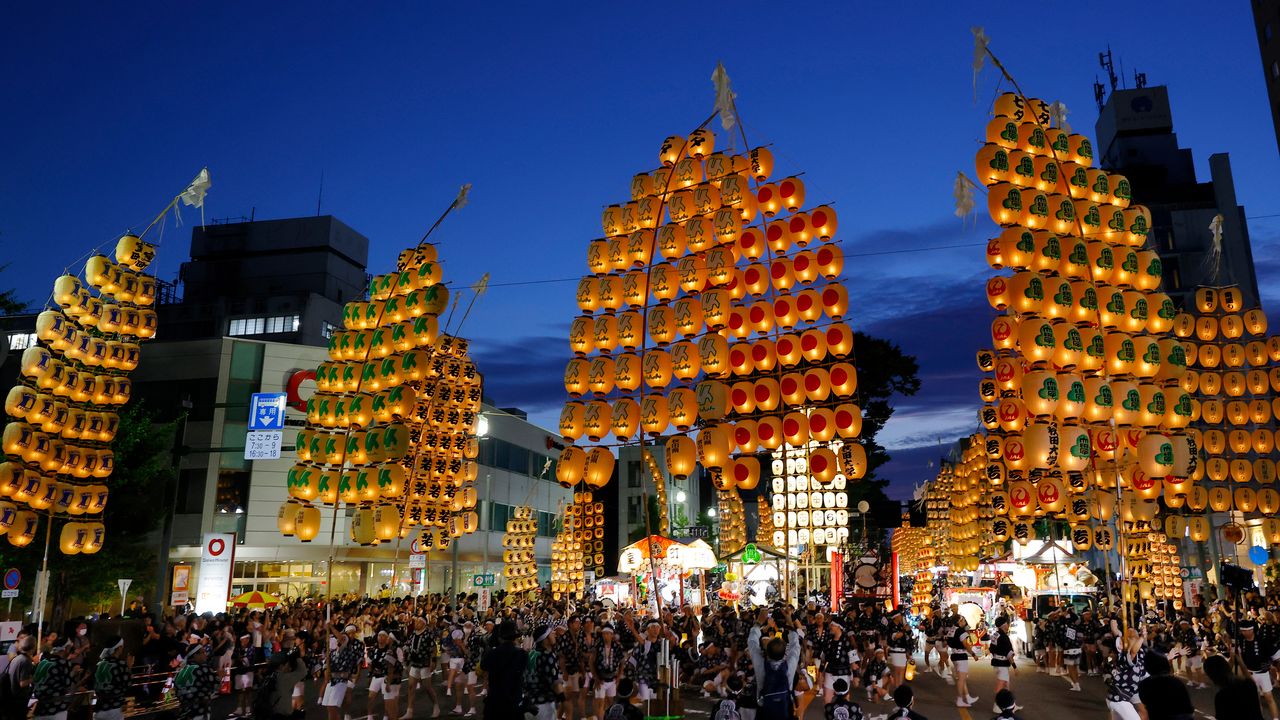
Three major Japanese festivals continue the tradition of illuminating summer nights with thousands of paper lanterns, each event drawing on distinct regional customs that date back centuries. The Akita Kantō Matsuri, Owari Tsushima Tennōsai, and Nihonmatsu Chōchin Matsuri feature large-scale nighttime processions where lanterns serve both decorative and symbolic roles in rituals for good health, bountiful harvests, and the warding off of misfortune.
The Akita Kantō Matsuri, held August 3–6 in Akita Prefecture, is described as Japan's largest lantern festival and one of the three great festivals of the Tōhoku region. Performers balance bamboo frames called kantō, ranging from 5 to 12 meters long and weighing up to 50 kilograms, adorned with up to 46 candlelit lanterns each. Over 10,000 lanterns illuminate the main street near Akita Station as bearers execute acrobatic transfers of the frames from hands to shoulders and hips. The festival originated as a summer ceremony to transfer impurities to paper decorations and lanterns, which were then washed away in rivers.
In Tsushima, Aichi Prefecture, the Owari Tsushima Tennōsai takes place on the fourth weekend of July at Tennōgawa Park. Five straw boats decorated with nearly 500 lanterns — including 365 on each of five bamboo poles representing days of the year and 12 on a central pole for months — are paraded across a pond at dusk. The lanterns' reflection on the water creates what organizers describe as an enchanting atmosphere. The festival honors Susanoo no Mikoto, a deity syncretized with the Indian god Gozu Tennō, and includes a morning ritual where men swim to a portable shrine to offer cloth banners. Historical records suggest the festival began around 600 years ago.
The Nihonmatsu Chōchin Matsuri occurs on the first Saturday, Sunday, and Monday of October in Nihonmatsu, Fukushima Prefecture. Seven neighborhood floats carry over 2,000 lanterns in total, making it one of the country's largest lantern processions. The festival opens with a departure ceremony where men race to light eight tall lanterns called suginari, representing the deity, using torches lit from a sacred shrine flame. Musicians atop the floats play distinctive shangiri music that changes key as the floats navigate hills, continuing past midnight. The event began in the early Edo period and expanded over time to include the lantern-decorated floats.
Lanterns entered Japan from China toward the end of the Heian period (794–1185) for use in palaces and temples. During the Edo period (1603–1868), improved Japanese candles made from haze sumac wax popularized foldable, portable lanterns for everyday use. While modern lanterns often use lightbulbs, the three festivals maintain candlelit traditions. In each case, the lanterns function as more than illumination: they guide ancestral spirits during midsummer bon observances, bear the names of donors expressing gratitude to deities, and serve as vessels for symbolically transferring impurities before disposal in water.
The festivals share a common historical purpose of driving away pestilence and ensuring community well-being during the demanding summer agricultural season. The Akita Kantō Matsuri and Aomori Nebuta Matsuri were intended to keep farmers awake during planting season, while the Owari Tsushima Tennōsai and Nihonmatsu Chōchin Matsuri evolved from prayers for health during epidemic-prone summers. Today, the events attract spectators who witness the preservation of performance techniques, music, and craftsmanship passed down through generations.
Each festival involves extensive community participation, from children practicing festival music year-round in Nihonmatsu to young boys performing on boats in Tsushima. In Akita, children also perform with smaller kantō frames. The events require overnight labor, such as the Tsushima organizers who redecorate boats between the night and morning processions. These collective efforts sustain not only the visual spectacle but also the social cohesion and cultural transmission that underlie the festivals' continued relevance.
Lantern Festivals Light Up the Evening Skies
This is an independent summary. The complete reporting, supporting context and any primary documents remain with Nippon.com.