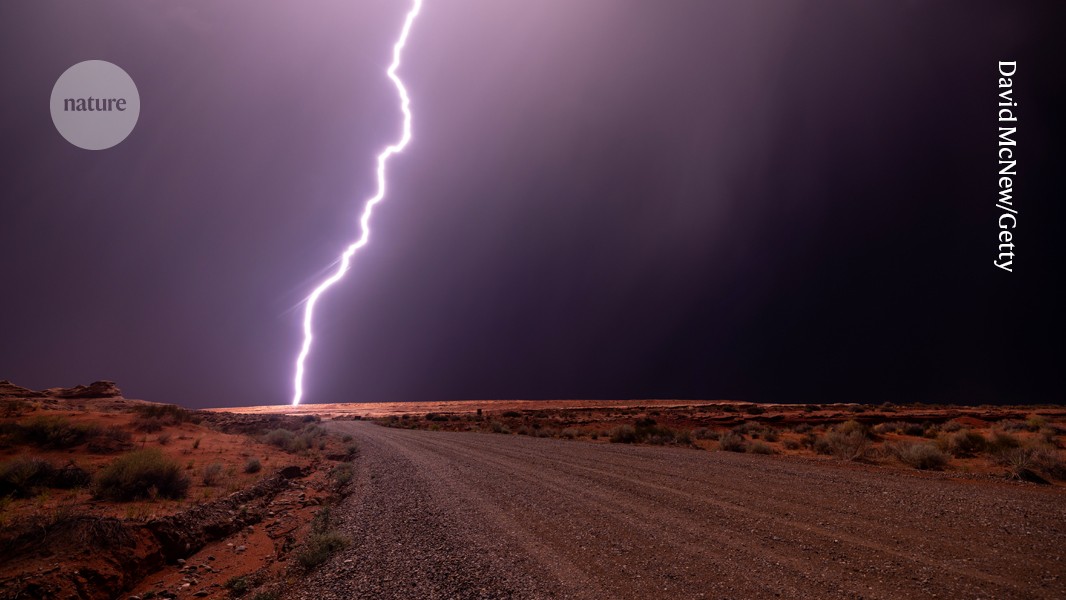
Researchers have demonstrated that thunderquakes — ground vibrations caused by loud thunderclaps — can be used to map hidden geological structures. The study, published in Science Advances, shows that the varying speeds of these vibrations reveal subsurface features in regions where traditional seismic data are scarce.
Thunderquakes occur when the acoustic energy from a thunderclap couples with the ground, creating measurable seismic waves. Unlike earthquakes, which are unpredictable and unevenly distributed, thunderstorms are frequent and widespread, providing a regular source of seismic energy.
The team analyzed recordings from seismic stations during thunderstorms, isolating the signals generated by individual thunderclaps. By measuring how fast these waves traveled through the ground at different frequencies, they inferred the stiffness and layering of near-surface materials.
The method was tested in an area with low natural seismicity, where conventional earthquake-based tomography would be ineffective. Results showed that thunderquake data could resolve geological boundaries and velocity changes in the upper crust.
Because thunderstorms occur globally, the technique could be applied in many regions lacking dense seismic networks or active tectonics. It also avoids the cost and environmental impact of artificial seismic sources such as controlled explosions or vibroseis trucks.
The researchers note that thunderquake signals are weaker and noisier than those from large earthquakes, limiting their depth penetration and resolution. However, the abundance of thunderclaps allows for stacking many events to improve signal quality.
Future work will explore combining thunderquake data with other ambient noise sources, such as ocean microseisms or human activity, to build more complete subsurface models. The approach may be especially useful for monitoring changes in groundwater, permafrost, or landslide-prone slopes over time.
Earth-shaking thunder probes underground geology
This is an independent summary. The complete reporting, supporting context and any primary documents remain with Nature.