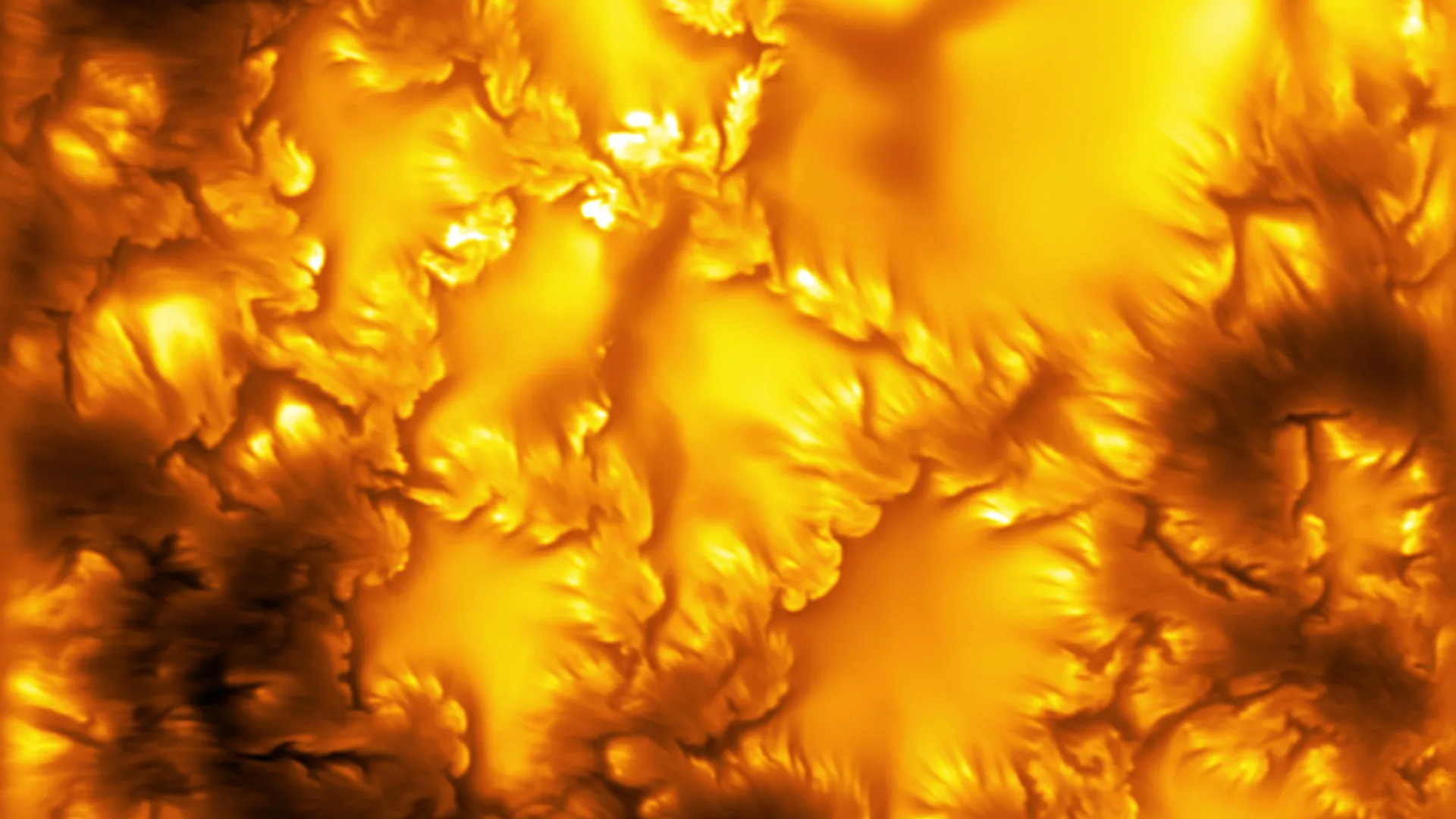
Scientists have detected previously unseen plasma vortices swirling across the Sun's visible surface, some measuring only about 20 kilometers wide. The discovery comes from a collaboration among the U.S. National Science Foundation National Solar Observatory, the Max Planck Institute for Solar System Research in Germany, and the High Altitude Observatory in the United States.
The team combined the highest-resolution images ever taken of the solar photosphere, captured by the Daniel K. Inouye Solar Telescope in Hawaii, with advanced computer simulations. A broadband imaging camera provided by the Max Planck Institute contributed to the observations, which were then processed with image-restoration techniques to reveal motions at the limit of current instrumental capability.
The tiny whirlpools appear along the edges of solar granules, the convective cells that give the Sun its mottled appearance. Granules typically span 500 to 2,000 kilometers, and hot plasma rises in their centers before cooling and sinking at their boundaries. At these boundaries, researchers resolved fine, fringe-like structures that repeatedly develop swirling motions resembling breaking ocean waves.
The swirling flows are interpreted as Kelvin-Helmholtz instabilities, a well-known fluid-dynamics phenomenon that arises when adjacent layers of fluid move at different speeds. Similar instabilities occur in Earth's oceans, clouds, and the atmospheres of Jupiter and Saturn. At granule boundaries, neighboring plasma layers appear to travel at different velocities, creating the shear conditions needed for these instabilities to form.
The vortices may help answer a long-standing question about how the Sun's magnetic field lines become twisted and coiled, storing energy that is later released in events such as nanoflares. Because the vortices appear continuously wherever the magnetic field is sufficiently strong, they could provide a persistent mechanism for twisting field lines, analogous to winding a spring.
The analysis also suggests the mini-vortices efficiently mix magnetized and non-magnetized plasma at the solar surface. This mixing could accelerate the transport of magnetic flux from the surface into the Sun's atmosphere, a process that current models struggle to explain at the observed speed. Rapid magnetic diffusion is essential for driving the Sun's roughly eleven-year activity cycle.
The findings were published in Nature by a team led by David Kuridze and including Friedrich Wöger, Michiel van Noort, Matthias Rempel, Robert Cameron, Thomas Rimmele, Sami K. Solanki, Sarah A. Jaeggli, Alexandra Tritschler, Han Uitenbroek, Damien Przybylski, and David A. Boboltz. The researchers caution that the observations are at the resolution limit of even the world's largest solar telescope and state-of-the-art simulations.
The sun is covered in tiny whirlpools we’ve never seen before
This is an independent summary. The complete reporting, supporting context and any primary documents remain with ScienceDaily.